When working through Math League Units and Rates problems, many students focus heavily on arithmetic speed or algebraic manipulation. However, a frequent source of lost points lies in a simpler cognitive step: ensuring that all quantities share a common unit before comparing them. This article addresses the specific reasoning failure where a student compares numbers without verifying their dimensional consistency.
The Core Difficulty: Dimensional Mismatch
In competition settings, time pressure often leads students to accept the first numerical value presented as the final answer. The difficulty arises when a problem provides data in mixed units—such as minutes versus hours, or centimeters versus meters—and asks for a comparison or a rate calculation. If the student fails to convert these to a single standard unit, the resulting comparison is mathematically invalid, even if the arithmetic performed was correct.
This issue is distinct from general preparation strategies discussed in our Math League Team Round: Building Collaborative Practice Before a Team Event guide. While team rounds emphasize communication, individual rounds test precision. A mismatched unit is a silent error; it does not trigger an obvious calculation failure, making it harder to catch during review.
- Contest registration
- Free past papers
- 1-on-1 trial lesson

It is also distinct from the broader conversion moves covered in Fractions, Ratios and Percents on Math League: The Four Question Shapes and the Conversion Moves That Save Marks (Grades 4-12, 2026-27), which addresses fraction-to-percent and ratio simplification across multiple problem types. This article focuses narrowly on the moment of unit selection before comparison.
Hypothetical Case 1: The Successful Conversion
Teaching illustration—original hypothetical problem, not an official Math League question.
Consider a sprint problem: Runner A completes 100 meters in 12 seconds. Runner B completes 1 kilometer in 250 seconds. Who is faster?
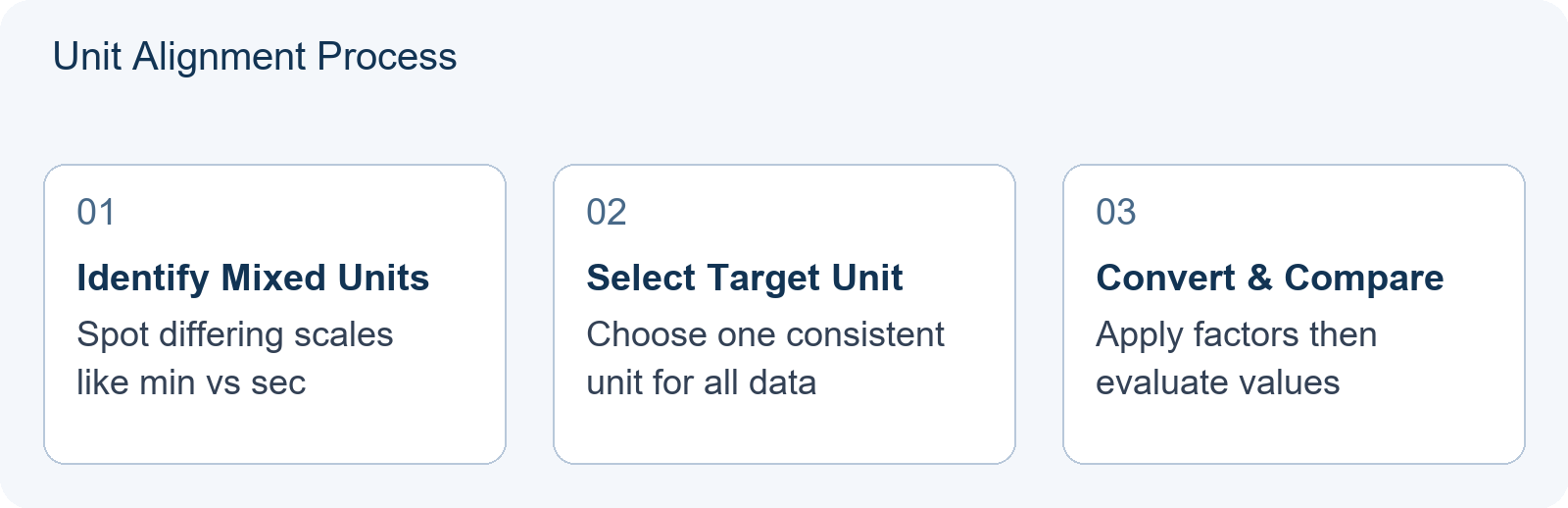
- Step 1: Identify the target unit. Let us choose meters per second (m/s).
- Step 2: Convert Runner A’s data. Distance = 100 m, Time = 12 s. Rate = 100 / 12 ≈ 8.33 m/s.
- Step 3: Convert Runner B’s data. Distance = 1 km = 1000 m. Time = 250 s. Rate = 1000 / 250 = 4.00 m/s.
- Step 4: Compare. 8.33 > 4.00. Runner A is faster.
Here, the conversion was explicit. The student recognized that “kilometer” and “meter” are different scales and adjusted before dividing.
Hypothetical Case 2: The Failed Shortcut
Teaching illustration—original hypothetical problem, not an official Math League question.
Now consider a similar setup with a trap: Pipe A fills a tank at 5 liters per minute. Pipe B fills the same tank at 0.2 liters per second. Which pipe has the higher flow rate?
- Mistake Path: A student might look at the numbers 5 and 0.2. Since 5 > 0.2, they conclude Pipe A is faster.
- Correct Analysis: The units are incompatible (per minute vs. per second). To compare, we must align them.
- Conversion: Pipe B’s rate is 0.2 L/s. In one minute (60 seconds), Pipe B delivers 0.2 × 60 = 12 liters. So, Pipe B’s rate is 12 L/min.
- Comparison: Pipe A (5 L/min) vs. Pipe B (12 L/min). Pipe B is actually more than twice as fast.
The shortcut failed because the student compared raw coefficients rather than normalized rates. This type of error is common in speed-focused rounds, where rapid mental checks can bypass unit verification.
Diagnostic Table for Unit Errors
Use this table to self-check your work during practice sessions.
| Symptom | Likely Cause | Correction Strategy |
|---|---|---|
| Answer seems “too big” or “too small” intuitively | Unit scale ignored (e.g., cm vs m) | Write down the unit next to every number immediately |
| Two methods yield different answers | Inconsistent conversion factor applied | Check if you multiplied or divided by the conversion factor correctly |
| Time-based rates feel counter-intuitive | Confusing frequency (per sec) with duration (sec) | Convert everything to the smallest time unit (seconds) first |
Targeted Practice Sequence
To build this skill, follow this three-step sequence in your next study session:
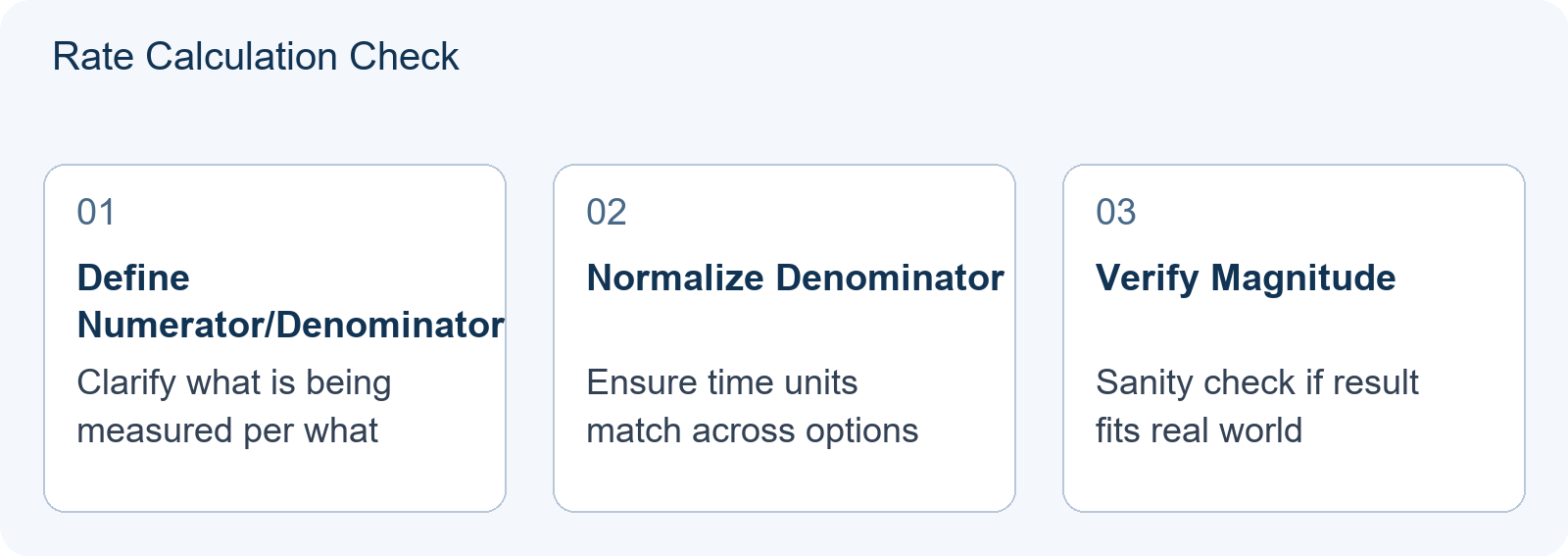
- Isolate Variables: Take a past-style problem and circle only the units. Ignore the numbers for a moment. Do the units match? If not, write the conversion factor explicitly.
- Dimensional Analysis Check: After solving, multiply the units as if they were variables. For example, if calculating distance, ensure (Speed [m/s]) × (Time [s]) results in [m]. If the result is [m/s], you made an error.
- Reverse Verification: Plug your final answer back into the original scenario. Does the magnitude make sense? If you calculated a car’s speed as 500 m/s, you likely forgot to convert kilometers to meters.
For the China-region online preliminary, the 2026–2027 participant manual prohibits calculators and other auxiliary tools, so manual unit tracking is critical; students cannot rely on digital tools to flag dimensional inconsistencies. The official Math League notice dated 4 July 2026 separately allows calculators without a QWERTY keyboard in US/Canada school contests for 2026-27 and says the no-calculator policy will apply the next school year. For additional practice material selection guidance, see Math League Past Papers: How to Choose Practice Material That Matches Your Grade’s Problem Style (2026-27).
Demonstrating Competence
A learner should be able to demonstrate this skill by verbally explaining why two seemingly different numbers represent the same physical quantity after conversion. For instance, stating clearly that “0.5 hours is equal to 30 minutes, so I converted both times to minutes before adding them.” This transparency prevents the silent errors that plague high-stakes competitions.
For families planning preparation schedules, including homeschool arrangements, see Math League Homeschool Preparation: Planning Practice and Confirming Entry Options.
Frequently Asked Questions
Do I need to memorize all conversion factors?
You should know common metric prefixes (kilo, centi, milli) and basic time conversions (60s=1min, 60min=1hr). Complex conversions are usually provided or simplified in competition contexts.
What if the problem gives no units?
If units are omitted, assume consistency within the problem statement. However, always verify if the context implies standard units (e.g., currency, length) to avoid misinterpretation.
How does this affect team rounds?
In team rounds, one member might calculate while another verifies. Explicitly stating units helps teammates catch mismatches early, reducing collaborative errors.