When a Math League problem asks whether one number divides another, students often solve it twice: once to get an answer, then again to check. That second pass eats time and invites the same error. The skill worth building is checking a candidate answer with a different operation—not repeating the same steps.
The Core Problem
Suppose you have found, by long division or factoring, that a candidate answer claims “247 is divisible by 13.” You want confidence without re-running the same division. The check must use a different mathematical path, one that is faster and catches the specific errors that plague divisibility work: off-by-one multiples, sign slips, and factor-pair gaps.
Worked Hypothetical Case 1: The Shortcut Works
Consider this teaching illustration: A student is asked whether 2,847 is divisible by 13. She performs long division and gets a quotient of 219 with remainder 0, so her candidate answer is yes. She now wants to check without redoing that division.
- Contest registration
- Free past papers
- 1-on-1 trial lesson

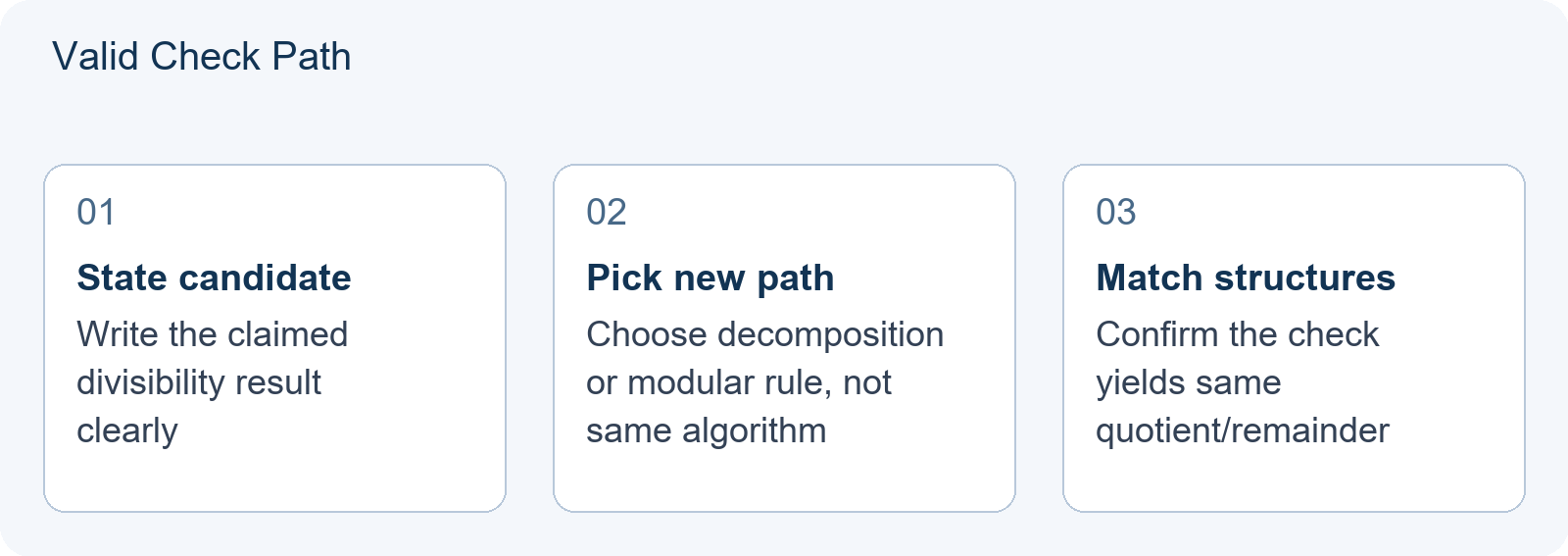
She applies a decomposition into known multiples tailored to 13: break 2,847 into 2,600 + 247. She recognizes 2,600 = 13 × 200, and 247 = 13 × 19. The sum 200 + 19 = 219 confirms her quotient. To verify the structure independently, she checks that 219 × 13 = 2,847 by computing 219 × 10 + 219 × 3 = 2,190 + 657 = 2,847. The check used mental arithmetic and no repeated long division.
Key move: she decomposed the number using known multiples of 13, not the original algorithm.
Worked Hypothetical Case 2: Where the First Assumption Fails
Now suppose a different student checks whether 2,847 is divisible by 7. He recalls that 2,800 is divisible by 7 (7 × 400 = 2,800), subtracts, and gets 47. He knows 47 is not divisible by 7, so his candidate answer is no. But he wants to verify.
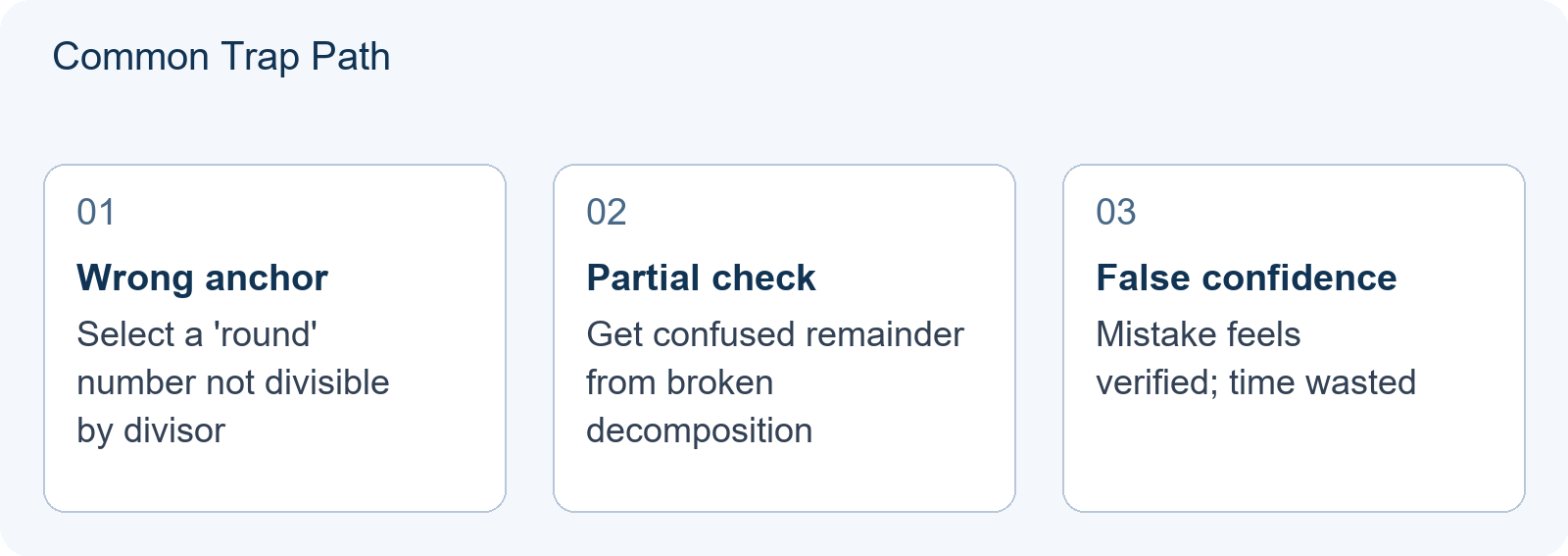
He uses the same decomposition trick: 2,847 = 2,800 + 47. He then notices 47 = 42 + 5, and 42 = 7 × 6 is divisible by 7. The remainder 5 confirms his answer. However, he almost made a common error: he initially wanted to test 2,847 = 2,500 + 347 because 2,500 “looks round.” But 2,500 is not a multiple of 7. The decomposition only works if the chosen anchor is itself divisible by the tested number. His first instinct would have led to a messy partial check with no clear remainder.
Diagnostic Table: Valid vs. Invalid Checks
| Check Method | When It Works | Common Failure |
|---|---|---|
| Decomposition into known multiples | You recall a nearby multiple of the divisor | Anchor number not actually divisible by divisor |
| Cross-multiplication verify | Candidate quotient is small and clean | Arithmetic error in the cross-step itself |
| Modular arithmetic (casting out) | Divisor has simple modular rules (e.g., 3, 9, 11) | Applying wrong rule (e.g., 11 rule for 13) |
| Factor pair confirmation | Number has obvious factors | Missing a factor; incomplete factorization |
The Mistake to Catch: False Confirmation
The most dangerous error is not a failed check but a check that appears to confirm a wrong answer. In our second case, if the student had decomposed 2,847 as 2,500 + 347, then tested 347 ÷ 7 ≈ 49.57, he might have rounded mentally to 50, seen 7 × 50 = 350, and concluded 347 = 350 − 3 gives remainder 4, not matching his original. The confusion between remainders from different decompositions would waste time and erode confidence.
The fix: always state what the check is supposed to match before performing it. If the original method gave quotient 219 with remainder 0 for 2,847 ÷ 13, the check must independently produce a structure consistent with 219 × 13 = 2,847, not merely a plausible remainder.
Targeted Practice Sequence
To build this skill deliberately:
- Level 1: Pick a 3-digit number and a divisor. Compute once, then verify by decomposition only.
- Level 2: Deliberately use a wrong anchor (like 2,500 for 7). Observe the failure mode.
- Level 3: For divisors with modular rules (3, 9, 11), confirm the modular result matches the decomposition result.
- Level 4: Under timed conditions, allocate 15 seconds for the check after 45 seconds for the solve.
For deeper coverage of divisibility rules and remainder techniques, see Number Theory on Math League: Divisibility, Remainders and Digit Questions, Decoded (Grades 6-12). For broader sequencing of Math League preparation across years, see Math League Homeschool Preparation: Planning Practice and Confirming Entry Options.
What to Demonstrate Next
After this practice, a learner should be able to: state a candidate divisibility answer, choose a non-identical verification method, execute it mentally or with minimal writing, and identify whether the check truly confirms the result or merely muddles it. This is the specific skill the title targets—checking without recalculating everything—not general test-taking advice.
Preparing for Consultation
If you are considering structured preparation, the most useful first step is to bring a single worked problem with your original method and your attempted check. A coach can then diagnose whether the check is structurally sound or cosmetically similar to the original work. For questions about contest format and equipment requirements, the Asia-Pacific online preliminary manual prohibits calculators and other auxiliary tools, and equipment checks require a computer or tablet camera and a smartphone second camera with student ID upload at least two weeks ahead (Math League official sources retrieved October 2026). The official 4 July 2026 notice separately allows calculators without a QWERTY keyboard in US/Canada school contests for 2026-27 and says the no-calculator policy will apply the next school year. For related problem-solving approaches, see Math League Team Round: Building Collaborative Practice Before a Team Event.
Frequently Asked Questions
Can I use the same method to check if I am very careful?
Technically yes, but it defeats the purpose. Repeating the same algorithm catches transcription errors but not conceptual ones. A different method catches the mistake in how you approached the problem.
What if I cannot find a nearby multiple for decomposition?
Then use modular arithmetic or factor pairs instead. The goal is to change the mathematical operation, not to force one specific technique.
How fast should this check be during an actual contest?
Aim for roughly one-third of the solve time. If the check takes longer, it is likely too elaborate and may not be the best use of remaining time.