For students preparing for Math League, a specific recurring challenge involves “reverse percentages.” Unlike standard percentage calculations where you find a part of a whole, reverse percentages require recovering the original quantity from a final value that has already been increased or decreased by a certain percentage. This distinction is critical because the arithmetic operation changes from multiplication to division, a shift that often trips up students relying on mental shortcuts.
This article focuses narrowly on this reasoning failure. It does not cover broad competition entry routes or general study habits, which are addressed in our Math League Homeschool Preparation: Planning Practice and Confirming Entry Options. Instead, we provide two worked hypothetical examples and a diagnostic table to help learners identify and correct their approach to these specific problem types.
Understanding the Core Difficulty
The primary difficulty in reverse percentage problems is the misconception that percentages are symmetric. Students often assume that if a number increases by 20%, decreasing it by 20% returns it to the original value. This is false. A 20% increase means multiplying by 1.2. To reverse this, one must divide by 1.2, which is equivalent to multiplying by approximately 0.833, not 0.8. Recognizing that the base quantity changes after the first operation is key to efficient recovery of the original amount.
- Contest registration
- Free past papers
- 1-on-1 trial lesson

Worked Hypothetical Example 1: The Direct Recovery
Teaching illustration — not an official Math League problem.
Consider a scenario where a student encounters a problem stating: “After a 15% discount, an item costs $42.50. What was the original price?”
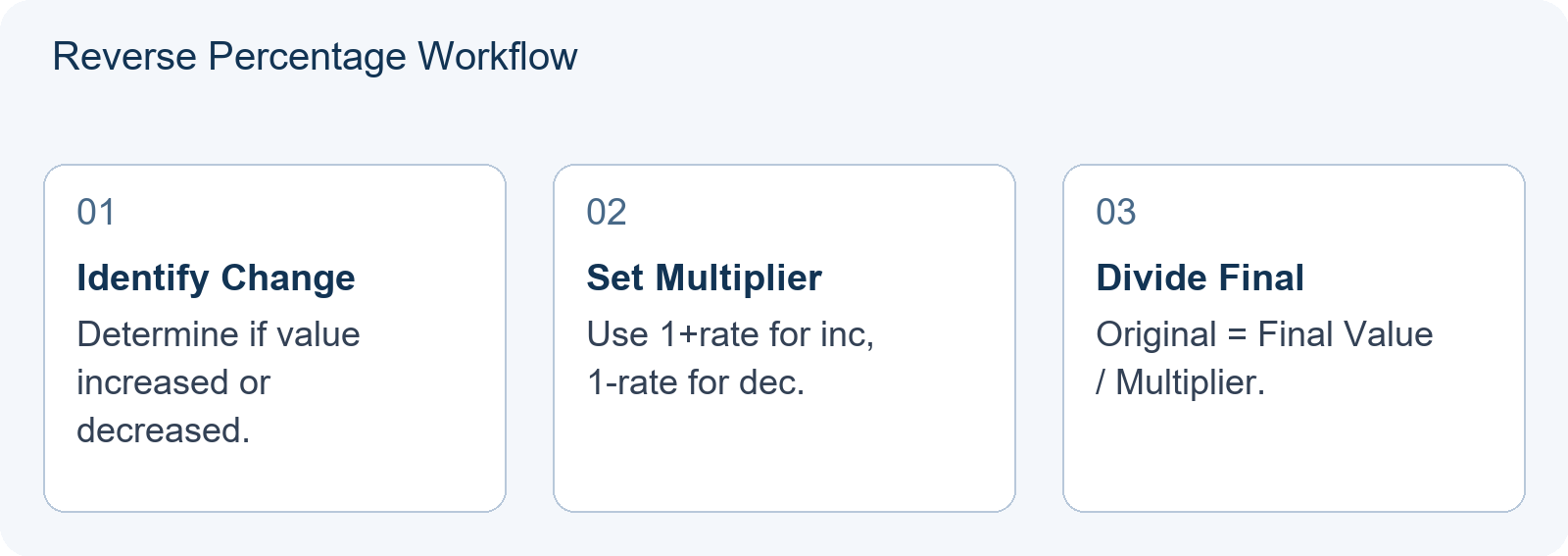
Step 1: Identify the relationship. The final price ($42.50) represents 85% of the original price (100% – 15%).
Step 2: Set up the equation. Let x be the original price. Then, 0.85x = 42.50.
Step 3: Solve for x. Divide both sides by 0.85. x = 42.50 / 0.85 = 50.
The original price was 50 gives $7.50, and $50 – 42.50, confirming the answer. This direct division method is reliable and minimizes rounding errors compared to iterative estimation.
Worked Hypothetical Example 2: Where Shortcuts Fail
Teaching illustration — not an official Math League problem.
Now consider a more complex case: “A population increased by 10% in Year 1 and then decreased by 10% in Year 2. If the final population is 9,900, what was the initial population?”
A common mistake is to assume the net change is 0% (10% up, 10% down), leading students to guess the initial population was also 9,900. This is incorrect because the base for the second calculation is different.
Correct Approach:
Let P be the initial population.
Year 1 end: P × 1.10
Year 2 end: (P × 1.10) × 0.90 = P × 0.99
We know the final population is 9,900. So, 0.99P = 9,900.
P = 9,900 / 0.99 = 10,000.
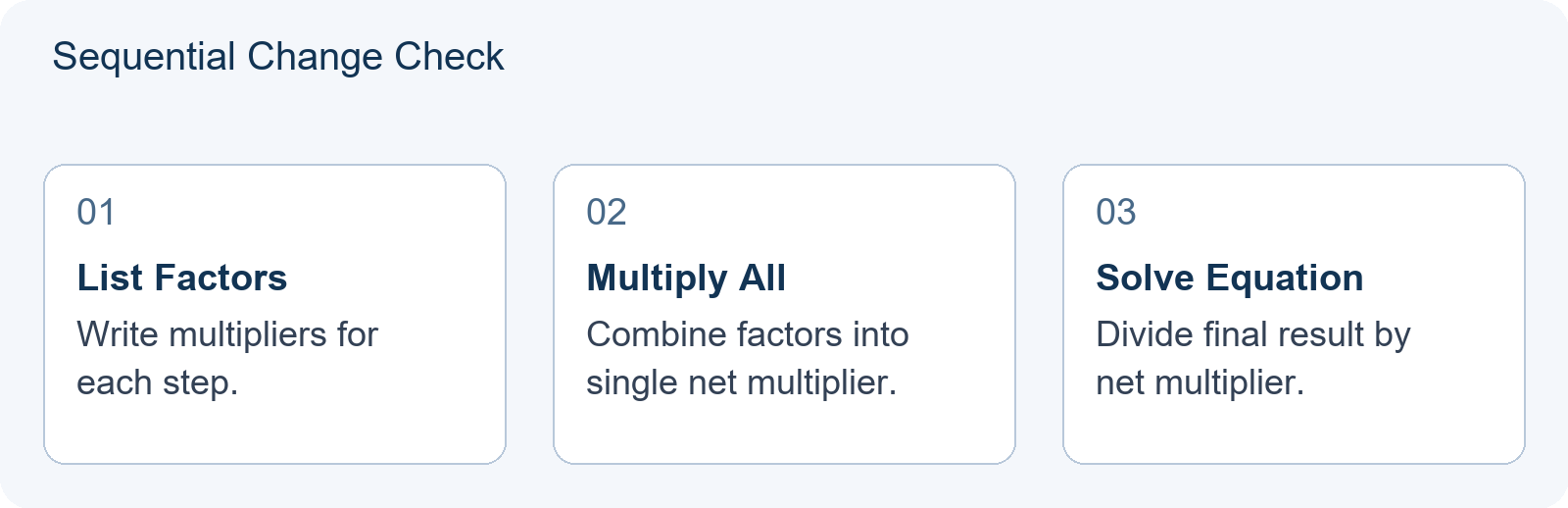
The initial population was 10,000, not 9,900. The shortcut of canceling equal percentage increases and decreases fails because the multipliers (1.1 and 0.9) do not multiply to 1; they multiply to 0.99. This example highlights why algebraic setup is safer than mental heuristics for sequential changes.
Diagnostic Table: Identifying Your Error Type
| Error Symptom | Likely Cause | Correction Strategy |
|---|---|---|
| Answer is too high when reversing a decrease | Student multiplied by (1 – rate) instead of dividing | Use division: Final / (1 – rate) |
| Net change assumed to be zero for equal % up/down | Ignoring changing base values | Multiply all factors together first |
| Rounding errors accumulate | Calculating intermediate steps separately | Keep fractions or decimals until final step |
Targeted Practice Sequence
To master this skill, students should follow a structured practice sequence rather than random drilling. First, solve single-step reverse percentage problems using the division method exclusively. Second, tackle multi-step problems involving sequential increases and decreases, ensuring each step is represented as a multiplier. Third, verify answers by working forward from the calculated original quantity to the given final quantity.
For broader context on how such skills fit into overall preparation, refer to our Math League Team Round: Building Collaborative Practice Before a Team Event. Additionally, understanding how to select appropriate practice materials can help you find problems at the right difficulty level; see our Math League Past Papers: How to Choose Practice Material That Matches Your Grade’s Problem Style (2026-27).
Conclusion: Demonstrating Competence
The specific skill a learner should demonstrate next is the ability to set up an algebraic equation for any reverse percentage problem without hesitation. This includes correctly identifying whether the operation requires division by a factor greater than 1 (for increases) or less than 1 (for decreases). Mastery here reduces cognitive load during timed competitions, allowing students to allocate more time to complex geometry or combinatorics problems.
Frequently Asked Questions
Why can’t I just subtract the percentage to reverse an increase?
Because the base value changes. A 20% increase adds 20% of the original, but a 20% decrease removes 20% of the new, larger total, resulting in a lower final value than the start.
Is there a quick formula for multiple percentage changes?
Yes, multiply all the individual change factors (e.g., 1.10 * 0.90) to get a single net factor, then divide the final value by this net factor to find the original.
Do calculators help with these problems in Math League?
For the China-region online preliminary, calculators are not allowed, so students must rely on mental math or written arithmetic techniques for these operations. In US/Canada school contests for 2026-27, the official 4 July 2026 notice allows calculators without a QWERTY keyboard and says the no-calculator policy will apply the next school year.