For a 2026-27 Math League counting or probability question that says ‘at least one,’ a sensible first move is to define the opposite event—‘none’—count that smaller set, and subtract from the total. Use this only when the opposite event is genuinely easier to count; then verify the subtraction with at least one direct case. This is a preparation technique, not a rule that every at-least-one question must be solved by complement.
The one-line rule and its limits
The complement method is simple in form: if E is the event you want, then P(E) = 1 − P(not E). The hard part is not the subtraction. The hard part is writing the complement exactly and using the same sample space for both counts. A student who counts ‘no red’ from unordered pairs but counts the total from ordered pairs has mixed two experiments, even if each count looks reasonable on its own.
Use the table below as a first decision check, not as a substitute for reading the question.
- Contest registration
- Free past papers
- 1-on-1 trial lesson

| Signal in the question | Complement route? | Reason |
|---|---|---|
| ‘At least one’ in repeated independent trials | Try complement first | ‘None’ is one product, such as no six on either die. |
| ‘At least one’ in a draw without replacement | Try complement first | ‘None’ can be one combination count, such as both counters blue. |
| ‘Exactly one’ | Direct cases first | The complement may include zero, two, three, and more cases. |
| ‘At least two’ | Compare both routes | The complement may be zero or one; count both routes before choosing. |
A four-step diagnostic before any calculation
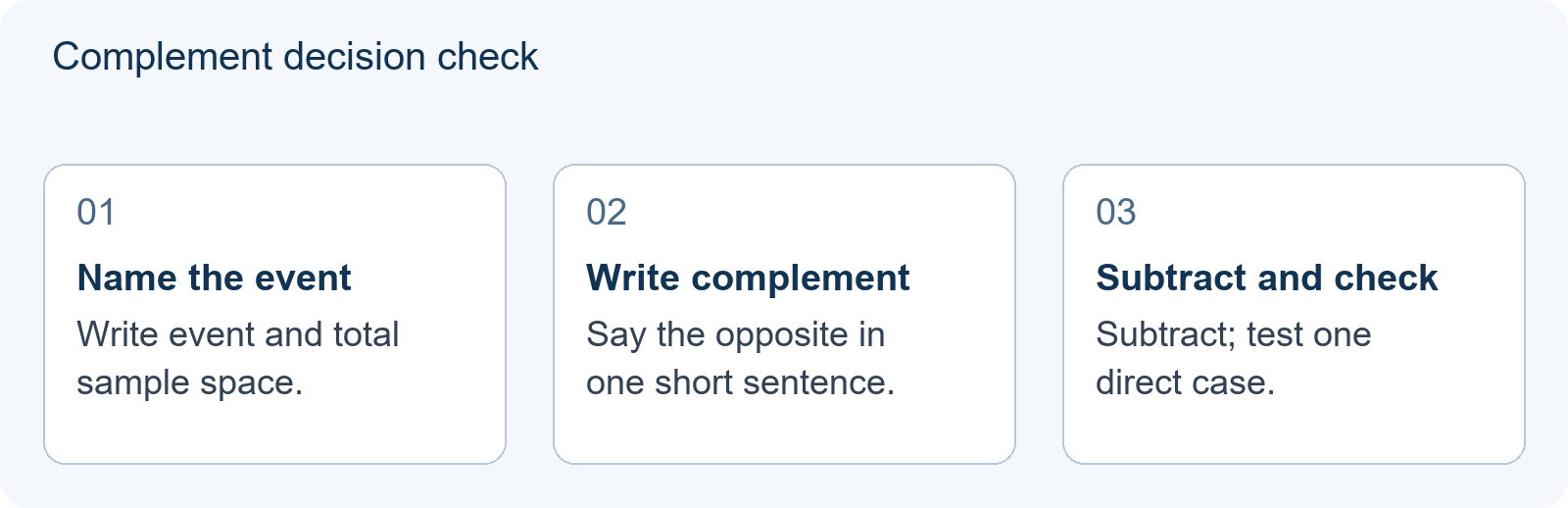
- Write the event and the sample space. State whether order matters, whether draws are with or without replacement, and whether trials are independent. These premises decide the denominator.
- Write the complement in one sentence. For ‘at least one red,’ the complement is ‘no red,’ not ‘exactly one red.’ For ‘at least one six,’ the complement is ‘no six on either die.’
- Count the complement using the same sample space. Then subtract: 1 minus that probability. A result outside 0 to 1 signals a counting or denominator error, but a result inside the range is only a sanity check, not a proof.
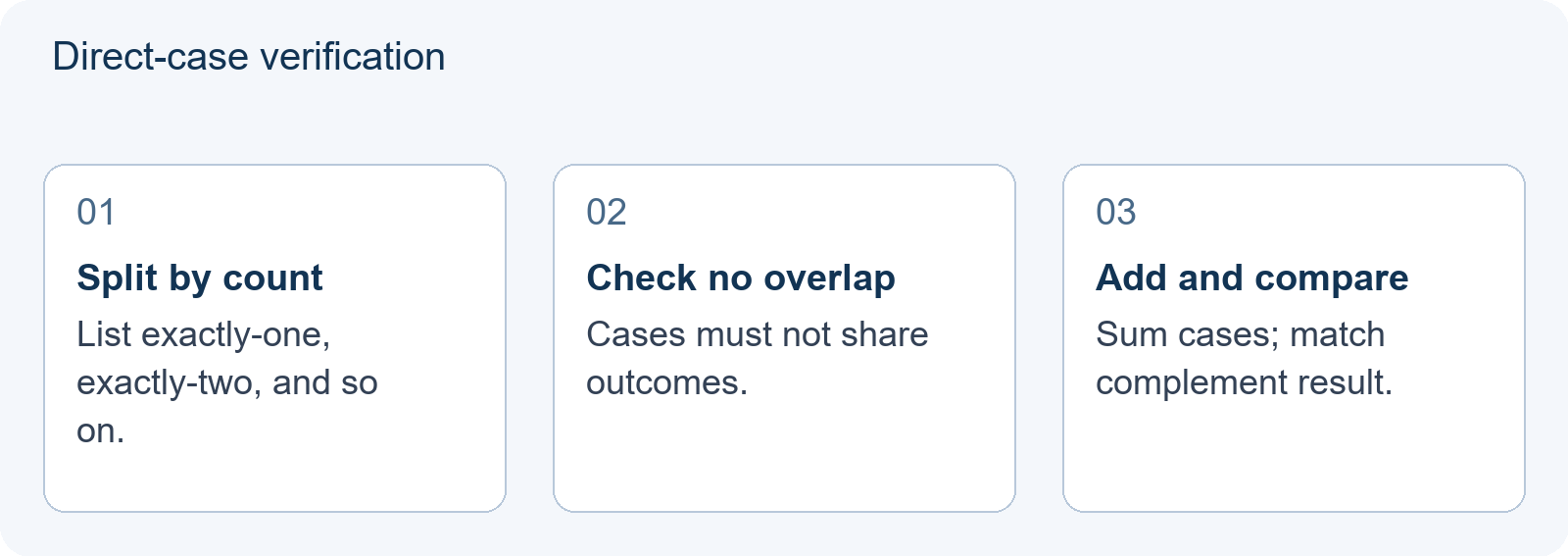
- Verify with direct cases. Split the original event into disjoint cases and add them. If the direct sum and the complement result agree, the subtraction is much more trustworthy.
Before a long calculation, use Math League Estimation: Eliminate an Impossible Answer Before Calculating: is the answer closer to 1 or to 0? If ‘at least one red’ from a bag with many red counters comes out below one half, pause and recheck the complement.
Teaching illustrations: two draws and two dice
The worked examples and practice prompts below are original teaching illustrations, not past Math League problems or official scoring guidance.
Teaching illustration 1: two draws without replacement
A bag contains 5 red and 3 blue counters. Two counters are drawn without replacement. Find the probability that at least one is red.
Total unordered pairs: C(8,2) = 28. The complement is ‘no red,’ which means both counters are blue. That count is C(3,2) = 3. Therefore
P(at least one red) = 1 − 3/28 = 25/28.
Now verify directly. ‘At least one red’ splits into exactly one red and two red. Exactly one red means choose 1 of 5 red and 1 of 3 blue: 5 × 3 = 15 pairs, so 15/28. Two red means C(5,2) = 10 pairs, so 10/28. The cases are disjoint: a draw cannot have exactly one red and two red at the same time. Their sum is 15/28 + 10/28 = 25/28, matching the complement result.
The denominator 28 is the key. It is not 8 × 7 = 56, because this solution counts unordered pairs. If the question asked for ordered draws, the total would be 56 and the favourable counts would double. The probability would be unchanged, but the written counts must stay consistent.
Teaching illustration 2: two dice and ‘at least one six’
Two fair six-sided dice are rolled. Find the probability of at least one six.
The sample space has 6 × 6 = 36 ordered outcomes. The complement is ‘no six on the first die and no six on the second die.’ There are 5 choices for the first die and 5 for the second, so 25 outcomes contain no six. Thus
P(at least one six) = 1 − 25/36 = 11/36.
Direct verification: exactly one six can happen as six-then-not-six or not-six-then-six. That is 5 + 5 = 10 outcomes. Two sixes is 1 outcome. These cases are disjoint, so the total is 10/36 + 1/36 = 11/36. The complement and direct counts agree.
One tempting mistake is to reason ‘the first die is six or the second die is six’ and add 1/6 + 1/6 = 1/3. That double-counts the outcome where both dice show six. The correct union calculation is 1/6 + 1/6 − 1/36 = 11/36.
When the complement is not the shorter route
The phrase ‘at least one’ does not force complement counting. Consider the same bag of 5 red and 3 blue counters, but ask for the probability of exactly one red when two are drawn without replacement.
Direct counting is short: choose 1 of 5 red and 1 of 3 blue, giving 15/28. The complement of ‘exactly one red’ is ‘no red or two red.’ That is 3/28 + 10/28 = 13/28, so 1 − 13/28 = 15/28. The complement is valid but longer. A student who automatically writes ‘1 minus’ for every probability question has not chosen the simpler route; they have chosen a valid route with more cases.
The practical rule is: count the route with fewer disjoint cases, then check the answer against the other route when time allows. ‘At least one’ is a trigger to pause and inspect the complement, not a command to use it blindly.
Errors that survive a correct-looking subtraction
- Subtracting the wrong event. For ‘at least one red,’ the complement is ‘no red,’ not ‘exactly one red.’ If the subtracted probability describes a different event, the answer is wrong even when the arithmetic is correct.
- Mixing replacement rules. In the 5-red, 3-blue bag, drawing two without replacement gives P(at least one red) = 25/28. With replacement, P(no red) = (3/8)² = 9/64, so P(at least one red) = 55/64. These are different experiments and different answers.
- Double-counting overlapping direct cases. ‘First draw is red’ and ‘second draw is red’ overlap when both draws are red. If you add those probabilities, subtract the overlap or switch to disjoint cases such as exactly one red and two red.
- Mismatching sample spaces. Two dice have 36 ordered outcomes, not 21 unordered pairs. A bag without replacement can be counted with ordered pairs or unordered pairs, but the numerator and denominator must use the same convention.
- Not checking plausibility. If the answer is negative or above 1, the error is certain. If the number feels too small or too large, use the Stuck on a Math League Question? The Five Recovery Moves That Turn Unfamiliar Into Solvable (2026) and recalculate the complement in words before recalculating symbols.
A five-prompt drill for the next practice session
The prompts below are original teaching drills. For each, first decide whether the complement is the shorter route, then verify with one direct split.
| Prompt | Complement route | Direct check |
|---|---|---|
| A bag has 4 green and 2 yellow counters; draw 2 without replacement. Find P(at least one yellow). | No yellow: C(4,2)/C(6,2) = 6/15; answer 9/15 = 3/5. | Exactly one yellow: 2 × 4 = 8; two yellow: 1; total 9/15. |
| Three fair coins are tossed. Find P(at least one tail). | No tail: HHH = 1/8; answer 7/8. | Exactly one, two, or three tails: 3/8 + 3/8 + 1/8 = 7/8. |
| Two fair dice are rolled. Find P(at least one 4). | No 4: 25/36; answer 11/36. | Exactly one 4: 10/36; two 4s: 1/36; total 11/36. |
| A bag has 3 red and 5 blue counters; draw 3 without replacement. Find P(at least one red). | All blue: C(5,3)/C(8,3) = 10/56; answer 46/56 = 23/28. | Exactly 1 red: 30; exactly 2: 15; exactly 3: 1; total 46/56. |
| Draw 2 cards without replacement from a standard 52-card deck. Find P(at least one ace). | No ace: C(48,2)/C(52,2) = 1128/1326; answer 198/1326 = 33/221. | Exactly one ace: 4 × 48 = 192; two aces: 6; total 198/1326. |
Turning a practice attempt into useful feedback
A useful review starts with evidence, not ‘I don’t get probability.’ Bring two written solutions to one at-least-one problem: the complement solution and the direct-case check. Mark the sample space, the replacement rule, and the sentence that defines the complement. Then note where the two routes disagreed, if they did.
This makes the error pattern visible. A teacher can see whether the issue is reading the event, choosing the denominator, double-counting, or simply running out of time. If you use a score report, connect the practice to Reading Your Math League Score Report: How to Use Knowledge Tags to Target Practice so that the next practice set targets the same skill rather than a random worksheet.
For a short self-check, solve two at-least-one problems and write both the complement route and the direct check. In your notes, record which route was shorter, where the counts could have overlapped, and whether the final probability stayed between 0 and 1. That record is specific, and it does not depend on a promised outcome or an invented success rate.
Source and scope
As a coaching choice, this technique is worth practising because it trains exact event definition and same-sample-space counting. The Hanlin Courses WeChat guide ‘Heavyweight | Math League US Mathematics League preliminary registration opens! First bilingual Chinese-English paper!’ published 8 November 2026 mentions counting and basic number theory among Math League question types, and it includes probability in its list of math English vocabulary. Those are preparation observations from that guide, not an official claim that every paper contains an at-least-one probability item.
For current contest schedules and primary notices, check the Math League site. No official contest prompt is reproduced here; the examples are original teaching material.
This is an independent preparation guide, not affiliated with, endorsed by, or sponsored by Math League.
Frequently Asked Questions
When should I use the complement for an at-least-one Math League probability question?
Use the complement when the opposite event, usually ‘none,’ is genuinely easier to count with the same sample space. Then subtract from 1 and verify with at least one direct case. Do not use it automatically if the complement creates more cases than the original event.
Do I still need direct cases if the complement calculation looks easy?
Yes, at least once in practice. A direct split into disjoint cases catches wrong complements, replacement mistakes, and double-counting. In a timed paper, the direct check can be brief, but it should use the same sample-space convention as the complement count.
What mistake should I check first in at-least-one probability?
Check whether you subtracted the wrong event, such as subtracting ‘exactly one’ when the question asks for ‘at least one.’ Another error to check is mixing with-replacement and without-replacement counts, or adding overlapping direct cases without removing the overlap.