For the 12 December 2026 Math League preliminary, use a 75-minute Math League preliminary time budget with four checkpoints: a 5-minute orientation scan, a 50-minute first solving pass, a 15-minute return to marked questions, and a 5-minute answer-list check. This is a teaching plan, not official section timing.
The 75-minute checkpoint table
The Hanlin Courses WeChat article Major News: Math League US Preliminary Registration Opens — Bilingual Chinese-English Paper for the First Time (Hanlin Courses WeChat account, 8 November 2026) states that the 2026 preliminary is scheduled for 12 December 2026, lasts 75 minutes, is bilingual Chinese-English for the first time, and has a large number of questions. It does not give an official question count or official section timings. The plan below is therefore a Hanlin teaching budget, not an official schedule.
| Phase | Clock | Minutes | Main rule |
|---|---|---|---|
| Orientation scan | 0-5 | 5 | Mark easy, uncertain, and long items; do not solve. |
| First solving pass | 5-55 | 50 | Solve, mark, and move; protect easy marks. |
| Marked-question return | 55-70 | 15 | Return only to marked items with a new idea. |
| Final answer-list check | 70-75 | 5 | Verify entries, blanks, and format. |
| Total | 0-75 | 75 | Checkpoints at 0, 5, 55, 70, and 75 minutes. |
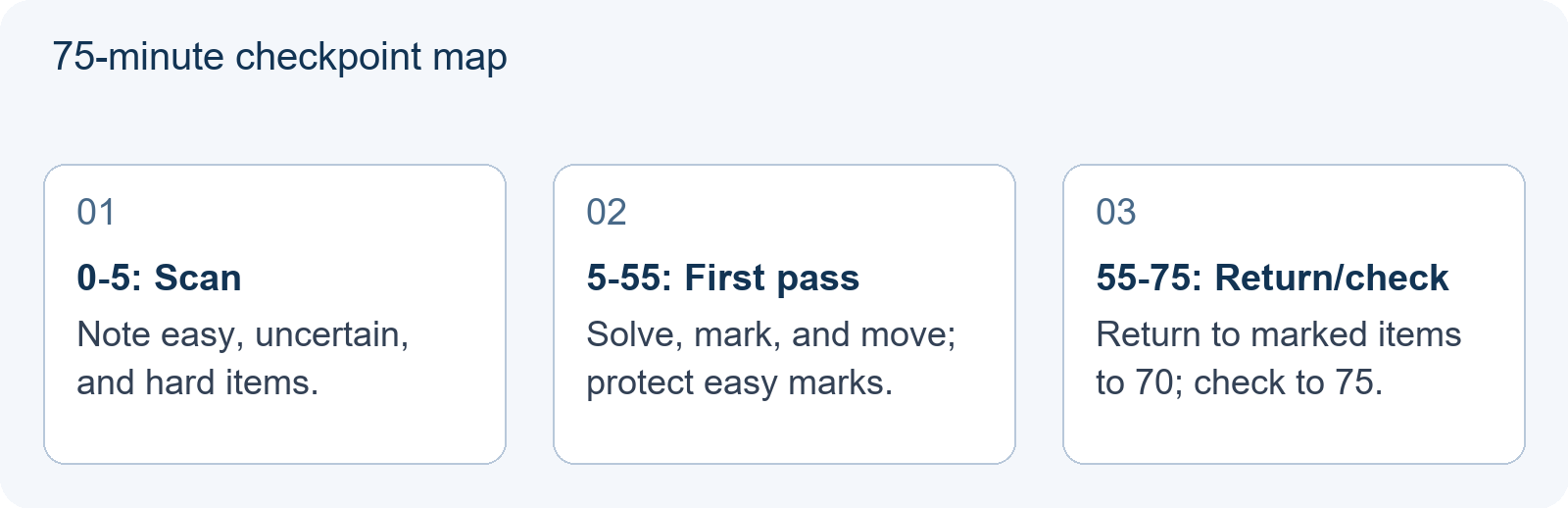
The plan has three working passes: an orientation scan, a first solving pass, and a marked-question return pass. The final five minutes are a fixed verification block, not a fourth solving pass. Use the clock as a decision trigger, not a score prediction. At minute 5 the scan ends even if you have not classified every item. At minute 55 the first solving pass ends even if one hard item is still open. At minute 70 the return pass ends; the last five minutes belong to verification.
- Contest registration
- Free past papers
- 1-on-1 trial lesson

For the organization’s public contest pages, see The Math League; do not infer China preliminary rules from a different contest page.
Why this is not the 45-minute speed-round problem
The existing article Math League Speed Round: How to Pace a 60-Question Paper in 45 Minutes covers a different budget: a 45-minute paper with 60 short speed items. That paper can reward rapid switching on short questions. The December preliminary described in the 8 November 2026 Hanlin Courses article is a 75-minute bilingual paper with a large number of questions, but the article does not publish an official question count or official section timings. Do not divide 75 by an assumed number of questions and call the result a target. The useful comparison is structural: a speed round can reward one fast pass, while this preliminary needs an orientation scan, a first solving pass, a return pass, and a final entry check.
This difference matters most for reading time. In a short speed round, a long word problem can be a deliberate skip. In a 75-minute preliminary with bilingual text, the same word problem may be worth returning to after easier marks are secured, because the paper is longer and the second pass has a real purpose. The budget protects that purpose instead of spending all 75 minutes inside the first reading.
Pass 1: the five-minute scan and the fifty-minute solve
During the scan, do not solve. Your job is to create a map: which items look direct, which contain unfamiliar wording, which are long scenario questions, and which appear to require a diagram or a multi-step set-up. A simple three-mark system is enough: a dot for likely direct, a question mark for uncertain, and a bracket for long. The scan is not a classification exam; it ends at minute 5 even if some marks are rough.
During the 50-minute first pass, every item should receive a decision: answer it, mark it and move, or leave it marked for the second pass. Do not let one unfamiliar scenario consume the second-pass reserve. A useful personal rule is to mark and move when one clear method has failed and you cannot yet name a second method. Another useful rule is to mark and move when an item has already taken longer than several nearby questions combined. These are teaching rules, not official scoring rules. The purpose is to protect known marks and keep the return pass intact.
Pass 2: return only to marked questions with a reason
The second pass is not a reread of the whole paper. It is a return to marked questions with a fresh constraint, a simpler representation, or a different entry point. If you cannot name a new idea, skip the item and preserve the final check. For example, a multi-step scenario may become a table of cases; a rate question may become a unit comparison; a geometry question may become an estimate that eliminates impossible choices. These are generic teaching moves, not official solutions.
Order the marked questions by likely gain, not by original paper order. A short item that failed because of a misread condition can be a better return than a long item that failed because the method is unknown. If two marked items are both uncertain, choose the one with a clearer verification path. The second pass should produce decisions, not open a new long investigation.
The final five minutes: answer-list verification
At minute 70, stop solving. Verify the answer-entry format, check that no answer is blank by accident, and confirm that your recorded answers match your working notes. If the route you are using requires a photographed answer list, use the Math League Answer-List Photo Checklist Before the Online Preliminary Submit (2026-27). If the route uses direct entry, rehearse the entry steps in your timed practice so the final check is about catching clerical loss, not learning a new interface.
This block is not for relearning mathematics. It is for catching clerical loss: a skipped row, a misplaced mark, an answer written in the wrong format, or a blank left because the item was marked and then forgotten. The final check is short because it is narrow.
A worked mid-paper rescue (teaching illustration)
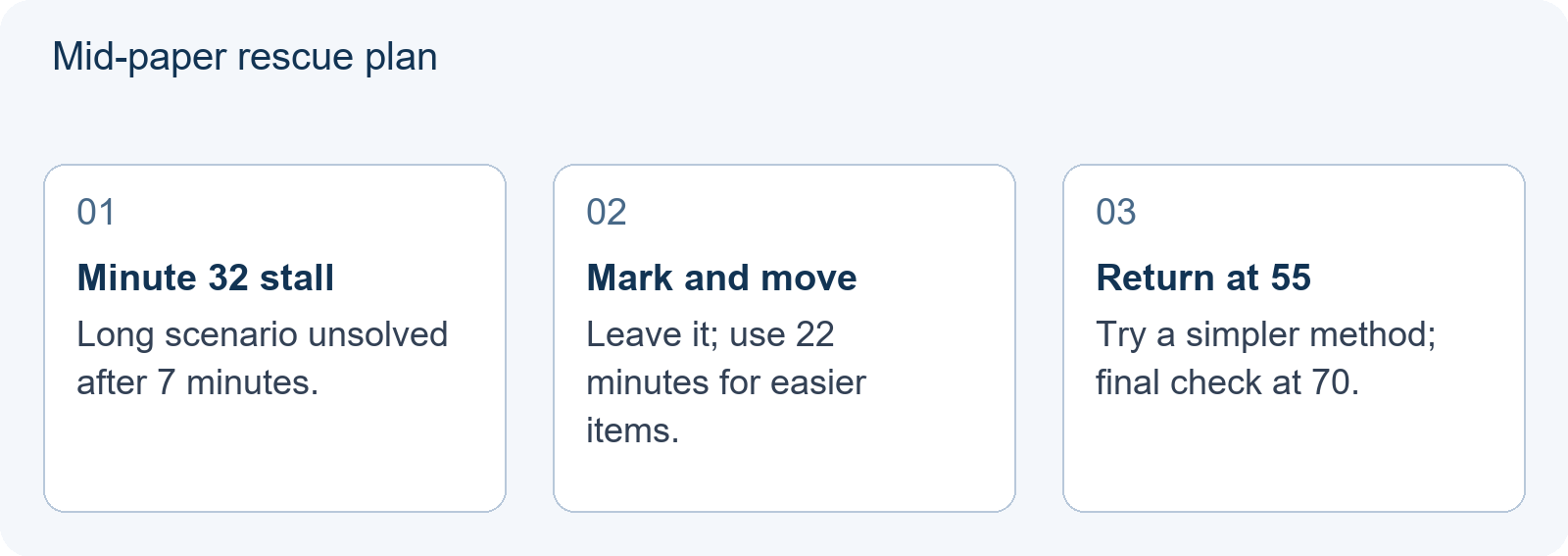
This is a teaching illustration, not a real student or a released question. Assume a 75-minute practice paper, a visible clock, and the same 5/50/15/5 checkpoints. At minute 32 of the timed practice, a student has spent seven minutes on a multi-step scenario that began at minute 25 and still sees no answer. Under the checkpoint plan the first pass ends at 55, so 23 minutes remain. If the student stays on the item until minute 45, only 10 minutes remain before the planned first-pass stop; the remaining first-pass items must be compressed or the 15-minute return pass must be eaten into. If the student marks the item at minute 33 and moves, 22 minutes remain for easier items.
Suppose the student reaches minute 55 with that one long item still marked and two short marked items still pending. The return pass can run 55-63 for a new table or simpler method, 63-68 for the two short marked items, and 68-70 to confirm that markings correspond to entries before the final check. That is 8 + 5 + 2 = 15 minutes. The final check then runs 70-75. The rescue does not create extra time; it reallocates time from a long attempt to a first-pass finish, a fresh return, and a final verification. The contrast in this illustration is checkpoint discipline, not additional knowledge.
Bilingual reading: budget one primary line, not double reading
The first bilingual paper changes reading time, but it does not mean every item should be read twice in full. Choose a primary language for each item and use the second line when a term, negation, or condition is ambiguous. Put that check inside the first pass; do not save bilingual reading for the second pass, where it can consume the return budget. The separate guide Math League Bilingual Paper 2026-27: When to Use the Chinese Line in the 12 December Preliminary handles when to consult the Chinese line; this article only budgets the reading pause.
A practical reading rule is to finish the primary-language sentence first, then glance at the second line only if the question shape is unclear. Do not alternate sentence by sentence unless the item is short and the wording is genuinely uncertain. The goal is to keep reading as part of the first pass, not as a separate task that crowds out solving.
Two rehearsals and a one-page log
Before 12 December, run two timed 75-minute dry runs using practice material you are allowed to use. One dry run should use your bilingual reading habit; the second should use an English-only read-through so you can see which delays come from vocabulary and which come from method search. Do not use unreleased papers. The purpose is to test your checkpoints, not to predict a score.
Keep a one-page log with four columns: minute reached, item type, reason for marking, and whether the return pass produced a new idea. After each run, look for time leaks rather than a single total score. If the first pass consistently ends after minute 60, the problem may be reading speed, method search, or inability to leave an item. Those are different problems and need different practice.
What to record in your own rehearsal review
Use the two checkpoint logs and a short list of question types that caused time sinks. A useful review separates reading delay, method-search delay, and answer-entry delay. Build a practice plan, not a score prediction or an advancement guarantee. A useful record is not how many questions you attempted, but where your first pass stopped and why your marked questions were left open.
This is an independent preparation guide, not affiliated with, endorsed by, or sponsored by Math League.
Frequently Asked Questions
Is 5/50/15/5 the official section timing for the 12 December 2026 preliminary?
No. The Hanlin Courses article states that the preliminary lasts 75 minutes and has a large number of questions, but it does not publish official section timings or an official question count. The 5/50/15/5 split is a teaching time budget that sums to 75 minutes.
Should I read every question in both Chinese and English?
No. Choose a primary language for each item and use the second line mainly when a term, negation, or condition is ambiguous. Full double reading can consume the first-pass budget; the bilingual line is a check, not a second full paper.
What should I do if I am stuck at minute 32?
Mark the item, move on at about minute 33, and return during the 55-70 return pass with a new method or simpler representation. Protect the final five minutes for answer-list verification. This is a teaching decision rule, not an official rule.