Speed rounds are won by triage, not by solving every problem in order. In a contest with 60 questions and only 45 minutes, attempting to work sequentially guarantees that you will run out of time before reaching the later questions, regardless of their difficulty. The primary strategic error is treating the paper as a linear sequence rather than a pool of opportunities. To succeed, students must adopt a non-linear approach that prioritizes high-confidence answers first, defers complex calculations, and reserves time for verification.
What the 60/45 Format Actually Asks
The 2026 Math League International Summer Challenge (online) is a useful model for a true speed-round paper. The official Math League homepage announcement dated 28 May 2026 states that each level participated in two contests: a 10-to-15-Question Short Answer Contest lasting 60 minutes and a 60-Question Speed Round Contest lasting 45 minutes. The same announcement lists seven levels: Grade 3; Grade 4; Grade 5; Grade 6; Grade 7; Grades 8 and 9; and Grades 10, 11, and 12. The 2026 Summer Challenge contests were held on Sunday, August 16, 2026, from 12 to 2 PM Eastern Time. For current or future contests, confirm the schedule and rules on the official Math League pages.
The arithmetic is simple but easy to misuse. Forty-five minutes is 2,700 seconds. Divided by 60 questions, that is 45 seconds per question on average. That average is not a per-question budget. Some questions may take 10 seconds; others may take 3 minutes. If you spend 2 minutes on one question, you have used 120 seconds, or about 2.67 average question slots. Three minutes is 180 seconds, or 4 average slots. Five minutes is 300 seconds, or about 6.67 average slots. The point is not that every long question is bad; the point is that a single long question must be a deliberate investment, not an accident.
- Contest registration
- Free past papers
- 1-on-1 trial lesson

This is why the first strategic move is to stop treating the paper as a linear list. You need a triage protocol: secure high-confidence answers, defer problems that need setup, and return to partial work with enough time to finish and check.
A Three-Pass Pacing Protocol
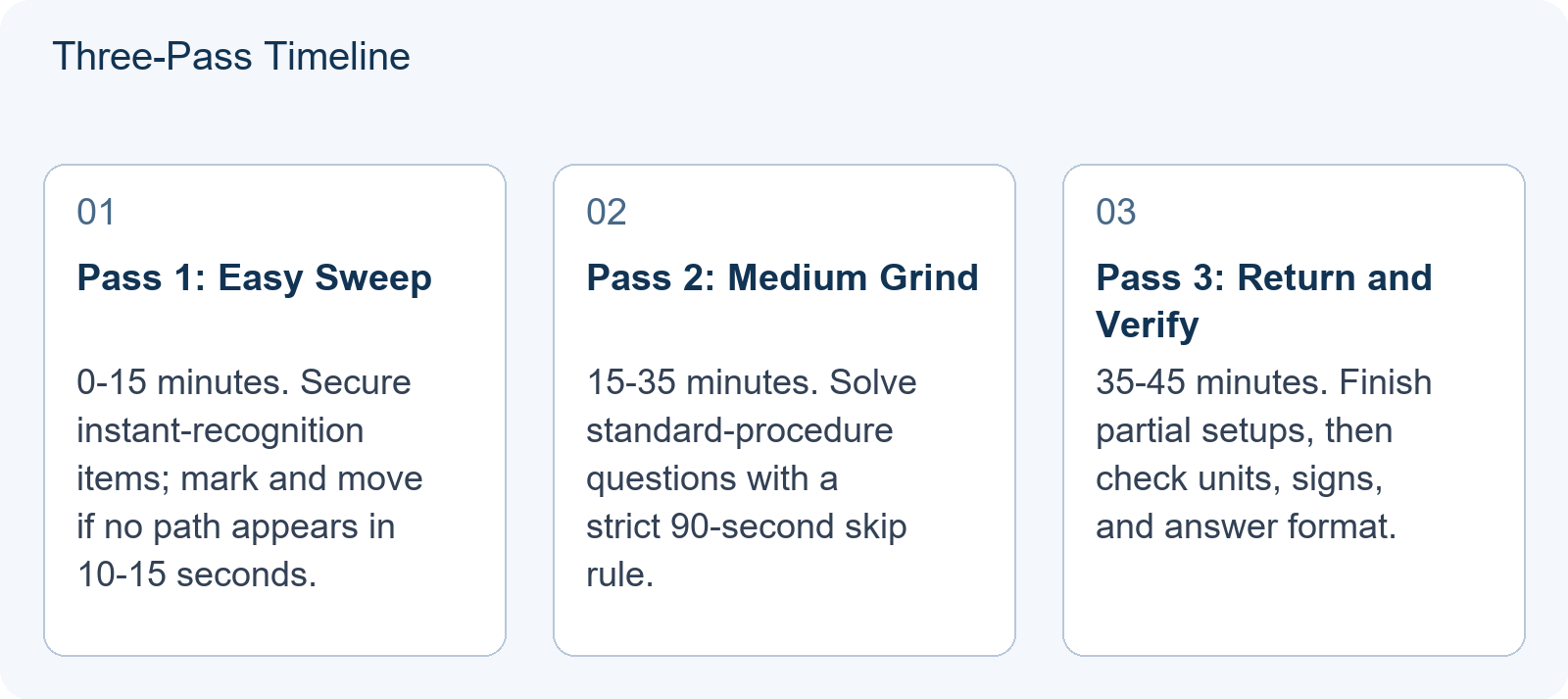
Pass 1: Easy Sweep, Minutes 0-15
Objective: collect the fastest correct answers. You have 900 seconds. If you aim for about 24 items in this pass, the mathematical average is 37.5 seconds per item, but you should not spend 37.5 seconds on each one. Spend very little on instant items and move quickly past anything that does not show a path almost immediately. A reasonable teaching rule is: if you cannot see a plausible first move within 10-15 seconds, mark the question and leave it. Do not erase it from your mind; mark it for Pass 3. The goal is momentum and a base of confident answers.
Pass 2: Medium Grind, Minutes 15-35
Objective: solve standard-procedure questions. You have 1,200 seconds. If you aim for about 20 new items here, the average is 60 seconds per item. That is a useful budget because many medium questions require one or two setup steps plus a calculation. Use a strict 90-second rule: if you have worked for 90 seconds and do not have a clear path or a nearly finished answer, mark the question and move on. Do not let one medium problem consume the time reserved for several other medium problems.
Pass 3: Return and Verify, Minutes 35-45
Objective: convert partial work into correct answers. You have 600 seconds. Return first to questions where you already have an equation, a diagram, or a partial calculation. These are cheaper to finish than fresh hard questions. Next, check high-risk answers for unit mistakes, sign errors, and answer-format errors. Finally, if time remains, attack one marked question from scratch. The order matters: completion beats exploration in the final ten minutes.
Worked Teaching Illustration: Alex’s 45 Minutes
This is a hypothetical teaching illustration, not an official contest problem or scoring guide.
Alex is preparing with a 60-question, 45-minute practice paper. Alex decides to rehearse the three-pass protocol rather than solve in order.
| Time | Action | Alex’s target | Time arithmetic | Rationale |
|---|---|---|---|---|
| 0:00-15:00 | Easy sweep | About 24 high-confidence items | 900 seconds / 24 = 37.5 seconds average | Build a base score and identify skips early. |
| 15:00-35:00 | Medium grind | About 20 standard-procedure items | 1,200 seconds / 20 = 60 seconds average | Use setup routines; enforce 90-second skip. |
| 35:00-45:00 | Return and verify | Partial setups, flagged items, checks | 600 seconds total | Finish cheap completions before fresh hard problems. |
Now consider a single bad decision. At minute 2, Alex starts a difficult question and stays with it for 5 minutes. That is 300 seconds, or about 6.67 average question slots. Even a 2-minute detour costs about 2.67 average slots; a 3-minute detour costs about 4 average slots. The three-pass protocol prevents this by forcing a mark-and-move decision before the detour becomes the whole round.
The illustration also shows why ‘targets’ are not quotas. If Alex reaches minute 15 with only 18 easy items instead of 24, the correct response is not to panic and rush. The correct response is to enter Pass 2 with the same skip discipline and let Pass 3 absorb the remainder.
Skip-and-Return Decision Rules
- Two-move rule for Pass 1: If you cannot identify a first move and a second move within a few seconds, skip. A first move might be recognizing a formula; a second move might be setting up the equation. If both are absent, the question is not an easy-sweep question.
- Ninety-second rule for Pass 2: If 90 seconds of work has not produced a clear path or a nearly finished answer, mark and leave. The mark should mean ‘time decision,’ not ‘I am bad at this.’ That distinction keeps the review honest.
- Return priority: In Pass 3, finish partial setups first, then check uncertain answers, then start fresh marked questions. A question with a correct equation already written is usually closer to a point than a blank hard question.
- Simple marking system: Use one mark for ‘skip early,’ one for ‘partial setup,’ and one for ‘misread risk.’ Keep it small so marking itself does not consume time.
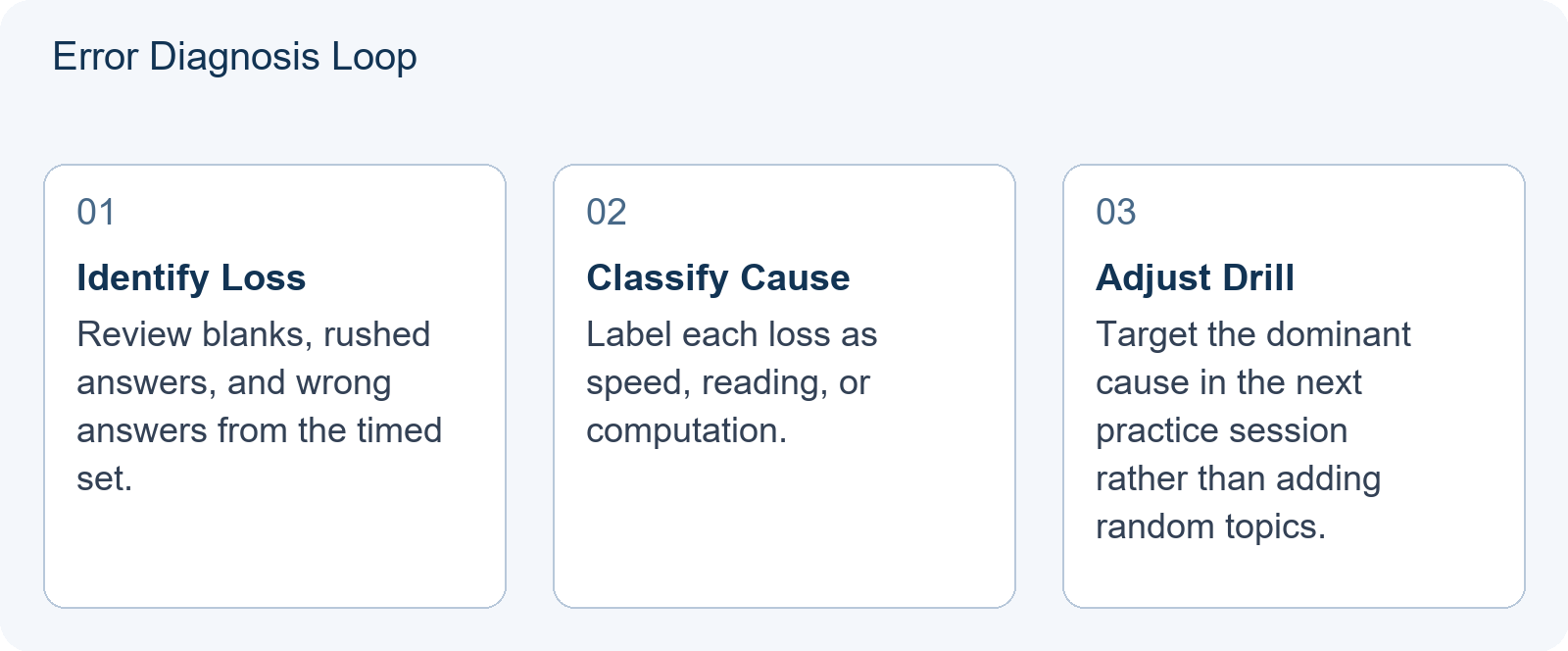
Diagnostic After Practice: Speed, Reading, or Computation
After a timed set, do not only count the score. Classify the lost points. The categories below are teaching diagnostics, not official score categories.
| Error type | What it looks like | Practice response |
|---|---|---|
| Speed | You knew the method but left the question blank or rushed it at the end. | Use timed sectionals and number-fluency drills; rehearse the three-pass protocol. |
| Reading | You solved a different question or missed a constraint. | Underline key conditions; restate the final question before calculating. |
| Computation | The method was right but the arithmetic failed. | Use estimation checks and slow down only at the calculation step. |
For example, if a practice review shows 6 speed losses, 2 reading losses, and 2 computation losses, the next session should emphasize pacing, not more advanced topics. If reading losses dominate, shorten the paper and practise translating each question into a one-line plan before solving. If computation losses dominate, use short arithmetic sprints and estimation checks.
Drills That Build Speed Without Sacrificing Accuracy
- Five-minute mental math sprints: Work on the operations that appear in your grade band: integer arithmetic, fractions, percentages, simple algebraic manipulation, and unit conversions. The goal is fluency, not recklessness.
- Pattern-recognition sets: Make a deck of question stems from your practice papers. Sort them into archetypes such as rate, percent, area, remainder, and sequence. The faster you name the archetype, the faster you choose the tool.
- Timed sectionals: A 10-question set in 7 minutes gives 420 seconds, or 42 seconds per question. That is close to the 45-second average of the 60/45 round and easier to review than a full paper.
- Error log: Record the question number, the time spent, and the error type. The log turns pacing from a feeling into a measurable habit.
Calculator policy is a separate issue from pacing. Math League’s official homepage announcement dated 4 July 2026 states that, for the 2026-2027 school year, calculators without a QWERTY keyboard are allowed after contradictory printed materials said they were prohibited; the same announcement says the no-calculator policy will be implemented the next school year. The Summer Challenge note supplied here does not state a separate calculator rule for its speed round, so check the specific contest instructions before relying on any tool. Either way, number fluency reduces time pressure.
Common Speed-Round Traps
- Re-reading excessively: Once you have understood the question, commit to that interpretation and calculate. Re-reading can be useful once, but repeated re-reading is a time leak.
- Perfect formatting: Scratch work only needs to be clear enough for you to follow. Do not spend speed-round seconds making it beautiful.
- Sunk-cost questions: If a question has already absorbed 3 minutes and you still do not have a path, the invested time is gone. Protect the remaining time.
- Sequential loyalty: Solving in order feels orderly, but it is not optimal when difficulty varies. The 60/45 format rewards deliberate triage.
- Ignoring answer format: A correct calculation with a wrong format can still lose credit. Reserve final-pass seconds for format checks.
One-Page Pacing Card
Speed Round Pacing Card
Total time: 45 minutes | Total questions: 60 | Average: 45 seconds per question
Pass 1 (0-15 min): Easy sweep. Mark and move if no path in 10-15 seconds. Target about 24 high-confidence items.
Pass 2 (15-35 min): Medium grind. Enforce a 90-second skip. Target about 20 standard-procedure items.
Pass 3 (35-45 min): Return and verify. Finish partial setups, then check units, signs, and answer format.
Golden rule: A 5-minute detour costs about 6.67 average question slots. Never let one question steal the round.
For the Summer Challenge format and scheduling details, see the existing article on Math League Summer Challenge 2026 (16 August, Online): Format, the China Time-Zone Trap, and a 3-Week Plan. If a question feels unfamiliar, use the recovery moves in Stuck on a Math League Question? The Five Recovery Moves That Turn Unfamiliar Into Solvable (2026). For online contests, rehearse the interface with Math League Online Practice: Rehearse Answer Entry and the Final Submission Check.
Frequently Asked Questions
How should I handle a question that takes longer than 90 seconds?
In Pass 2, mark it and move on. Return in Pass 3 only if you have a partial setup or a clear path. The point of the 90-second rule is not that the question is impossible; it is that one long question can consume several average question slots.
Can I use a calculator during the Math League Speed Round?
For the 2026-2027 school year, Math League’s official homepage announced that calculators without a QWERTY keyboard are allowed, after contradictory printed materials; the same notice says the no-calculator policy returns the next school year. The Summer Challenge announcement supplied here does not state a separate calculator rule, so check the specific contest instructions. Train both with and without a calculator for fluency.
How does the Speed Round differ from the Short Answer Contest?
The 2026 Summer Challenge source lists a 10-to-15-question Short Answer Contest lasting 60 minutes and a 60-question Speed Round Contest lasting 45 minutes. The speed round rewards rapid recognition and triage; the short answer contest allows more multi-step reasoning per question.