The 2026 Math League Summer Challenge is an online contest published for August 16, 2026, 12–2 PM Eastern Time, offered at seven levels from Grade 3 up to Grades 10–12 at USD 66 per grade level. It combines a 10-to-15-question short-answer contest (60 minutes) with a 60-question speed round (45 minutes). For families in China, that published window falls overnight — and that changes how you prepare.
What the Summer Challenge is — and what it is not
Math League runs two very different things in summer, and they are constantly confused. The International Summer Tournament is an in-person camp and competition at The College of New Jersey, running six days of individual, team, relay and speed contests plus lectures — for 2026 the published sessions were grades 4–5 on July 13–18 and grades 6–10 on July 20–25, with entry linked to qualifying scores (Math League lists a score of 25 or higher on its contests for those grade levels, or a cumulative score of 28 or higher across its six high-school contests).
The Summer Challenge is the online event. No travel, no visa, no qualifying score published as a gate — you register, you sit it from wherever you are. For a China-based student in August, it is the only one of the two that is still available and still actionable. If Math League itself is new to you, read our overview of what Math League is first, because the Summer Challenge is not a substitute for the regular school-year season; it is a standalone contest.
- Contest registration
- Free past papers
- 1-on-1 trial lesson

The two rounds, and why they demand opposite skills
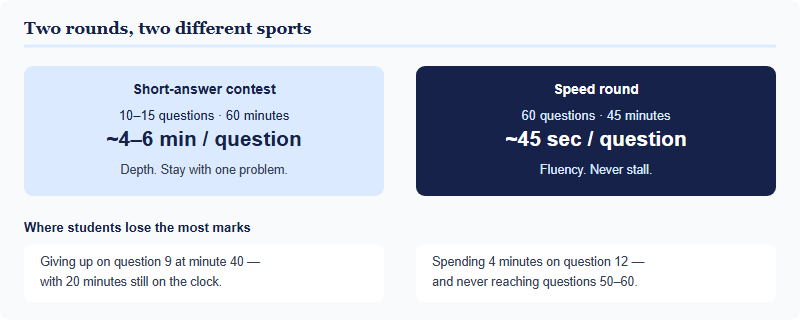
The published format is two contests in one sitting, and they pull in different directions. This is the single most useful thing to understand before you train.
| Short-answer contest | Speed round | |
|---|---|---|
| Questions | 10 to 15 | 60 |
| Time | 60 minutes | 45 minutes |
| Average per question | roughly 4–6 minutes | roughly 45 seconds |
| What it rewards | Depth: multi-step reasoning, holding a problem in your head | Fluency: instant recall, clean arithmetic, no hesitation |
| How you lose marks | Abandoning a problem too early; one arithmetic slip late in a long chain | Stalling on a single question and starving the rest of the paper |
| Training that works | Long, untimed problem sets, then timed at the end | Short daily timed sets; arithmetic drills; no calculator |
Notice the arithmetic: 60 questions in 45 minutes leaves about 45 seconds each, and that is before you read the question. A student who is strong at hard problems but slow at basic computation will feel comfortable in the first contest and be overrun in the second. The reverse is also common: fast, accurate calculators-in-the-head who have never spent five minutes on a single problem freeze when one is put in front of them.
Also plan for the no-calculator era. Math League has stated that from September 2026 calculators are not permitted on any of its contests. Even for an August sitting, training unassisted arithmetic is the right default — and it is exactly what a 45-second-per-question round demands.
The time-zone trap: what 12–2 PM Eastern means in China
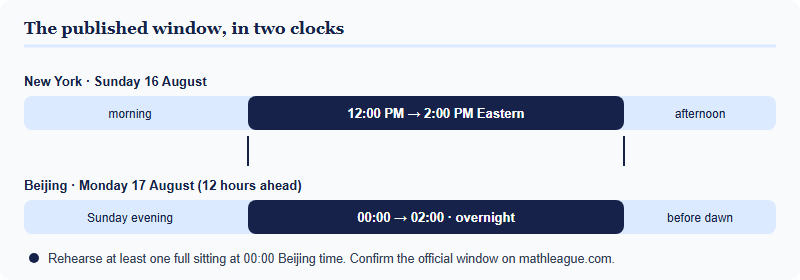
This is the part that catches China-based families every year, and it is not in any brochure. In mid-August, New York runs on Eastern Daylight Time, which is twelve hours behind Beijing. Working from the published window:
| New York (Eastern, August) | Beijing | What it means at home |
|---|---|---|
| Sun 16 Aug, 12:00 PM — start | Mon 17 Aug, 00:00 — midnight | The contest begins as Sunday turns into Monday |
| Sun 16 Aug, 2:00 PM — window ends | Mon 17 Aug, 02:00 | You finish in the small hours of a Monday morning |
Two rounds of 60 and 45 minutes total 105 minutes, which fits inside the published two-hour window — so plan for a student who is doing genuinely demanding mathematics from roughly midnight to 2 a.m. Beijing time.
Three consequences you should build into the plan, not discover on the night:
- Shift the sleep schedule deliberately. Do not simply stay up late once. In the last week, move bedtime and wake time later in stages so that midnight is a normal alert hour, and add an afternoon nap on the day itself.
- Rehearse at the real hour. At least one full-length practice sitting should happen at 00:00 Beijing time. Cognitive speed at midnight is not the same as at 4 p.m., and the speed round is the first thing to suffer.
- Check the school calendar. Mid-August is when many international schools in China restart. A contest ending at 02:00 on a Monday may collide with the first days of term.
Do not assume an alternative sitting exists for other time zones. If your student cannot work at midnight, ask Math League directly what arrangements are available — and take the published window as the plan until you have an answer in writing. Times, dates and any regional accommodations are Math League's to set; confirm everything on mathleague.com.
Choosing your level among the seven
The Summer Challenge is published at seven levels: Grade 3, Grade 4, Grade 5, Grade 6, Grade 7, Grades 8–9, and Grades 10–12, with the fee listed as USD 66 per grade level. Two things stand out for planning.
First, Grade 3 appears here but not in the regular season. Math League's school-year contests run grades 4–12, so the Summer Challenge is the earliest formal entry point in the system. For a young, keen student, that is a low-stakes way to meet contest conditions a year before the regular papers become available — treat it as exposure, not as a verdict on ability.
Second, the top two levels merge grades. A grade 8 student and a grade 9 student sit the same paper; so do grades 10, 11 and 12. If your student is at the younger end of a merged band, expect content they have not been taught and score accordingly — that is the design, not a failure. Our companion piece on choosing the right grade band works through this trade-off in more detail.
If this is your family's first Math League entry from China, read our walkthrough of how to enter Math League from China and our contest overview before you start. Register through the official channel and confirm the current level list, fee and any deadline on mathleague.com — the figures above are as published for 2026 and can change.
A three-week plan from late July to 16 August
Three weeks is enough to move the speed round substantially and to steady the short-answer contest. It is not enough to learn new topics, so do not try.
| Week | Speed-round work (daily, 15 min) | Short-answer work (3× per week, 60 min) | Sleep & logistics |
|---|---|---|---|
| Week 1 (to 2 Aug) |
Pure arithmetic fluency: tables, squares, fraction-decimal conversions, no calculator | Untimed hard problems — the goal is to stay with one problem for 10 minutes | Confirm registration, level and fee; test your device and internet |
| Week 2 (to 9 Aug) |
Timed sets of 20 questions in 15 minutes; log every question that took over 60 seconds | One timed 60-minute set; rebuild every wrong answer from scratch | Begin shifting bedtime later by 30–45 minutes every two days |
| Week 3 (to 15 Aug) |
Two full 45-minute speed rehearsals; then taper to 10 minutes a day | One full-length rehearsal of both rounds back to back, at midnight Beijing time | Nap on contest day; set two alarms; charge everything by 22:00 |
The single highest-value session in that table is the back-to-back rehearsal. Sitting 60 minutes of deep problems and then immediately switching to a 45-second-per-question sprint is a specific skill, and almost nobody does it well the first time. Doing it once in practice is worth more than another week of problem sets. Both the timed speed sets and that back-to-back rehearsal need real papers: we can send you our own gathered pack of Math League practice sets — ask us through our resources page. For how this fits a longer training arc across the school year, see our Math League study roadmap.
How to read the result afterwards
The Summer Challenge is a standalone online contest. It is not the school-year season, it is not the in-person tournament, and a score on it does not carry the same institutional weight as a full high-school series result. Read it as three pieces of information:
- A speed baseline. Your speed-round score against the 60-question ceiling tells you how much arithmetic fluency you are carrying into the autumn.
- A depth baseline. How many of the 10–15 short-answer questions you finished tells you whether you can sustain a multi-step argument under time.
- A start-of-year plan. The gap between those two numbers is your training priority for September, when the school-year contests and the no-calculator rule both arrive.
Treat it as diagnostics with a scoreboard attached — useful precisely because it happens before the season, not after it.
Frequently asked questions
When is the 2026 Math League Summer Challenge?
Math League published August 16, 2026, 12–2 PM Eastern Time, online. That is roughly 00:00–02:00 on 17 August in Beijing. Confirm on mathleague.com.
What is the Summer Challenge format?
Two contests: a 10-to-15-question short-answer contest in 60 minutes, and a 60-question speed round in 45 minutes.
How much does it cost and which levels exist?
USD 66 per grade level as published, across seven levels: Grades 3, 4, 5, 6, 7, Grades 8–9 and Grades 10–12.
Is the Summer Challenge the same as the Summer Tournament?
No. The Challenge is online; the International Summer Tournament is an in-person event in New Jersey with published qualifying scores.
This is an independent guide operated by Hanlin Education for China-based international-school students. We are not affiliated with, endorsed by, or sponsored by the official Math League (mathleague.com). Contest dates, times, formats, levels and fees are set by Math League and can change — always confirm current details on mathleague.com before registering. Time-zone conversions here are our own arithmetic on the published Eastern-time window. Factual corrections are made within 7 working days of notification.