Math League is a U.S. school mathematics competition for grades 4 through 12, founded in 1977 by two high-school teachers, Steven R. Conrad and Daniel Flegler. It runs short, curriculum-aligned contests that have been taken by more than a million students across North America, plus an international summer championship that draws teams from China and beyond. This independent guide explains how it works, who it is for, and how it differs from the AMC.
Quick facts (2026)
| What it is | Curriculum-based school math contest, grades 4–12 |
| Founded | 1977, by Steven R. Conrad & Daniel Flegler |
| Where | USA & Canada core; international championships (China, Asia-Pacific, Europe) |
| Format | Grades 4–8: 30–35 multiple-choice in 30 min · Grades 9–12: six contests of 6 short-answer in 30 min |
| Scope | Arithmetic → algebra, geometry, trigonometry, pre-calculus (by grade) |
| Official source | mathleague.com |
How Math League works: the grade bands
Math League is not one test — it is a ladder of contests that grows with the student. The questions stay tied to what schools actually teach, so a strong classroom student can start without specialized olympiad training. What changes from band to band is the question style and the depth of topics.
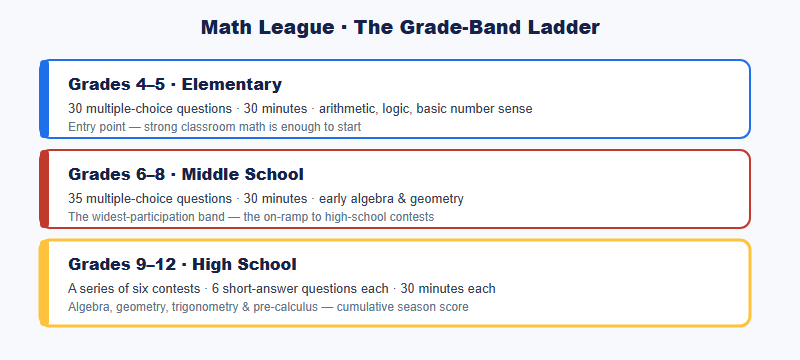
Two details matter for planning. First, the high-school level is a six-contest season, not a single sitting — consistency across the year counts, not one lucky day. Second, the lower bands are multiple-choice while grades 9–12 switch to short-answer, so the step up from middle to high school is as much about showing exact answers as it is about harder topics.
- Contest registration
- Free past papers
- 1-on-1 trial lesson

Math League vs the AMC: a common mix-up
International families often confuse Math League with the AMC (American Mathematics Competitions, run by the MAA). They are different ladders with different goals. The AMC is concentrated at the high-school level and is the first step toward AIME and the USA(J)MO olympiad track. Math League spans grades 4–12 and stays closer to the school curriculum — it is broader and starts much earlier.
| Math League | AMC (MAA) | |
| Grades | 4–12 (full ladder) | Mainly 8/10/12 |
| Style | Curriculum-aligned | Olympiad-leaning |
| Leads to | Season score, regional/international finals | AIME → USA(J)MO |
| Best for | Building a multi-year habit from elementary on | High-schoolers chasing the olympiad path |
Neither is “better” — they answer different questions. A grade-6 student who loves math can begin Math League now and add the AMC later in high school. For a deeper side-by-side, see our companion piece on how the contests compare.
How international and China-based students take part
Math League is best known in the U.S., but it runs international contests and an annual summer championship that bring together students from China, the Asia-Pacific region, Canada and Europe. For students at international schools in China, there are two practical routes: sit the regional rounds locally during the school year, and (for those who qualify and want the experience) travel to the international summer championship.
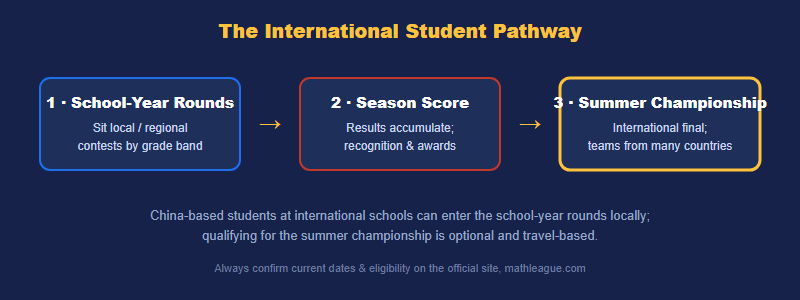
Because exact dates, fees and regional availability change each season, treat this guide as the map and the official Math League site as the source of truth for registration windows. If you are figuring out which band your child should enter, our grade-band guide walks through it; for the China-region rounds specifically, see how the rounds work locally.
How to get started — and how China-based students prepare
You do not need a separate olympiad curriculum to begin. The most reliable plan is simple: pick the band that matches the student’s current grade, work through official past contests under the real 30-minute limit, and review every missed question by topic rather than re-doing whole papers. Because grades 4–8 are multiple-choice and 9–12 switch to short-answer, older students should practise writing exact, clearly-labelled answers — losing marks to format rather than maths is the most common avoidable mistake.
For students at international schools in China, the practical questions are usually “which band, and how do we register locally?” That is where we help: our team works with families and school math clubs to place students in the right band, set a realistic term-by-term practice rhythm, and walk through the China-region registration steps — so Math League becomes a multi-year habit rather than a one-off sign-up.
Is Math League worth it for international students?
For most families the honest answer is: yes, as a habit rather than a trophy. Math League’s value is that it is low-barrier and repeatable — a grade-4 student can start, and the same competition grows with them through grade 12. That continuity is exactly what U.S. university readers like to see: sustained engagement, not a one-off certificate. It is not the olympiad path (that is the AMC/AIME track), and it should not be presented as such. Used well, it builds the consistency that makes the harder contests possible later.
The mistakes that cost international students marks
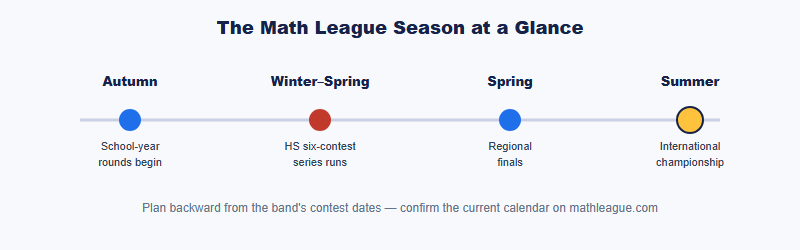
When students lose marks, it is rarely because the mathematics was too hard — it is usually one of three avoidable habits. Rushing the easy questions: the early items in each contest are the cheapest marks, yet they are where careless mis-reading happens most. Messy short-answer format (grades 9–12): at the high-school level answers are written, not chosen, so an un-simplified fraction or a missing unit can cost a correct idea its mark. Treating one weak contest as the whole season: because the high-school level is scored across six contests, a single off day matters far less than steady results — students who quit after a bad round give up the part of the system designed to help them. Fixing these three is usually worth more than drilling extra topics.
Hanlin students at Math League: 2024–25 results
In the 2024–25 Math League season, Hanlin students placed in the Top 8% / Top 25% / Top 50% across the field, with an ~85% advancement rate from Stage 1; at Stage 2, 8 students reached the Top 8% and 15 advanced to the final. Results span the grade 4–12 bands. (Hanlin internal data.)
Frequently asked questions
Is Math League the same as the AMC?
No. The AMC (MAA) is mostly a high-school olympiad-track contest leading to AIME and the USA(J)MO. Math League spans grades 4–12 and stays closer to the school curriculum. Many students do both, at different ages.
What grades can take Math League?
Grades 4 through 12, split into bands: 4–5, 6–8, and 9–12. Each band has its own format and topic depth.
Do international students in China qualify?
Yes. School-year regional rounds can be sat locally, and qualifying students may join the international summer championship. Confirm current eligibility and dates on mathleague.com.
Does Math League require special olympiad training?
Not to start. The lower bands track the school curriculum, so a strong classroom student can begin without separate preparation, then add training as they move up.
Independent guide · not affiliated with the official Math League (mathleague.com). Figures reflect publicly available information and may change by season — always confirm on the official site. This site is the Math League international guide operated by Hanlin Education for China-based international-school students.