Math League scores 1 point per correct answer, with no penalty for wrong answers. Each school's team score is the sum of its top five students' scores, and cumulative totals add up across the season. Awards range from book prizes and certificates of merit (grades 4–5) to league- and region-level recognition for top students and schools. Founded in 1977 by Steven R. Conrad and Daniel Flegler, the contests run grades 4–12.
If you are a parent trying to make sense of the score report your child brought home, this guide walks through the three things that actually matter: how a single paper is scored, how those papers roll up into a team score, and what counts as "winning." Math League does not work like a single elimination tournament — there is no bracket to climb. Understanding that up front saves a lot of confusion. For the big picture of what the program is, start with our What Is Math League explainer; this article zooms in on the numbers.
How a single contest is scored
The scoring rule is refreshingly simple and identical across every grade band: each correct answer is worth exactly 1 point. There is no partial credit, and — importantly for nervous test-takers — no deduction for a wrong answer. Because blanks and wrong answers cost the same (zero), the rational strategy is to attempt every question your child can reach. A student's raw score for a contest is simply the count of questions they answered correctly.
- Contest registration
- Free past papers
- 1-on-1 trial lesson

What changes between grade bands is not the scoring — it is the shape of the paper: how many questions, how much time, and whether it is multiple-choice or short-answer. Those structural differences matter because a "good score" on a 40-question middle-school paper means something very different from a good score on a 6-question high-school paper.
| Grade band | Questions | Time | Format | Max individual score / contest |
|---|---|---|---|---|
| Grades 4 & 5 | 30 | 30 minutes | Multiple choice, 3 pages | 30 |
| Grades 6, 7 & 8 | 40 | 30 minutes | Multiple choice, 3 pages | 40 |
| Algebra Course 1 | 30 | 30 minutes | Multiple choice | 30 |
| High School (9–12) | 6 per contest × 6 contests/year | 30 minutes each | Short answer | 6 per contest |
A first-party note from coaching Chinese international-school students: the 6-question high-school paper trips families up the most. A score of 3 or 4 out of 6 sounds "average" to a parent used to percentage grades, but on a hard Math League high-school contest it is often a strong, league-competitive result. Read the score relative to the contest's difficulty, not as a percentage. To pick the right entry point for your child, see our breakdown of which grade band is right.
The elementary and middle-school paper: three pages, rising difficulty
For grades 4–8, the multiple-choice paper is deliberately structured in three pages of increasing difficulty. Page 1 is straightforward and meant to be accessible to most participants; page 2 is moderate; page 3 is the genuinely challenging stretch that separates the top scorers. This design is useful for parents to know because it changes how you read a result.
- A student clearing page 1 cleanly has solid fundamentals for their grade.
- A student getting partway into page 2 is performing at or above the typical level.
- A student reaching page 3 problems correctly is in contention for the per-school recognition described below.
Because the difficulty climbs, two children with the same total can have very different profiles — one steady through pages 1–2, another with gaps early but a couple of hard page-3 solves. When you plan practice, target the page where your child stalls rather than re-drilling what they already clear. Our study roadmap lays out how to build that practice over a season.
How the team (school) score works
Math League is as much a team competition as an individual one, and the team rule is where a lot of parent questions arise. For every contest, a school's team score is the sum of the scores of its five highest-scoring participants from that school. A school can enter many students, but only the top five count toward the team total on any given contest — and the five can change from contest to contest depending on who has the best day.
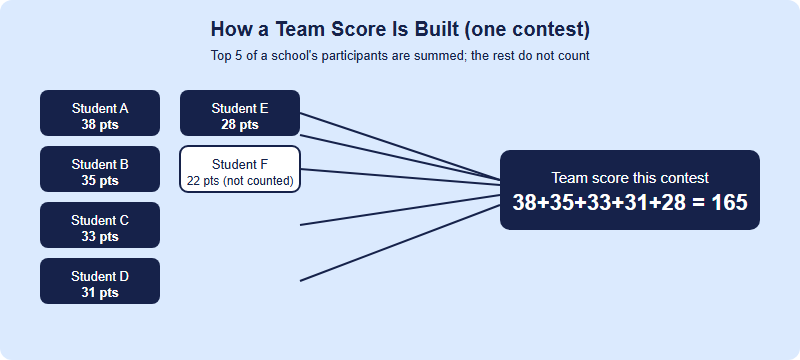
For high school, this team rule has a tidy ceiling: with 6 questions worth 1 point each and 5 students counting, a perfect team score for a single contest is 30 (5 × 6). For grades 6–8, the same top-five rule applies to the 40-question paper. This is why depth matters: a school with one brilliant student but a thin bench can be out-scored by a school with five steady performers.
Cumulative scoring: there is no bracket, the season adds up
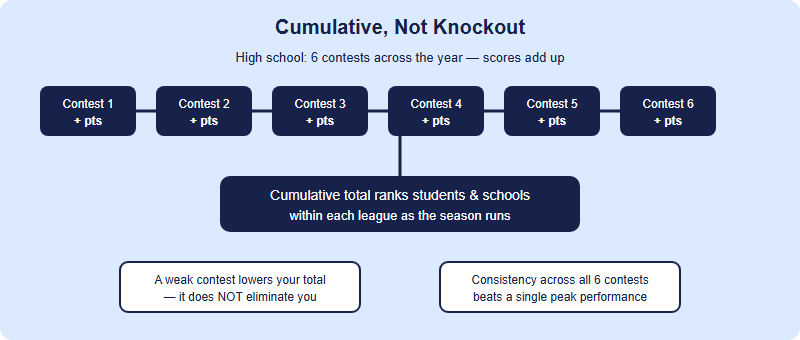
The single most important thing for parents to understand about "advancement" in the regular Math League season is that it is cumulative, not knockout. The high-school division runs 6 contests across the year, and you do not get eliminated by a bad day. Instead:
- A student's cumulative score is the sum of that student's scores across all contests taken to date.
- A school's cumulative team score is the sum of its team scores (top five each time) across all contests to date.
- Score reports rank the top students and top schools within each league on these running totals as the season progresses.
This structure rewards consistency over a single peak. A student who misses one contest can still post a strong year-end total by performing across the remaining contests — though every contest skipped is points left on the table, since there is no "drop the lowest" mechanic in the basic cumulative total. (Confirm any league-specific tie-breakers or count rules on the official site.)
What awards actually exist
Recognition in Math League is layered, and the lower grades are intentionally encouraging rather than cut-throat. Here is how it breaks down by grade band, based on the official rules:
| Level | Recognition |
|---|---|
| Grades 4 & 5 and Algebra Course 1 | In each school, the highest-scoring student on each contest receives a book award; other high scorers receive certificates of merit. |
| Grades 6, 7 & 8 | In each school, a certificate of merit is awarded to the highest-scoring student on each contest. |
| Per-school, year-end | Certificates of merit to the top 5 scoring students for the year in each school. |
| League level | Prizes to the top-scoring schools and students in each league. |
| Regional level | Prizes to the top schools in each region. |
Two practical wrinkles parents should know. First, regions are formed by geography and participation: counties, provinces, or states with fewer than fifteen participating schools are grouped together into a combined region for awards. Second, to spread recognition, a school generally cannot take both a regional and an overall league award on the same grade level in the same school year. The exact wording and any updates live on the official site, so verify before you set expectations.
Where the Summer Challenge fits
Separate from the regular cumulative season, Math League runs a Summer Challenge with a different shape: a 10-to-15-question short-answer contest (60 minutes) paired with a 60-question speed round (45 minutes). Eligibility typically references a qualifying score (for example, 25 or higher on Math League contests) or comparable competition experience, and the organisation states it will consider applications from students who have demonstrated mathematical talent through other means. Treat the summer event as an enrichment opportunity rather than a continuation of the regular-season standings — and confirm the current year's dates, fee, and qualifying rules on the official site, since these change.
Frequently asked questions
Is there a penalty for wrong answers in Math League?
No. Each correct answer earns 1 point and wrong answers earn zero, the same as a blank. Because guessing costs nothing, attempt every question your child can reach.
How is the school team score calculated?
For each contest, the team score is the sum of the school's five highest-scoring participants. Only the top five count, and the five can differ from contest to contest.
Does my child get eliminated after a bad contest?
No. The regular season is cumulative across the contests, not a knockout bracket. Scores add to a running total used to rank students and schools within each league.
What award can a grade 4 or 5 student win?
In each school, the top scorer on each contest receives a book award, and other high scorers receive certificates of merit. Lower grades are designed to be encouraging.
This is an independent guide operated by Hanlin Education for China-based international-school students and their families. It is not affiliated with, endorsed by, or sponsored by the official Math League (mathleague.com). Contest formats, scoring rules, awards, dates, and fees can change — always confirm current details on mathleague.com before registering or making decisions. Math League was founded in 1977 by Steven R. Conrad and Daniel Flegler and serves grades 4–12. If you spot a factual error in this guide, we correct confirmed errors within 7 working days.