Math League, MATHCOUNTS and Math Kangaroo are three different tools for three different jobs. Math Kangaroo (grades 1–12, one 75-minute multiple-choice test) is the gentlest on-ramp; Math League (grades 4–12, short-answer rounds) builds toward serious problem-solving across a season; MATHCOUNTS (grades 6–8, a team-based US tournament with four rounds) is the most intense but hardest for students in China to enter. The right fit depends on your child's grade, temperament, and — crucially — whether they can actually register from where you are.
The 30-second answer: match the contest to the child, not the prestige
Families often ask “which one is the best?” That is the wrong question. None of these three is objectively superior — they overlap in age but differ sharply in format, purpose, and who can realistically sit them. A confident grade-3 student who loves puzzles needs something very different from a grade-10 student building a competition record for university applications.
Before comparing difficulty, settle three plain questions: What grade is your child in? Math Kangaroo starts at grade 1; Math League starts at grade 4; MATHCOUNTS is strictly grades 6–8. Does your child want a low-pressure introduction or a high-stakes challenge? One multiple-choice test feels nothing like a multi-round tournament. And can you register where you live? This last filter matters most for China-based international-school families, and we return to it below. If you are still new to one of these names, our explainer on what Math League is is a useful companion read.
- Contest registration
- Free past papers
- 1-on-1 trial lesson

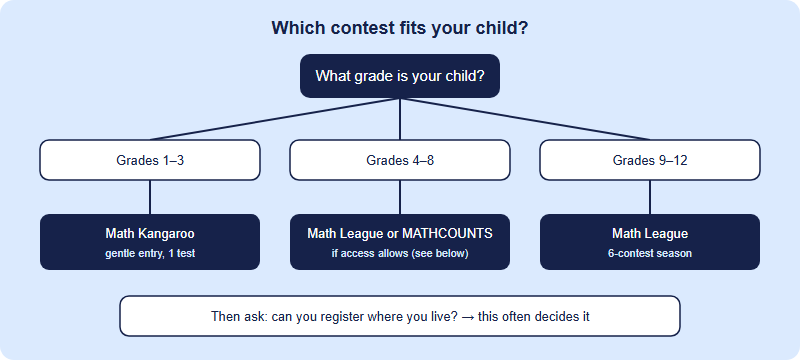
Side-by-side: grade range, format, difficulty and purpose
Here is the core comparison, with every procedural detail drawn from each organiser's own published information. Where a figure can shift year to year, confirm it on the official site before you commit.
| Dimension | Math League | MATHCOUNTS | Math Kangaroo (USA) |
|---|---|---|---|
| Grade range | Grades 4–12 (banded: 4–5, 6–8, 9–12, plus Algebra 1) | Grades 6–8 only | Grades 1–12 (12 levels) |
| Founded | 1977, by Steven R. Conrad & Daniel Flegler | 1983 (NSPE, NCTM & CNA); first national 1984 | Math Kangaroo USA, a nonprofit (per its site) |
| Format | Short-answer contests; grades 4–5 and 6–8 are timed question sets, high school is a series of 6 contests across the season | Four rounds: Sprint, Target, Team, Countdown | One test, multiple-choice (5 options) |
| Length / count | Per official materials: grades 4–5 use 30 questions in 30 min; grades 6–8 use 35 questions in 30 min (confirm current specs) | Sprint 30 problems / 40 min (no calculator); Target 8 problems in pairs, 6 min each (calculator); Team 10 problems / 20 min (calculator) | 75 minutes; 24 questions (grades 1–4) or 30 questions (grade 5 and up) |
| Individual or team | Primarily individual scoring across the season | Team-anchored: only the 4-student team takes the Team Round officially | Individual |
| Structure / advancement | Season of contests; the high-school track aggregates scores across 6 contests | Tiered: school → chapter → state → national | Single sitting; no multi-round advancement ladder |
| Best for | Building sustained problem-solving over a season; broad grade coverage | Middle-schoolers who thrive on speed, teamwork and a tournament arc | A confident, low-pressure first taste of competition maths |
A few honest reads of that table. Math Kangaroo is the widest door — it is the only one of the three that a grade-1 or grade-2 child can enter, and a single multiple-choice paper is far less daunting than a tournament. MATHCOUNTS is the narrowest and most intense — brilliant for grades 6–8 who love the energy of a buzzer round and a team, but it is built around a US school-and-chapter pipeline. Math League is the broadest ladder — it spans grades 4–12 and, in the high-school years, rewards consistency across a whole season rather than one good day. If you are weighing which Math League band your child belongs in, we walk through that in detail in our guide to choosing the right grade band.
The question most comparisons skip: can you actually enter it from China?
This is the part generic “contest comparison” articles ignore, and it is the one that matters most for families at international schools in China. A contest your child cannot register for has zero value, no matter how prestigious. So check access before difficulty.
MATHCOUNTS is structured around US participation. Per the MATHCOUNTS Foundation, the Competition Series runs through US schools and advances school → chapter → state → national, and it operates across US states, DC and US territories. For a student physically in China without a registered US-pipeline school chapter, this is the hardest of the three to plug into. If the tournament-and-team format is what excites your child, verify whether any accessible pathway exists for your situation directly with the organiser — do not assume an international route exists simply because the contest is famous.
Math League and Math Kangaroo are more reachable internationally, and Math League in particular runs activity in the Asia–Pacific region. But “reachable” is not the same as “automatic.” The exact registration steps, dates, fees and whether a given round is sat at a school or a regional centre vary by region and by year. For these, confirm the current procedure on the official site — mathleague.com for Math League — rather than relying on any third-party summary, including this one. We have deliberately not printed specific registration dates or fees here, because those change; an out-of-date number is worse than no number.
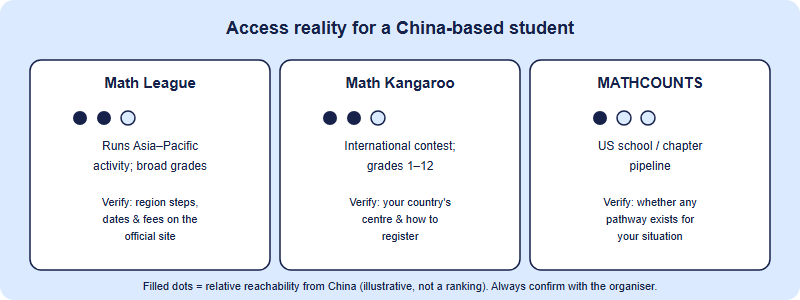
Difficulty and purpose: they are not on one ladder
It is tempting to rank these three from “easy” to “hard,” but difficulty here is multi-dimensional. Math Kangaroo's multiple-choice format with five options means a stuck student can still reason by elimination — lowering the floor and making it forgiving for younger or newer competitors. Math League's short-answer contests remove that safety net: you either produce the answer or you do not. MATHCOUNTS adds two more pressures — raw speed (30 Sprint problems in 40 minutes, no calculator) and the social-cognitive load of a buzzer Countdown and a collaborative Team Round.
So the honest framing is by purpose:
- Math Kangaroo — exposure and confidence. Best as a first contest, or for a younger child (grades 1–5) who is curious but not yet battle-hardened. One sitting, no season-long commitment.
- Math League — depth and consistency. Best for a student ready to train across a season and to be measured on accuracy without multiple-choice scaffolding. Its grade-4-to-12 span means a child can grow inside the same ecosystem for years.
- MATHCOUNTS — intensity and teamwork. Best for grades 6–8 who are energised by speed, rivalry and a team identity — if an accessible pathway exists for them.
A practical note from working with students: many do not choose one. A common, sensible progression is Math Kangaroo in the early years to build comfort, then Math League from upper-primary onward to develop genuine problem-solving stamina. They are complementary, not competing. If you want a structured way to build that stamina, our study roadmap lays out a term-by-term plan.
How to decide this week
Skip the agonising. Run these four checks in order and the answer usually appears:
- 1. Grade gate. Under grade 4? Math Kangaroo is effectively your only option of the three. Grades 6–8 and craving a tournament? Look hard at whether MATHCOUNTS is reachable for you. Grades 9–12? Math League's high-school season is the natural home.
- 2. Temperament check. Does your child shut down or light up under a clock and a crowd? Speed-and-team formats (MATHCOUNTS) reward one type; a quieter, deeper solver may prefer Math League's individual season.
- 3. Access check. Confirm on the official site that you can actually register from your location this year. This single step eliminates more options than difficulty ever will.
- 4. Goal check. First taste → Math Kangaroo. Multi-year development and a track record → Math League. A specific middle-school team experience → MATHCOUNTS, access permitting.
Whatever you choose, choose for genuine mathematical growth, not for a line on an application. The students who go furthest are the ones who enjoyed the maths first — the credentials followed.
Frequently asked questions
Which contest is easiest for a young child?
Math Kangaroo. It starts at grade 1, is a single 75-minute multiple-choice test (5 options), so a stuck child can still reason by elimination — the gentlest on-ramp of the three.
Can a student in China take MATHCOUNTS?
MATHCOUNTS runs through a US school-and-chapter pipeline (school → chapter → state → national). Access from China is the hardest of the three; confirm any pathway directly with the organiser — do not assume one exists.
What is the biggest difference between Math League and MATHCOUNTS?
Math League (grades 4–12) is largely individual and season-long; MATHCOUNTS (grades 6–8) is a team-anchored four-round US tournament with speed and buzzer elements. Different jobs.
Should my child do more than one?
Often, yes. A common path is Math Kangaroo early for confidence, then Math League from upper-primary for problem-solving depth. They complement rather than compete.
This is an independent guide operated by Hanlin Education for China-based international-school students and their families. It is not affiliated with, endorsed by, or sponsored by the official Math League (mathleague.com), MATHCOUNTS, or Math Kangaroo. Contest formats, grade levels, dates, fees and registration procedures change — always confirm current details on the relevant official site (for Math League, mathleague.com) before registering. Math League was founded in 1977 by Steven R. Conrad and Daniel Flegler. Any confirmed factual error will be corrected within 7 working days.