Math League and the AMC are not rivals — they answer different questions. Math League is a curriculum-aligned school contest for grades 4–12 that builds steady speed and confidence. The AMC (run by the MAA) is concentrated at grades 8/10/12 and is the entry ramp to the AIME and USA olympiad track. For most China-based students, Math League comes first and the AMC comes later — and the strongest profiles use both.
The short answer: which one, and when
If your child is in grades 4–8, or is new to timed math contests, start with Math League. Its questions stay close to what schools actually teach, so a strong classroom student can begin without specialized olympiad training. If your child is in grades 9–12 and aiming at selective STEM admissions, the AMC 10/12 matters because it is the recognized first step toward the AIME and the USA(J)MO. These two paths overlap, not collide: the arithmetic fluency and exam temperament Math League builds are exactly what the AMC rewards. For the full beginner picture, see our guide on what Math League is.
| Your situation | Best first step |
| Grades 4–6, building confidence | Math League (curriculum-aligned, gentle on-ramp) |
| Grades 7–8, strong and curious | Math League now; trial AMC 8 to test olympiad-style thinking |
| Grades 9–10, targeting top STEM admissions | AMC 10 is the priority; Math League keeps speed sharp |
| Grades 11–12, advanced | AMC 12 → AIME track; Math League optional for rhythm |
Side-by-side: the facts that actually differ
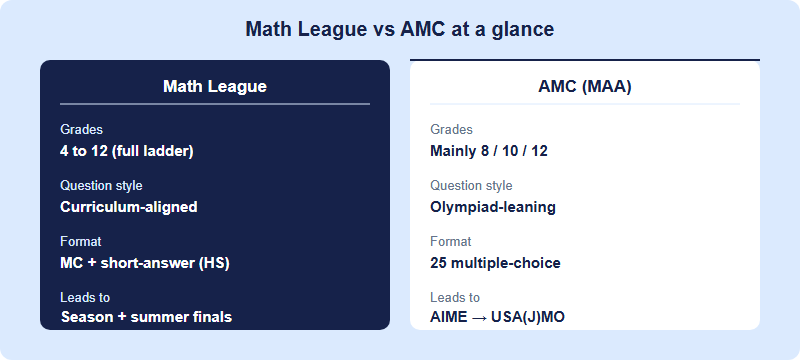
The two contests differ on four things that matter to a planning parent: who can enter, how the test is shaped, how hard it gets, and where it leads. The table below is built from each organizer's own published rules — always reconfirm current details on the official sites before you register.
- Contest registration
- Free past papers
- 1-on-1 trial lesson

| Math League | AMC (American Mathematics Competitions) | |
| Run by | Math League Press (independent) | Mathematical Association of America (MAA) |
| Founded | 1977, by Steven R. Conrad & Daniel Flegler | 1950 |
| Grade range | Grades 4–12 (full ladder) | Mainly grades 8, 10, 12 (AMC 8 / 10 / 12) |
| Format | Grades 4–8: ~30–35 multiple-choice in 30 min · Grades 9–12: six contests of 6 short-answer in 30 min | All levels: 25 multiple-choice · AMC 8 in 40 min · AMC 10/12 in 75 min |
| Style | Curriculum-aligned; rewards accuracy and speed on school topics | Olympiad-leaning; rewards creative problem-solving |
| Leads to | Season score; regional and international summer championships | AIME → USAMO / USAJMO → IMO selection |
| Cadence | Multiple contests across the school year + a summer tournament | AMC 8 in January; AMC 10/12 (A & B) in November |
| Official source | mathleague.com | maa.org |
A few of these deserve unpacking. The age caps on the AMC are real and easy to miss: AMC 8 is for students in grade 8 or below who are under 15.5 years old; AMC 10 is for grade 10 or below under 17.5; AMC 12 is for grade 12 or below under 19.5. Math League sets no such age ceiling — it simply asks the student to sit the contest for their grade band. If you are unsure which Math League level fits your child, our breakdown of which grade band is right walks through it.
Difficulty and purpose: speed vs depth
The clearest way to feel the difference is to picture the kind of thinking each test rewards. Math League questions are mostly recognizable — they look like harder, faster versions of classroom problems, so progress comes from accuracy under time pressure. The AMC, especially the back third of the AMC 10/12, leans on non-obvious insight: a problem may need a clever substitution or a parity argument that no textbook chapter spells out. Neither is “better.” They train different muscles, and serious students benefit from both.
Purpose follows from difficulty. Math League is built to give a wide range of students regular, achievable wins and a visible season-long record of improvement — ideal for grades 4–8 and for keeping high-schoolers sharp. The AMC is built as a filter: from 2027 the MAA invites students who score 100 or above on the AMC 10, or 85 or above on the AMC 12, to the AIME — fixed thresholds that replaced the older percentile bands — and the strongest of those advance toward the USAMO or USAJMO. That selective ceiling is exactly why selective universities recognize AMC and AIME results.
It helps to see how that filter actually works, because it changes how you weigh a result. Olympiad invitations are decided by a published index, not by the AMC score alone: the USAMO index is the AMC 12 score plus 20 times the AIME score, and the USAJMO index is the AMC 10 score plus 20 times the AIME score. The MAA selects only a few hundred students nationwide each year across both olympiads. The practical takeaway for a parent: the AMC is not a “pass/fail” exam but a ranking machine — every extra correct answer moves a student up a national list — whereas a Math League season is judged on accumulated, repeatable performance. Knowing which kind of yardstick you are being measured against should shape how your child practices: drill for consistent accuracy on Math League, and train for marginal high-end problems on the AMC.
| Goal | Which contest serves it |
| Build confidence and a “win habit” early | Math League |
| Sharpen timed accuracy on school topics | Math League |
| Signal elite problem-solving to admissions | AMC → AIME |
| Aim at the national/international olympiad ladder | AMC → USA(J)MO → IMO |
How families actually choose (a decision tree)
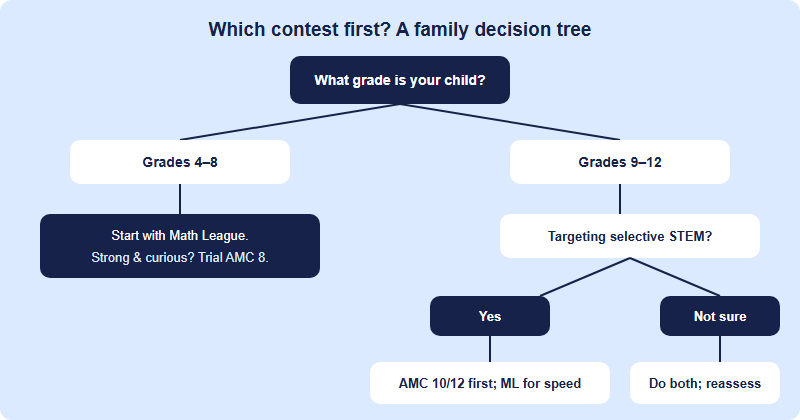
In practice, the choice is rarely “one or the other.” The decision tree below mirrors how we see China-based international-school families sequence the two contests across a student's school years — start where the student is, then layer the AMC on as the goal sharpens. From our first-party experience preparing students in this exact group, the most common and most durable pattern is Math League in middle school to build fluency, then AMC 10 from grade 9 once that base is steady — students who skip the fluency stage tend to stall on AMC timing, not on the hard insight problems.
Can — and should — you do both?
Yes, and for many students it is the smartest plan. The two contests are complementary on the calendar and on skills. The AMC 10/12 falls in November and the AMC 8 in January, while Math League runs several contests through the school year plus a summer tournament — so they rarely clash, and Math League's in-season reps keep a student exam-fit for the higher-stakes AMC sittings. Doing both also de-risks a single bad day: one off AMC morning does not erase a season of Math League results, and vice versa.
The skills transfer in one direction especially well. Because Math League's lower bands are multiple-choice with tight time limits, they train the exact reflexes the AMC demands first: reading a problem fast, eliminating wrong options, and managing a clock across 25 questions. A student who has done two or three Math League seasons rarely panics at AMC pacing — they have simply sat enough timed contests. The reverse is less automatic: AMC-style insight does not, on its own, guarantee the clean arithmetic speed Math League rewards. That asymmetry is the single best argument for the common middle-school-Math-League-then-high-school-AMC sequence.
There is also a distinctly international upside. Math League runs an International Summer Tournament (held in the United States) that, in its most recent edition, drew roughly 250 students from China, Japan, Canada and the United States, with a qualifying-score requirement to attend. That gives a China-based student a tangible global stage that the AMC track does not offer at the same age. To turn “do both” into a week-by-week plan, see our study roadmap.
Frequently asked questions
Is the AMC harder than Math League?
Generally yes at the top end — AMC 10/12 problems lean on creative insight, while Math League stays closer to the school curriculum and rewards speed and accuracy.
Which one do universities care about?
Selective STEM admissions widely recognize AMC and AIME results. Math League shows consistent achievement and is a strong foundation, especially in earlier grades.
Can my child take both in the same year?
Yes. AMC 10/12 is in November and AMC 8 in January; Math League runs across the year plus a summer event, so schedules rarely conflict. Confirm dates officially.
My child is in grade 5 — is the AMC an option?
The AMC 8 allows younger students under the age cap, but most grade-5 students are better served starting with Math League, then trialing AMC 8 when ready.
This is an independent guide operated by Hanlin Education for China-based international-school students and families. It is not affiliated with, endorsed by, or sponsored by the official Math League (mathleague.com), the Mathematical Association of America, or the AMC. Grade ranges, formats, dates, age limits and qualification thresholds change; always confirm current details on the official sources — mathleague.com and maa.org — before registering. Spotted an error? We correct confirmed mistakes within 7 working days.