Math League has stated that beginning in September 2026, calculators are no longer allowed on any of its contests. On papers that already move fast — 30 to 35 questions in 30 minutes at the lower levels, six short-answer questions in 30 minutes at high school — that removes a safety net most students lean on daily. This guide is the training programme: the five number skills that actually earn marks, and a 10-minute drill that builds them.
Why this rule bites harder than it looks
The instinct is to shrug: contest maths was never really about calculation. That is half true, and the half that is false is where marks disappear.
Every Math League question has two layers. The top layer is the idea — set up the equation, spot the structure, choose the right approach. The bottom layer is the arithmetic that carries the idea to a number. A calculator never helped with the top layer. It quietly did all of the bottom layer, and it did it without errors. Take it away and every question grows a second failure point.
- Contest registration
- Free past papers
- 1-on-1 trial lesson

The time cost is the sharper edge. On a 30-question, 30-minute paper you have around 60 seconds per question including reading. If unassisted arithmetic adds fifteen seconds to a third of the paper, you have lost roughly two and a half minutes — several questions' worth of thinking time — before making a single mistake. On the high-school series, where each of the six contests asks for exact short answers rather than choices, an arithmetic slip does not cost you time; it costs you the whole mark. What you write is what is marked, so an answer that is nearly right scores like an answer that is wrong.
This article is the drill curriculum. If you want the rules themselves — what you may bring, how each band's paper is structured — start from our overview of Math League and its contest formats; here we assume you know the format and want to train for it.
The five number skills that actually pay
Not all mental-arithmetic training is equal. Chinese school mathematics already produces strong calculation, but it trains for accuracy on set procedures, not for the specific patterns a multiple-choice contest paper rewards. These five are the ones that convert into marks.
| # | Skill | Why it earns marks | What to memorise or drill | Weekly minutes |
|---|---|---|---|---|
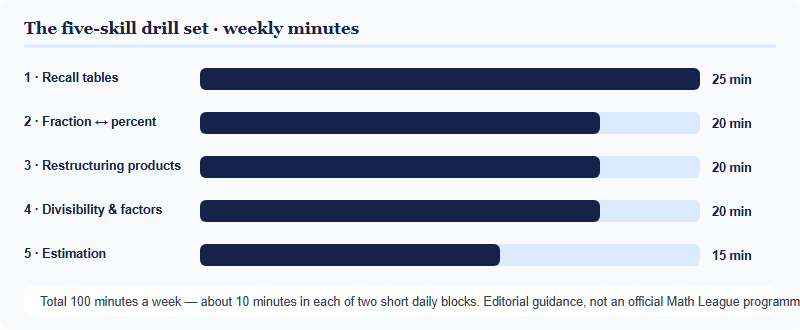
| 1 | Recall tables | Removes hesitation from every other step | Multiplication to 20×20; squares to 30; cubes to 12; powers of 2 to 212 | 25 |
| 2 | Fraction ↔ decimal ↔ percent | Rate, ratio and percent word problems dominate the middle pages | Halves through twelfths; 1/8 family; 1/16 family; both directions | 20 |
| 3 | Restructuring products | Turns an ugly multiplication into two easy ones | ×25 as ÷4 then ×100; ×11 shortcut; 47×53 as 502−32; distributing over round numbers | 20 |
| 4 | Divisibility & factorisation | Number-theory questions collapse once you see the factors | Rules for 3, 4, 6, 7, 8, 9, 11; prime factorisation on sight up to 200; primes to 100 | 20 |
| 5 | Estimation & magnitude | Kills wrong options before you compute anything | Rounding to one significant figure; bounding an answer above and below; sanity-checking size and sign | 15 |
Two notes on that table. Skill 1 is the least glamorous and the highest-yield: everything else runs on top of it, and hesitation there is a tax on every question. Skill 5 is the one Chinese-curriculum students most often skip, because school marking rewards the exact answer and never rewards a smart approximation — but on a multiple-choice paper an approximation that eliminates three options is the answer.
Which skills matter most, by grade band
The same five skills pay off differently depending on which paper you sit, because the formats differ. Multiple-choice papers let estimation do real work; short-answer papers do not.
| Band | Format as published | Dominant skills | Why |
|---|---|---|---|
| Grades 4–5 | 30 multiple-choice questions, 30 minutes | 1, 2, 5 | Speed of recall and sensible estimation decide most questions at this level |
| Grades 6–8 | 35 multiple-choice questions, 30 minutes | 1, 2, 4 | Ratio, percent and number-theory flavours arrive; factorisation starts to unlock questions |
| Algebra 1 | 30 multiple-choice questions, 30 minutes | 1, 3, 5 | Expanding, simplifying and back-substituting options all run on fast product work |
| Grades 9–12 | Six contests, six short-answer questions, 30 minutes each | 1, 3, 4 | No options to eliminate; exactness is everything, and estimation cannot rescue you |
That last row is the important one. Once you cross into the high-school series, skill 5 changes job: estimation stops being a way to find the answer and becomes only a way to check it. Students who have trained on multiple-choice papers for years often carry an elimination habit into a short-answer contest and discover there is nothing to eliminate. If your student is about to make that jump, read our guide to grade bands and where a student belongs alongside this.
The 10-minute daily drill
Long arithmetic sessions do not work. Recall is built by frequency, not duration — ten focused minutes a day beats seventy minutes on Sunday. Here is a shape that survives a normal school week.
- Minutes 0–3 — recall sprint. Forty questions from skill 1 or 2, written answers only, timed. Target: under three seconds each, zero errors.
- Minutes 3–7 — technique block. Ten questions from the day's rotating skill (3, 4 or 5). Work them the clever way, and write down which restructure you used.
- Minutes 7–10 — error review. Redo yesterday's wrong answers from scratch, not by reading the correction. If an error repeats three days running, it becomes tomorrow's recall sprint.
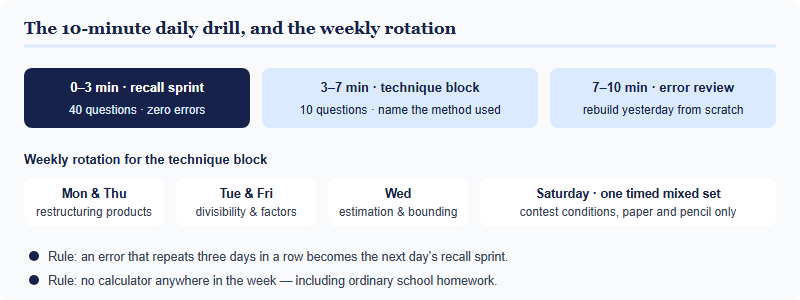
The rule that does most of the work is the last one: no calculator anywhere, including homework. Twenty minutes of drilling followed by two hours of calculator-assisted homework teaches the hand its old habit back. Students who go fully unassisted for a term stop noticing the change by about week four. For the Saturday timed set, work from real papers rather than improvised questions — we can send you our own gathered pack of Math League practice and drill sets; ask us through our resources page.
Two traps to design your training around
Trap 1 — training speed without training exactness. Fast, approximate arithmetic is rewarded on a multiple-choice paper and punished on a short-answer one, where the written answer is what gets marked. If your student sits the high-school series, at least half of every drill should be scored strictly: right or wrong, no “nearly.” Include answer form in that strictness — a value left as an unsimplified fraction or an unrationalised surd is a different answer from the one you meant.
Trap 2 — drilling arithmetic instead of mathematics. Number fluency is the floor, not the ceiling. Ten minutes a day is deliberately small so that the rest of your training time goes to actual problems. If arithmetic drilling has grown past twenty minutes a day, it has started eating the thing it was supposed to serve. Keep it bounded and put the remaining hours into problem sets, as laid out in our Math League study roadmap.
Both traps have the same tell: a student whose drill scores keep improving while their contest scores stay flat. If you see that pattern for three weeks, stop adding arithmetic and start adding problems.
What to check on mathleague.com before contest day
Everything above is training guidance. The rules themselves are Math League's, and they are the ones that count on the day. Before any sitting, confirm on mathleague.com: whether calculators are permitted for the specific contest and year your student is entering; what materials may be brought into the room; the question count and time limit for that band; and how answers are to be written and marked. Math League has announced the no-calculator change from September 2026, but policies and formats change, and the official site is the only source that settles it.
Frequently asked questions
Are calculators allowed on Math League contests?
Math League has stated that beginning in September 2026, calculators are no longer allowed on any of its contests. Confirm for your year on mathleague.com.
How much daily arithmetic practice is enough?
About 10 focused minutes a day, split into a recall sprint, a technique block and an error review. Frequency matters far more than session length.
Which skill should a beginner start with?
Recall: multiplication to 20×20, squares to 30 and the common fraction-to-percent conversions. Every other technique runs on top of that.
Does estimation help on the high-school contests?
Only as a check. The high-school series asks for short answers, so there are no options to eliminate — exactness decides the mark.
This is an independent guide operated by Hanlin Education for China-based international-school students. We are not affiliated with, endorsed by, or sponsored by the official Math League (mathleague.com). Contest rules, formats, calculator policy and marking are set by Math League and can change — always confirm current details on mathleague.com before contest day. The drill plans and time allocations here are our editorial coaching guidance, not official Math League material. Factual corrections are made within 7 working days of notification.