Practise with whole past contests, not loose problems — and spend more time reviewing each paper than you spent sitting it. The protocol below runs on a two-week cycle: one timed sit, one cold review that sorts every lost mark into four fixable categories, and one retest fourteen days later. It is written for China-based students; always confirm the current format of your own contest on mathleague.com.
Why loose problem sets under-train you for a real paper
Most students in China prepare by working through problems: twenty questions from a workbook, ten from a screenshot, five that a teacher posted. That builds knowledge. It does not build the thing a contest actually measures, which is knowledge delivered inside a fixed clock, in one pass, with no second attempt.
Three structural features of Math League make whole-paper practice non-optional:
- Contest registration
- Free past papers
- 1-on-1 trial lesson

- The clock is short relative to the question count. Formats differ sharply by event: mathleague.com describes its regular contests as 30-minute tests, while its 2026 International Summer Challenge uses a 10-to-15-question short-answer contest (60 minutes) and a 60-question Speed Round (45 minutes) — two completely different pacing problems. You cannot learn both by doing untimed sets.
- Answers are short-answer or multiple-choice, not proofs. There is no examiner reading your working and awarding partial credit for a good idea. A correct method with a slipped sign scores the same as a blank.
- From September 2026, calculators are not permitted on any Math League contest (per mathleague.com). Every arithmetic step you used to outsource is now inside your time budget. Untimed practice hides that cost completely.
There is a second reason, less obvious and more important. Doing a set of twenty questions on ratios trains recall within a known topic: you already know the answer will involve ratios before you read the question. A contest paper never tells you that. Half the difficulty of a real paper is recognition — deciding, in eight seconds, which of forty methods this question wants. That skill only develops when questions arrive unlabelled and out of order, which is exactly what a past contest is.
If you have not yet chosen which contest you are aiming at, settle that first — our guides to what Math League is and which grade band fits your child come before any practice plan. Math League has run contests since 1977, when it was formed by Steven R. Conrad and Daniel Flegler, and it now spans grades 4 to 12; the paper you should be practising on is the one for your own band, not the hardest one you can find.
The two-week cycle
One paper, three touches. The whole cycle costs roughly three hours spread across two weeks — less than most families currently spend on unstructured problem-doing, and far more productive.
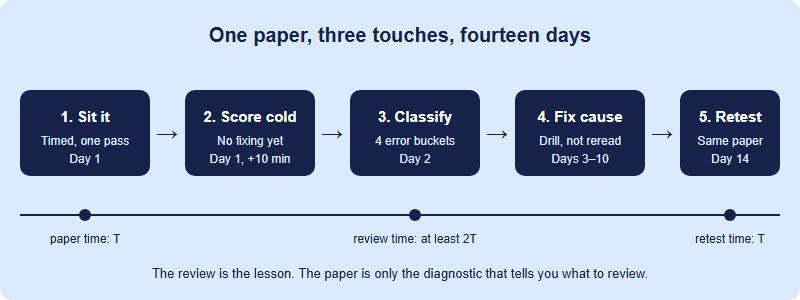
Touch 1 — the cold sit. Print the paper. Set a timer for the official length of your contest and stop dead when it rings. No dictionary, no phone, no calculator (that habit now matches the rules from September 2026 anyway), no getting up. If you finish early, do not leave — use the remaining minutes to re-derive answers you were unsure of, which is exactly what you should do on contest day.
Touch 2 — the cold review. Mark it yourself against the answer key, but do not read any solution yet. First, re-attempt every question you got wrong, untimed, with a clean sheet. This single step separates “I never knew how” from “I knew how but ran out of road” — and those two problems need completely different medicine.
Touch 3 — the retest. Fourteen days later, sit the same paper again under the same clock. Students resist this because it feels like cheating. It is not: if the fix worked, you should now score close to full marks and finish faster. If you do not, the fix did not take, and you have learned that cheaply.
The four error buckets — and what each one actually costs
Every lost mark goes into exactly one of four buckets. Do not allow a fifth category called “careless”, because “careless” is not a cause, it is a shrug. Force the classification.
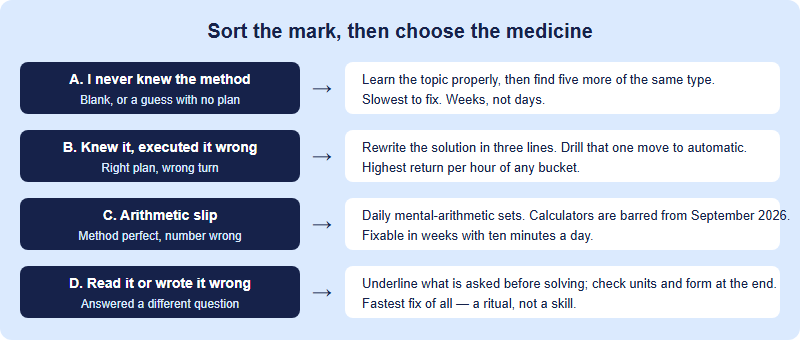
The reason to insist on this taxonomy is that students and parents systematically misdiagnose. A student who loses eight marks assumes the problem is “topics I haven’t learned” and buys another textbook. When the marks are actually sorted, a large share are usually buckets B, C and D — execution, arithmetic and reading — none of which a new textbook touches. Buckets C and D respond to habits within weeks; bucket A is the only one that genuinely needs new teaching time.
Keep the log in one table, one row per lost mark, on paper or in a spreadsheet. It should look like this:
| Paper & Q# | Topic | Bucket | The one sentence that fixes it | Retest result |
|---|---|---|---|---|
| Paper 3, Q7 | Ratio | B | Set the shared quantity to the LCM before comparing. | Correct, 40s |
| Paper 3, Q11 | Percentage | C | 17 × 12 is 204, not 214 — rehearse the 17 row. | Correct, 25s |
| Paper 3, Q14 | Geometry | D | It asked for perimeter, I gave area. | Correct, 55s |
| Paper 3, Q15 | Number theory | A | Never learned divisor counting. Schedule two sessions. | Still wrong |
Four columns of honesty beat forty pages of notes. Our step-by-step Math League study roadmap sets the weekly rhythm around this log; this article is the paper-by-paper protocol that fills it in.
Choosing which papers, and in what order
Two rules govern paper selection, and both are commonly broken.
Rule one: practise at your band, not above it. A grade-6 student sitting a high-school paper learns almost nothing, because nearly every lost mark lands in bucket A and the log stops being informative. Math League runs separate contests for grade 4, grade 5, grade 6, grade 7 and grade 8, an Algebra 1 contest, and a high-school series of six contests across the season; the format and difficulty are not interchangeable. Confirm which contest you are entering on mathleague.com before you build a paper list.
Rule two: spend your papers, don’t hoard them. Families often save “the good papers” for the final month. That is backwards. The value of a past contest is highest when there is still time to act on what it reveals. Front-load: sit a paper early, discover that bucket C is eating six marks, and you have three months to fix arithmetic. Discover it in the last fortnight and you have a fact, not a remedy.
A third, quieter rule governs how you store them. Keep every paper you have sat in one folder, in order, with its marked answer sheet and its error log stapled behind it. Families who keep practice in a scattering of photos and printouts lose the only thing that makes the second season easier than the first: the ability to look back and see that last October’s problem was arithmetic, not algebra. We keep organised practice sets with answer keys for the students we work with — worked solutions exist for some years rather than all of them, so treat “solutions available” as a bonus rather than an assumption.
| Weeks before the contest | Papers per fortnight | Emphasis | Retest? |
|---|---|---|---|
| 16–10 | 1 | Diagnosis. Expect a wide bucket spread; fix causes, not questions. | Yes, every paper |
| 9–5 | 1–2 | Topic repair for bucket A, daily mental arithmetic for bucket C. | Yes, if the paper had 3+ errors |
| 4–2 | 2 | Pacing. Full-length, same time of day as the real contest. | Only the worst paper |
| Final week | 0–1 short set | Rehearse the checking ritual. No new topics. | No |
Reading your scores honestly
A single score means very little; the shape of three consecutive scores means a lot. Use three self-set gates rather than guessing at official thresholds — Math League publishes its own award and qualifying criteria, and those are the ones that count.
- Gate 1 — stability. Three consecutive papers within a narrow range of each other. Volatile scores mean your result on the day is a coin toss, whatever the average says.
- Gate 2 — clock. You are finishing with a few minutes in hand and using them to check, rather than still writing when the timer goes.
- Gate 3 — no repeats. No error in this month’s log repeats an error from last month’s log. Repeats mean the fix was reading, not drilling.
Two comparability warnings. First, scores from different bands are not on the same scale — a mark on a grade 7 paper does not mean what the same mark meant on a grade 5 paper, so a “drop” in the first year of a new band is usually a change of ruler, not a change of student. Second, scores from practice sits taken at 9 p.m. after a full school day are not comparable with a contest sat mid-morning. If you want the practice number to predict the real number, sit at least the last two papers at roughly the same time of day as the contest itself.
One published figure is worth knowing as an external anchor: mathleague.com describes a score of 25 or higher on its grade 4, 5, 6, 7 or 8 contests as one route to qualifying for its International Summer Tournament (its International Summer Challenge is separately advertised as open to all who enter). Treat that as an example of how contest scores get used downstream, not as a target for every student — and confirm the current criteria, which can change, on mathleague.com.
Five ways students waste past papers
- Reading the solution before re-attempting. The moment you read a worked answer, you lose the ability to tell bucket A from bucket B for that question. Re-attempt first, always.
- Practising untimed forever. Untimed practice trains mathematics; timed practice trains contest performance. You need both, and only one of them is scheduled by default.
- Only doing the hard questions. The last question is worth exactly the same as the first. A student who skips the early questions in practice is rehearsing the wrong economy.
- Never retesting. Without the day-14 retest you never learn whether a “fix” was real. This is the single most skipped step in the entire protocol.
- Keeping calculator habits alive. With calculators barred from September 2026, any practice that leans on one is now measuring a student who will not be in the room on contest day.
Underneath all five is the same mistake: treating the paper as the work and the review as admin. It is the other way round. A student who sits eight papers and reviews none has done eight assessments and zero lessons. A student who sits four and reviews all four properly has done four lessons — each one aimed precisely at their own gaps, which is more targeted than any class can be. If your schedule is tight, cut the number of papers before you cut the review.
Frequently asked questions
How many past papers do I need before my first contest?
Fewer than you think, reviewed harder than you think. Six papers fully worked through the cycle beats twenty skimmed.
Should I use papers from other maths competitions instead?
Only as supplements. Format, phrasing and pacing differ between contests, and pacing is half of what you are training.
Is retesting the same paper really useful, since I remember the answers?
Yes. You are testing whether the corrected method now runs automatically and inside the clock, not whether you recall a number.
Where do I confirm my contest’s exact length and question count?
On mathleague.com. Formats differ by grade band and can change between seasons, so check before timing any practice sit.
This is an independent guide operated by Hanlin Education for China-based international-school students. We are not affiliated with, endorsed by, or sponsored by the official Math League (mathleague.com). Contest formats, dates, eligibility and awards are set by the organiser and can change — confirm current details on mathleague.com. Errors reported to us are corrected within 7 working days.