To solve a Math League ordering puzzle, do not write the full order from the first clue. Turn each before/after clue into a position constraint, treat an “immediately after” clue as a fixed two-item block, test the block’s placements, then ask what must be true. The method is a coaching technique for 2026-27 practice, not an official contest taxonomy.
The preparation context comes from Hanlin Courses, “Registration Opens for the Math League Preliminary: Bilingual Chinese-English Paper Adopted for the First Time,” 8 November 2026. That guide reports that scenario-based applied problems, logic reasoning, counting and basic number theory often appear, and that unfamiliar question styles and poor time allocation cause avoidable lost marks. It does not publish a formal ordering-puzzle taxonomy. The distinction between block placement and truth-value testing is a teaching judgment for 2026-27 practice.
What an ordering clue fixes
An ordering clue gives a relation between positions. It rarely fixes every position at once. “A is before B” means position(A) is less than position(B); it does not mean A is first, and it does not say how far apart they are. “C is immediately after D” means C occupies the next place after D, so the pair must be written as the block D-C, in that order. “D did not finish first” only removes first place; it does not mean D finished last.
- Contest registration
- Free past papers
- 1-on-1 trial lesson

| Clue | Translate to | Do not assume |
|---|---|---|
| A is before B | position(A) < position(B) | A is first, or A and B are adjacent |
| C is immediately after D | adjacent block D-C | The block is C-D |
| D did not finish first | position(D) is not 1 | D is last, or D must be second |
The table is deliberately literal because a common error is changing the clue while reading it. “Before” is flexible; “immediately after” is rigid. A block is not a loose pair. Once the wording is translated correctly, the remaining work is placement, not guessing.
The block-placement diagnostic
Use the same four moves on a four-slot or five-slot line. Do not try to produce a final order in the first ten seconds.
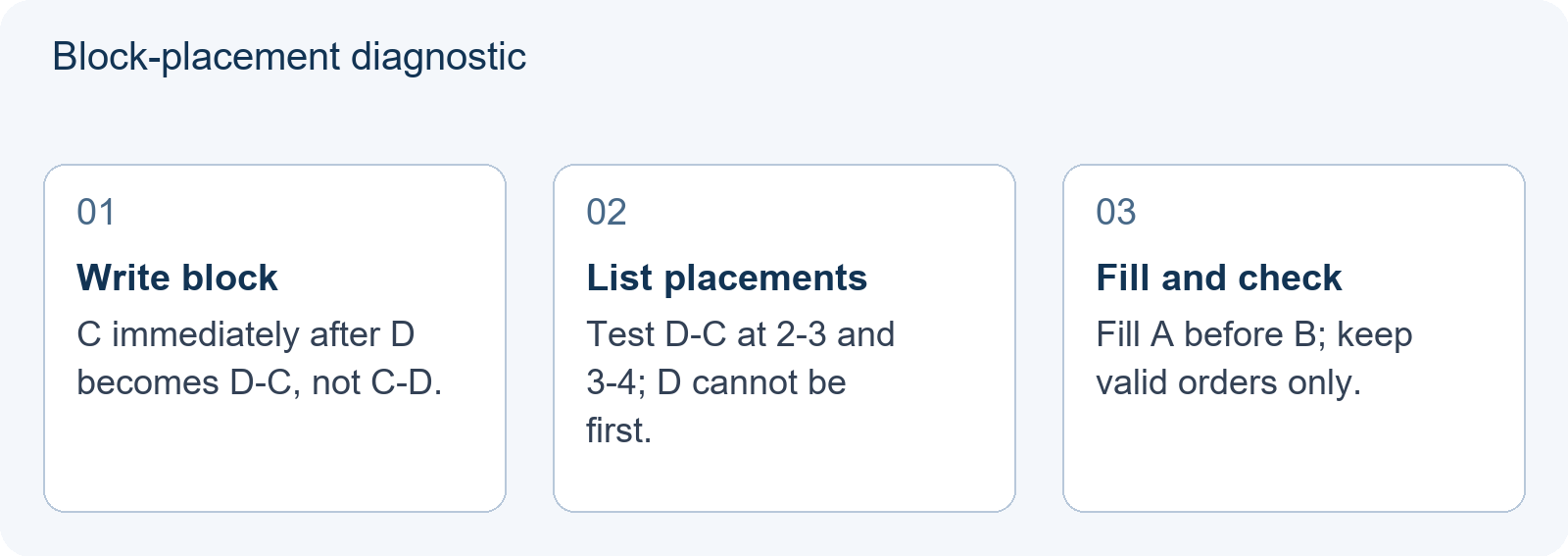
- Write the block. For “C immediately after D,” write D-C. Check the direction before doing anything else.
- List allowed block positions. In four slots, D-C can start at position 1, 2 or 3. Apply any extra clue, such as “D not first,” to remove illegal placements.
- Fill the remaining slots. Place the other named items into the empty positions, then apply every before/after clue.
- Keep only full candidates. A candidate must satisfy all clues at once. Do not keep a near miss because it satisfies the block clue.
For a four-slot line with D-C and “D not first,” the block can start only at position 2 or position 3. That immediately gives two placements to test: positions 2-3 and positions 3-4. This short list keeps the search visible: those are the only block placements left to test.
This diagnostic also exposes when a clue does no work. A clue that is satisfied in every candidate may feel important but should not drive the answer. The useful clues are the ones that remove placements or force an item into the same position across all remaining candidates.
Worked teaching illustration: four runners
Teaching illustration, not an actual contest problem. Four runners finish a race with no ties. A finished before B. C finished immediately after D. D did not finish first. Which runner must have finished first?
Start with the rigid clue: C immediately after D becomes the block D-C. Since D did not finish first, D-C cannot occupy positions 1-2. It can occupy positions 2-3 or positions 3-4. Now fill A and B into the remaining slots, keeping A before B.
| D-C placement | Remaining slots | Candidate order | Check |
|---|---|---|---|
| positions 2-3 | 1 and 4 | A-D-C-B | A before B; D not first |
| positions 3-4 | 1 and 2 | A-B-D-C | A before B; D not first |
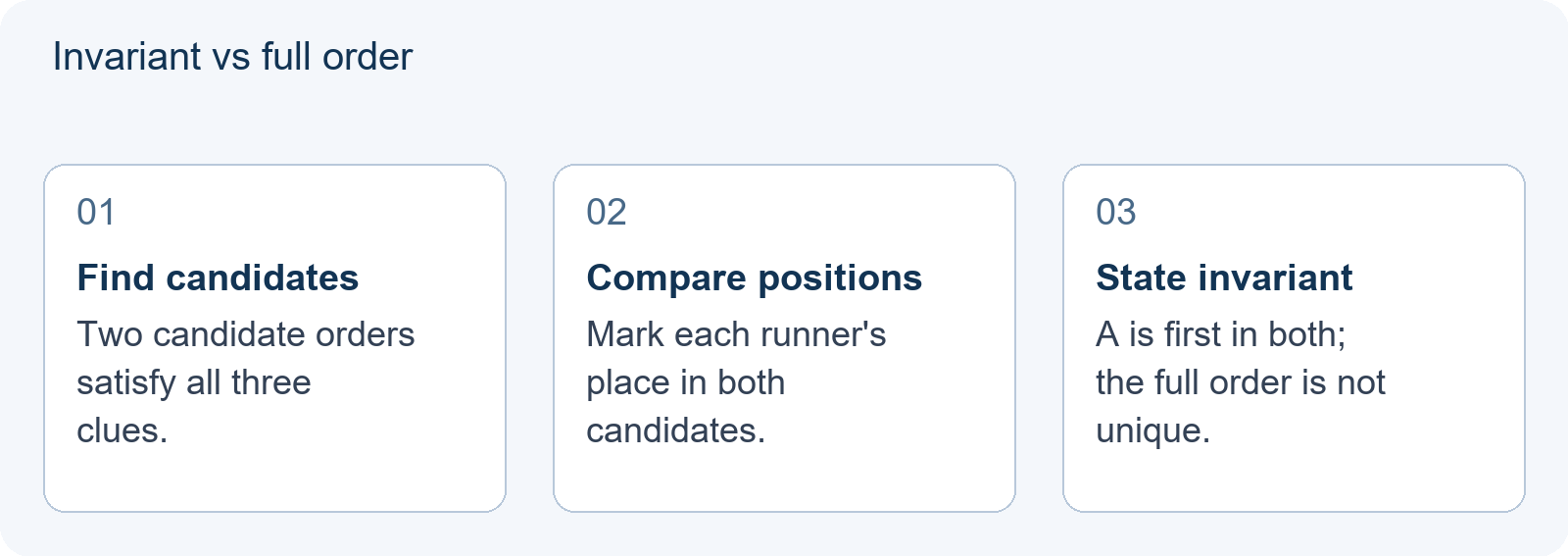
Both candidate orders satisfy every clue. The full order is not unique: A-D-C-B and A-B-D-C are both valid. The question asks which runner must have finished first, so compare the candidates. A is first in both. The answer is A. Do not write “the order is A-D-C-B” as though the puzzle had determined one complete order.
Why “must be true” is not “complete the order”
A valid candidate is a complete order that satisfies every clue. An invariant is a statement true in every valid candidate. The runner example has two valid candidates and one useful invariant: A is first. It is true that D is not first, but that was given. It is also true that C is after D, but that was given. The answer should be the forced conclusion the question asks for, not a repetition of a clue unless the options force that repetition.
On a timed paper, this distinction changes your final check. If the answer choices are complete orders, test each choice against all clues. If the answer choices are single names or positions, compare the candidate list and mark which item stays in the same place. If the question asks “which must be true,” a statement that happens to be true in one candidate but false in another is not an answer.
This check also prevents a common false confidence. A student may find one valid order, feel relief, and stop. The first valid order is evidence that the clues are consistent; it is not proof that the order is unique. The next candidate is what turns an example into a check.
Common errors in a timed paper
- Reversing the block. “C immediately after D” is D-C. Writing C-D changes the puzzle. If the block direction feels awkward, say the clue aloud in race order before writing.
- Turning “not first” into “last.” “D did not finish first” removes only position 1. In the runner example D can be second or third, depending on the candidate.
- Forcing a full order too early. A full order is a conclusion, not a first step. List block placements first, then fill the remaining slots.
- Checking only the new clue. A candidate must satisfy every clue, including the ones that seemed easy. The easy clue can remove the near miss.
The review question is not “did I get an order?” It is “did I translate each clue without changing it, and did I keep every candidate that satisfies all clues?” That question gives a concrete next step after a mistake; copying the correct order alone does not show which clue was mistranslated.
A five-item practice set for a 20-minute review
These five items are original teaching examples, not actual contest problems. Work each one by writing the block, listing placements, and stating whether the answer is a unique order or an invariant.
| Item | Clues | Answer to check |
|---|---|---|
| 1 | Three runners X, Y, Z. X is before Y. Z is immediately after X. What order is forced? | X-Z-Y only |
| 2 | Four cards L, M, N, O left to right. L is before M. N is immediately after O. O is not first. What must be true? | L must be first; two valid orders |
| 3 | Three students P, Q, R in a line. Q is before R. P is immediately after Q. What order is forced? | Q-P-R only |
| 4 | Four books E, F, G, H on a shelf. E is immediately after F. G is before H. F is not first. What must be true? | G must be first; two valid orders |
| 5 | Four objects W, X, Y, Z. W is immediately before X. Y is immediately before Z. W is before Y. What order is forced? | W-X-Y-Z only |
For each item, write the block in the correct direction, cross out illegal placements, and fill the remaining slots. If you find two candidates, compare them before answering. If you find one candidate, still check every clue once. Keep a three-line record: the block you wrote, the placements you tested, and the final invariant or unique order.
That record gives the next review a concrete object to inspect. It shows whether the mistake was direction, placement, or answer choice. Twenty minutes spent on five recorded items can produce more usable evidence than a larger set solved without notes, because the rejected candidates remain visible.
When to switch to a truth table
Ordering constraints and truth-value puzzles are different tools. In an ordering puzzle, the clues describe positions: before, after, adjacent, not first. In a one-liar puzzle, the clues are statements with truth values, and the task is to test which statement can be false. A position table does not naturally encode “exactly one statement is false.”
If the wording says that one student lied, one label is wrong, or exactly one statement is false, switch methods. The Math League Logic Reasoning: A Truth-Table Check for One-Liar Puzzles (2026-27) is the relevant technique, not another block-placement list. The two methods can appear in the same preparation session, but they should not be blended into one checklist.
Preparing a course-fit or resource request
A useful course-fit request names the paper level, the season and the exact skill you want reviewed. Bring one attempted ordering puzzle with your written block, your candidate list and the point where you hesitated. That gives a teacher something concrete to diagnose: clue translation, placement, or final answer choice. A general difficulty label does not show which step caused the hesitation.
After a timed set, use the guidance in Reading Your Math League Score Report: How to Use Knowledge Tags to Target Practice to separate an ordering-clue error from an arithmetic slip or a reading-speed problem. If an unfamiliar question style is the main issue, Stuck on a Math League Question? The Five Recovery Moves That Turn Unfamiliar Into Solvable (2026) is a practical next check. Neither step promises a score change; both make the next practice session more specific.
When comparing a practice resource, ask two concrete questions. Does it include prompts where several complete orders satisfy the clues? Does the answer key explain the forced relation rather than only print one order? Those questions fit the skill this article describes and help a family judge whether the resource actually practices invariant checking.
General event background is available at Event background.
This is an independent preparation guide, not affiliated with, endorsed by, or sponsored by Math League.
Frequently Asked Questions
Do ordering puzzles always have one complete answer?
No. Some clues force a single order, but others leave two or more valid orders. The question may ask what must be true; list candidates and compare positions before answering.
How is ‘immediately after’ different from ‘before’?
‘Immediately after’ fixes adjacency and order, so C immediately after D is the block D-C. ‘Before’ only says one position is earlier; the distance is unspecified.
If D did not finish first, does that mean D finished last?
No. It only removes first place. In the four-runner example D can be second or third, depending on which valid order you use.