For the 2026-27 Math League preparation cycle, the short answer to an exactly-one-liar logic puzzle is this: do not follow the story passively. Give each speaker a truth value, turn each sentence into a condition on those values, and keep only the assignments that satisfy the stated number of liars. The routine below is a practice method for the logic-reasoning question style described in Hanlin Courses’ 8 November 2026 course note; it is not an official contest rule or a substitute for the paper’s own wording.
Where logic reasoning fits the 2026-27 Math League picture
The Hanlin Courses note “Heavyweight | Registration opens for the American Math League preliminary round! First…” (published by the WeChat account Hanlin Courses on 8 November 2026) describes American-style Math League questions as situational application problems, logic reasoning, counting and basic number theory. The same note contrasts this with deliberately strange or extremely hard olympiad-style problems. That description is a coaching characterisation, not an official syllabus. It is enough to justify a short clinic: logic reasoning is one named question type, so a student should have a repeatable check rather than rely on narrative intuition.
The note also reports that the preliminary is 75 minutes and has a relatively large question volume, and it advises completing basic questions first and marking or skipping difficult ones. Those are details reported by the note, not a promise about any individual paper. The implication for logic puzzles is modest but useful: a three-speaker truth table should be compact enough to finish inside a normal question slot, and a puzzle that expands into many cases should be marked and revisited rather than allowed to consume the paper.
- Contest registration
- Free past papers
- 1-on-1 trial lesson

The truth-value table in four columns
For a short puzzle with speakers A, B and C, use four columns: speaker, assigned truth value, the sentence the speaker utters, and the condition that sentence imposes. If a speaker is truthful, the assigned value is true and the sentence must be true. If a speaker is lying, the assigned value is false and the sentence must be false. In classical two-valued puzzle logic there is no third “unhelpful” value. The table below is a template, not a contest problem.
| Speaker | Assigned value | Sentence | Condition to satisfy |
|---|---|---|---|
| A | T or F | “B is lying.” | value(A) = not value(B) |
| B | T or F | “C is lying.” | value(B) = not value(C) |
| C | T or F | “A is telling the truth.” | value(C) = value(A) |
Write “T” and “F” rather than “truth-teller” and “liar” in every cell; the abbreviations keep the table readable. The final column is the audit. If a row says A is true but A’s sentence is false, the row is dead. Do not repair it by changing the story. Change the assignment or reject it.
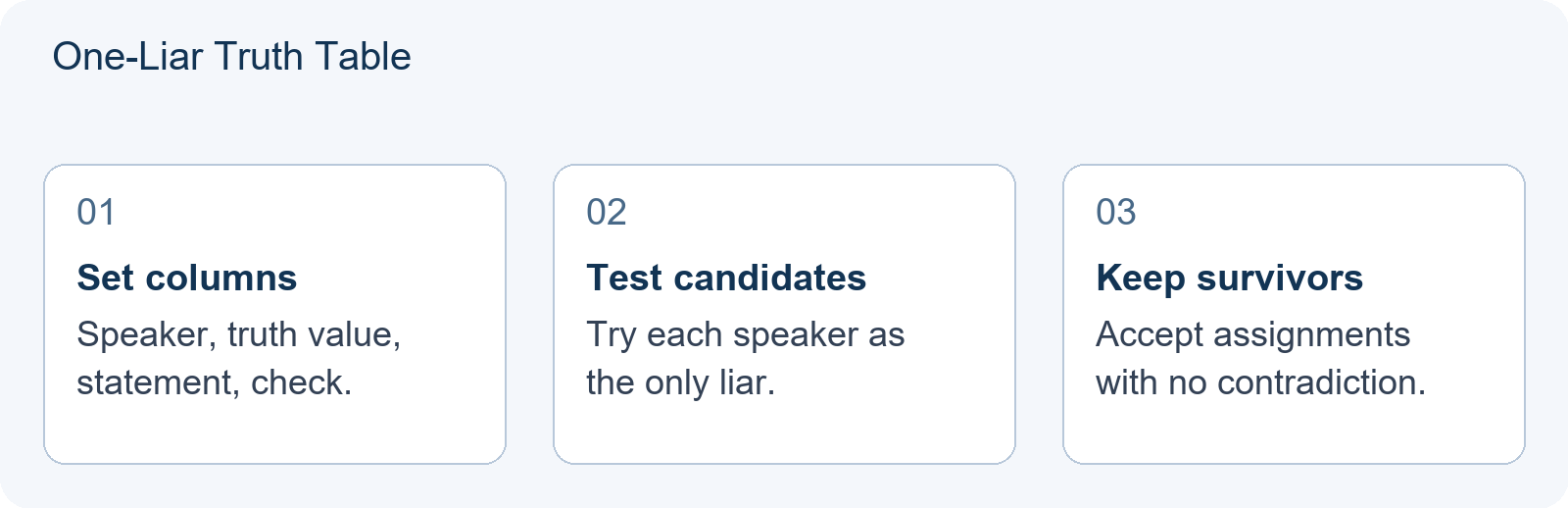
Teaching illustration: three speakers, exactly one liar
Teaching illustration (invented; not an actual contest problem and not official scoring guidance). Three speakers make one statement each:
- A says: “B is lying.”
- B says: “C is lying.”
- C says: “A is telling the truth.”
The premise is that exactly one of A, B and C is lying. We test each candidate liar. “Lying” means the speaker’s statement is false; “truthful” means it is true.
| Candidate liar | A | B | C | Check | Result |
|---|---|---|---|---|---|
| A | F | T | T | A’s sentence is false, which fits A lying; but B’s sentence is false while B is true, and C’s sentence is false while C is true. | Reject |
| B | T | F | T | A’s sentence is true; B’s sentence is false; C’s sentence is true. All three match their assigned values. | Keep |
| C | T | T | F | A’s sentence is false while A is true; C’s sentence is true while C is false. | Reject |
Only the second row survives. If B is the single liar, A is truthful and says B is lying—true. B is lying and says C is lying—false, because C is truthful. C is truthful and says A is telling the truth—true. The assignment is globally consistent. The other two candidate rows each create at least one contradiction, so they are rejected.
The mistake that breaks the table
One error that breaks the table is to assume the first sentence is true because it appears first. In the illustration, A’s sentence happens to be true in the surviving row, but that is a result, not a starting assumption. Another error is to treat a liar’s statement as merely “unhelpful” or “not proven.” In these puzzles, a liar’s statement must be false. A third error is to negate only part of a compound sentence. If a speaker says “B is lying and C is truthful,” the lie is the whole conjunction, not automatically “B is truthful and C is lying.” Write the sentence in the condition column before testing; this forces the whole statement to be negated when the speaker is false.
Keep the table small. One column per speaker is enough for three speakers. If the puzzle has four or five speakers, a full table may still be manageable, but write only the values needed to check the stated liar count. Do not add columns for impressions such as “sounds honest.” They are not truth values and cannot be audited.
When direct reasoning is enough
Direct reasoning is not forbidden. It is a compressed audit. In a two-speaker puzzle, if A says “B is lying” and the premise says exactly one is lying, then A truthful forces B liar; A liar forces B truthful. Both branches must still be checked against the remaining statements. The danger is stopping after the first branch. A useful compromise is to write the branch values in a two-row table, even if you do the reasoning mentally. This keeps the direct route honest without turning every question into a large grid.
For three speakers, use direct reasoning only when one sentence immediately fixes a value and the remaining sentences are simple negations. If a sentence contains “and,” “or,” “if,” or “unless,” write the condition first. The table is not a ritual; it is a visible audit trail. A student who can explain why each rejected row fails has learned more than a student who remembers the final letter.
A short sentence-audit checklist
Before accepting a row, ask four questions. Does every speaker have exactly one truth value? Does each assigned value match the truth value of that speaker’s whole sentence? Does the number of false values match the premise? Did you reject every row with at least one mismatch? If all four answers are yes, the row survives. If any answer is no, the row is dead. This checklist is deliberately mechanical; it is meant to be used under time pressure when the story is short but the possible assignments are easy to confuse.
At least one liar changes the answer set
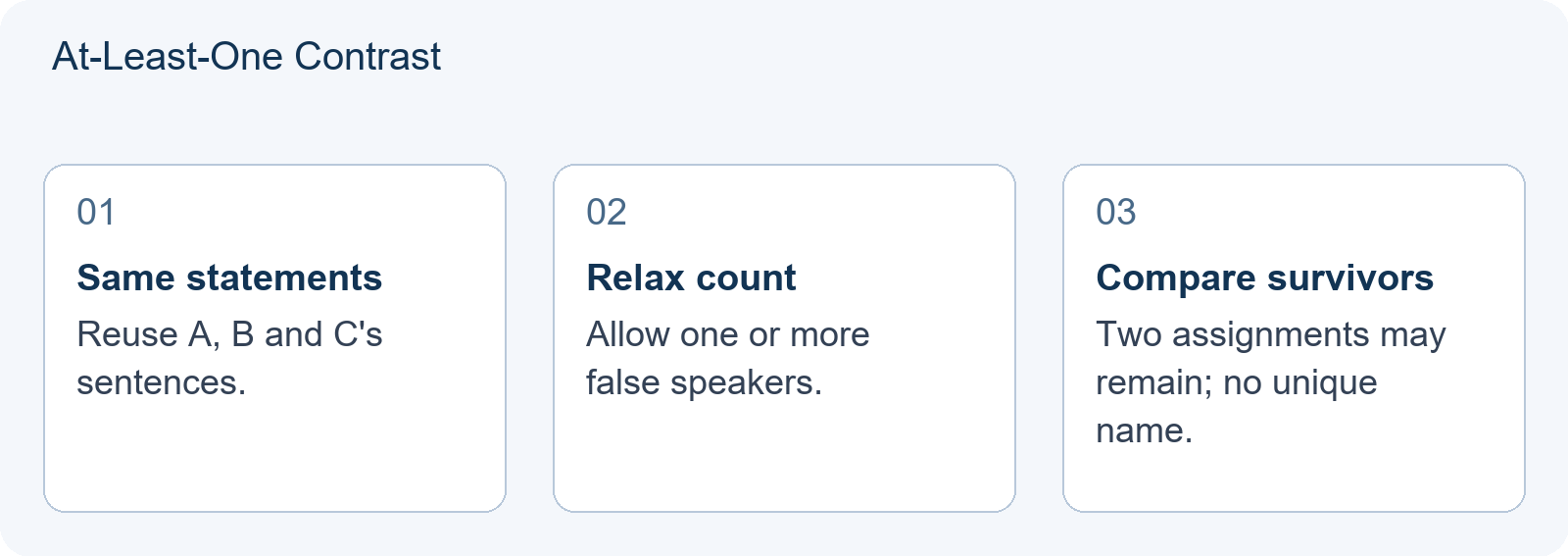
Use the same three sentences, but change the premise to “at least one of A, B and C is lying.” The same conditions still determine the consistent assignments; only the filter changes. The surviving assignment with B as the only liar remains valid, because it has at least one liar. A second assignment also survives: A false, B true, C false. Check it: A’s sentence “B is lying” is false because B is true; B’s sentence “C is lying” is true because C is false; C’s sentence “A is telling the truth” is false because A is false. This assignment has two liars, so it was rejected under “exactly one” but accepted under “at least one.”
| Consistent assignment | A | B | C | Liar count | Exactly one? | At least one? |
|---|---|---|---|---|---|---|
| B only | T | F | T | 1 | Keep | Keep |
| A and C | F | T | F | 2 | Reject | Keep |
The lesson is not that “at least one” is harder. It is that the answer set can grow. If a question asks “who is lying?” under an at-least-one premise, the wording may not determine a unique culprit. A student should state the surviving assignments rather than pick the first one. If the question expects one name, check whether the original wording said “exactly one” or supplied another condition. Do not silently strengthen the premise to make the answer unique.
A ten-minute diagnostic and exam-room compression
Here is a short diagnostic that a student can do without a timer. First, solve the exactly-one version above from scratch, using a table. Second, solve the at-least-one version using the same sentences. Compare the answer sets. If the second version produces the same single assignment, the student is probably not rechecking all candidates; if it produces two assignments, the student has seen the difference between a count filter and a uniqueness claim. This is a teaching exercise, not a score prediction.
In the exam room, compress rather than decorate. For three speakers, the full table can be the clearest audit because it prevents a half-followed story from being mistaken for a proof. A middle-speaker shortcut is reasonable only when one statement immediately fixes another value; otherwise the shortcut can hide a contradiction in the third sentence. The Hanlin note’s advice to finish basic questions first and mark difficult ones applies directly: if a logic puzzle’s case count grows beyond the table you can audit, mark it and return after the straightforward items. This is a coaching judgment about pacing, not an official rule.
For adjacent quantitative work, the set-up habits in Math League Word Problems: The Five Archetypes and the Three-Line Set-Up (Rate, Work, Mixture, Percent, Ratio) are a better match than forcing every word problem into a truth table. When the question is genuinely about counting arrangements or outcomes, see Counting and Probability on Math League: The Four Questions That Decide Every Problem (2026). If a puzzle stalls, the recovery moves in Stuck on a Math League Question? The Five Recovery Moves That Turn Unfamiliar Into Solvable (2026) are a general fallback; they do not replace the consistency check above.
What to bring to a preparation conversation
If you are comparing preparation options, make the conversation specific rather than asking for a generic “logic course.” Bring the exact wording of one puzzle you attempted, your truth-value table, and the row where the contradiction appeared. Ask whether the practice material separates exactly-one-liar items from at-least-one-liar items, and whether any supplied solutions show the full consistency check rather than only the final name. If a resource pack is offered, ask exactly which years it covers and whether worked solutions are included; do not assume that a “past paper” label means every year or every solution. These are reasonable questions for any provider, not a checklist that is already a Hanlin service.
Finally, keep the claim small. A truth table can show that an assignment is consistent with the stated premises. It cannot show that the assignment is an official answer key, that the question is well written, or that a particular score will follow. If the wording is ambiguous, the honest next step is to ask for the original text or a clarified version, not to invent a premise that makes the puzzle neat.
General event background is available at Event background.
This is an independent preparation guide, not affiliated with, endorsed by, or sponsored by Math League.
Frequently Asked Questions
When should I use a truth table instead of direct reasoning?
Use a truth table when a short puzzle gives two or three speakers and an exact liar count, because the table shows every candidate without relying on the order of the sentences. Direct reasoning is fine when one statement immediately fixes another speaker’s value, but still check every branch against the remaining sentences. The table is a visible audit, not a rule that every logic question must become a large grid.
How does “at least one liar” differ from “exactly one liar”?
“Exactly one” rejects any assignment with two or more false speakers. “At least one” accepts those assignments as long as the statements remain consistent. In the teaching illustration, the exactly-one filter leaves B as the only liar, while the at-least-one filter also leaves the assignment in which A and C are both lying. If a question still expects one name, its wording needs another condition.
Why is a consistent assignment not the same as an official answer key?
A consistent assignment shows only that a set of truth values satisfies the stated premises under the puzzle’s logic. It does not prove that the question wording is complete, that the intended answer matches, or that any score will follow. If the wording is ambiguous, ask for the original text or clarification rather than adding a premise that makes the puzzle unique.