Most students who lose marks on Math League word problems can do the algebra perfectly. What they cannot do quickly enough is turn an English paragraph into an equation. This guide covers the phrase-to-equation mapping, the three-line set-up that prevents the most expensive error on the paper, and the five archetypes — rate, work, mixture, percent and ratio — that cover most of what students meet in practice.
The bottleneck is translation, not algebra
Consider what a word problem actually demands in sequence: read English, identify the quantities, decide which one to call x, express every other quantity in terms of x, form an equation, solve it, and then answer the question that was asked. Only steps five and six are algebra. Everything before them is modelling, and everything after them is reading comprehension again.
For a China-based student working in English, there is an additional load that is easy to underestimate and easy to fix. It is not vocabulary in the dictionary sense — most students know what average and remainder mean. It is the speed of converting a compound phrase such as five less than three times a number into 3n − 5 without pausing. Under a 30-minute limit, a two-second pause on each phrase is the difference between finishing and not.
- Contest registration
- Free past papers
- 1-on-1 trial lesson

The good news is that this converts to marks faster than almost any other kind of practice, because the phrase set is small and closed. There are perhaps forty constructions that appear repeatedly, and they can be drilled to automatic in a couple of weeks.
The phrase-to-equation table
The traps in this table are not exotic. They are the ordinary reversals that a tired student makes in minute twenty-five of a timed paper.
| English phrase | Algebra | What goes wrong |
|---|---|---|
| five less than a number | n − 5 | Written as 5 − n. The order reverses; less than subtracts from the thing named after it |
| five is less than a number | 5 < n | Read as subtraction rather than an inequality; the word is changes everything |
| the quotient of a and b | a ÷ b | Inverted to b ÷ a |
| three consecutive even integers | n, n + 2, n + 4 | Written n, n + 1, n + 2, quietly dropping the word even |
| twice the sum of a number and four | 2(n + 4) | Written 2n + 4 — the bracket is lost, and with it the whole answer |
| a number is increased by 20 percent | 1.2n | Written n + 20, treating a percentage as an amount |
| the ratio of boys to girls is 3 to 5 | boys = 3k, girls = 5k | Treated as 3 boys and 5 girls, losing every other valid case |
| the average of three numbers is 12 | a + b + c = 36 | Left as an average, when the usable form is always the total |
| the number is 7 more than half of another | n = m∕2 + 7 | Bracketing error: (m + 7)∕2 is a different statement |
One structural note about the average row: on contest problems, an average is almost never useful in its stated form. Converting it immediately into a total — three numbers averaging 12 means they sum to 36 — turns an abstract statement into an equation you can actually use. Train the conversion as a reflex.
The three-line set-up
Before any solving, write three physical lines on your paper. This takes about fifteen seconds and it prevents the most expensive class of error on the paper: solving correctly and then submitting the wrong quantity.
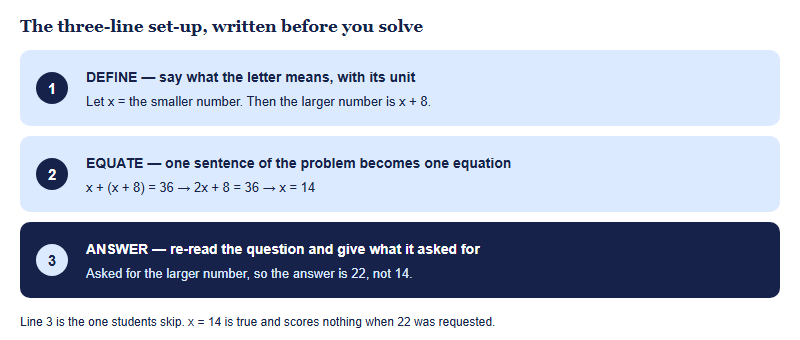
Line 1 deserves one extra remark: define the variable as the quantity that makes the other quantities easiest to write, not necessarily the quantity the question asks for. In the example above, calling x the smaller number makes the larger one x + 8; calling x the larger number would work too, but choosing the version that avoids subtraction usually produces cleaner arithmetic — which matters more now that Math League states on mathleague.com that from September 2026 calculators are no longer permitted on any of its contests.
The five archetypes
Most quantitative word problems fall into one of five families. Recognising the family tells you the relationship to write down before you have finished reading.
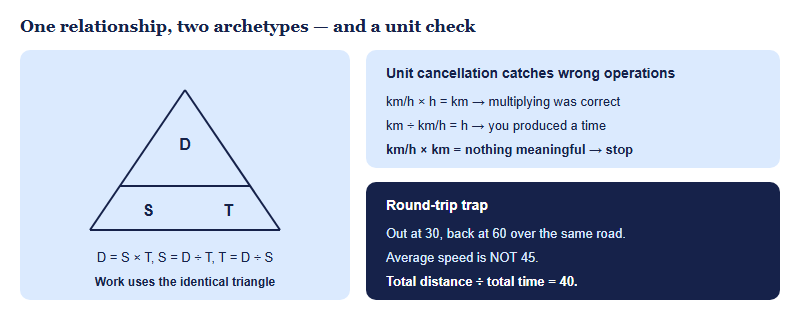
- Rate and distance. The relationship is always distance = speed × time. The classic trap is the round trip: a journey out at 30 and back at 60 does not average 45, because the two legs take different times. Compute total distance divided by total time, always.
- Work. Same structure, different words: work done = rate × time. If a pipe fills a tank in 6 hours, its rate is 1/6 of a tank per hour, and two pipes together have rate 1/6 + 1/10. Convert every “takes n hours” into “does 1/n per hour” on sight.
- Mixture and concentration. Track the pure substance, never the solution. In 40 litres of 25 percent acid there are 10 litres of acid; when you add water, the 10 stays fixed and only the total changes. Writing the fixed quantity first solves most of these instantly.
- Percent change. Increases and decreases multiply, they do not add. Up 20 percent then down 20 percent gives 1.2 × 0.8 = 0.96, a net loss of 4 percent. Percentage questions also require care about the base: a percentage of what is the whole question.
- Ratio, age and shares. Introduce the multiplier k immediately: a ratio of 3 to 5 means 3k and 5k. For age problems, build a small two-column table of now and then rather than trying to hold both in your head; ages change by the same amount for everybody.
Two checks that cost ten seconds each
Both of these are worth building into the routine because they catch different errors, and neither requires redoing the problem.
- The unit check. Attach units to every number and confirm the units of your answer match the units of the question. If the question wants hours and your working produced kilometres, you multiplied where you should have divided. This check is more powerful than it sounds because it catches operation errors, not just arithmetic errors.
- The plausibility check. Ask whether the number is the right size. A boy cannot be 140 years old; a mixture cannot be 130 percent acid; a discounted price cannot exceed the original. An implausible answer is a warning to go back rather than something to move past, and on the high school contests there is no answer list to reassure you: Math League’s high school rules require answers to be written into the answer column.
Both checks matter more from September 2026 onwards. Without a calculator, students naturally look for shortcuts, and shortcuts are where reversals enter. On papers marked strictly against a solution key, a fast wrong answer scores the same as a blank.
How to train this in two weeks
Word-problem skill improves through short, high-frequency repetition rather than long sessions, because the target is reflex speed. For how a two-week block fits into a full season, see the study roadmap; for where you should be entering in the first place, see the grade-band guide.
- Days 1-4 — translation only. Take twenty short phrases a day from the table above and write the algebra. No solving. Aim for under three seconds each.
- Days 5-8 — set-up only. Take full word problems and write only the three lines: define, equate, and a statement of what is being asked. Stop before solving. This isolates modelling from arithmetic and makes it obvious which one is actually weak.
- Days 9-11 — one archetype per day. Rate, then work and mixture, then percent and ratio. Six to eight problems each, fully solved, with units written throughout.
- Days 12-14 — timed mixed sets. Contest conditions, no calculator. Log every error as translation, algebra, or answered the wrong question. The third category is usually larger than students expect, and it is the fastest to eliminate.
Math League has run contests since 1977 and covers grades 4 to 12, and word problems appear across that whole range — as one-step situations in the elementary grades and as multi-stage set-ups in the high school series, where each contest carries six questions in 30 minutes and the last two are described as generally harder than the first four. The modelling habit built at grade 6 is the same habit that carries a grade 11 student through the back end of a paper. For a fuller picture of the contests themselves, start with our overview of Math League.
Frequently asked questions
Why do I get word problems wrong when my algebra is strong?
Usually translation or the final step. Either the equation did not match the sentence, or you submitted an intermediate value instead of what was asked.
What should I call x when several quantities are unknown?
Choose the quantity that lets you write the others most simply, then express everything else in terms of it before forming any equation.
Is the average speed of a round trip just the average of the two speeds?
No. Use total distance divided by total time, because the slower leg takes longer and therefore carries more weight.
Are calculators allowed for the arithmetic in word problems?
No. Math League states on mathleague.com that from September 2026 calculators are not permitted on any of its contests. Confirm current rules there.
This is an independent guide operated by Hanlin Education for China-based international-school students. We are not affiliated with, endorsed by, or sponsored by the official Math League (mathleague.com). Contest dates, eligibility, formats and rules change — always confirm current details on mathleague.com before entering. Any factual error reported to our editorial desk is corrected within 7 working days.