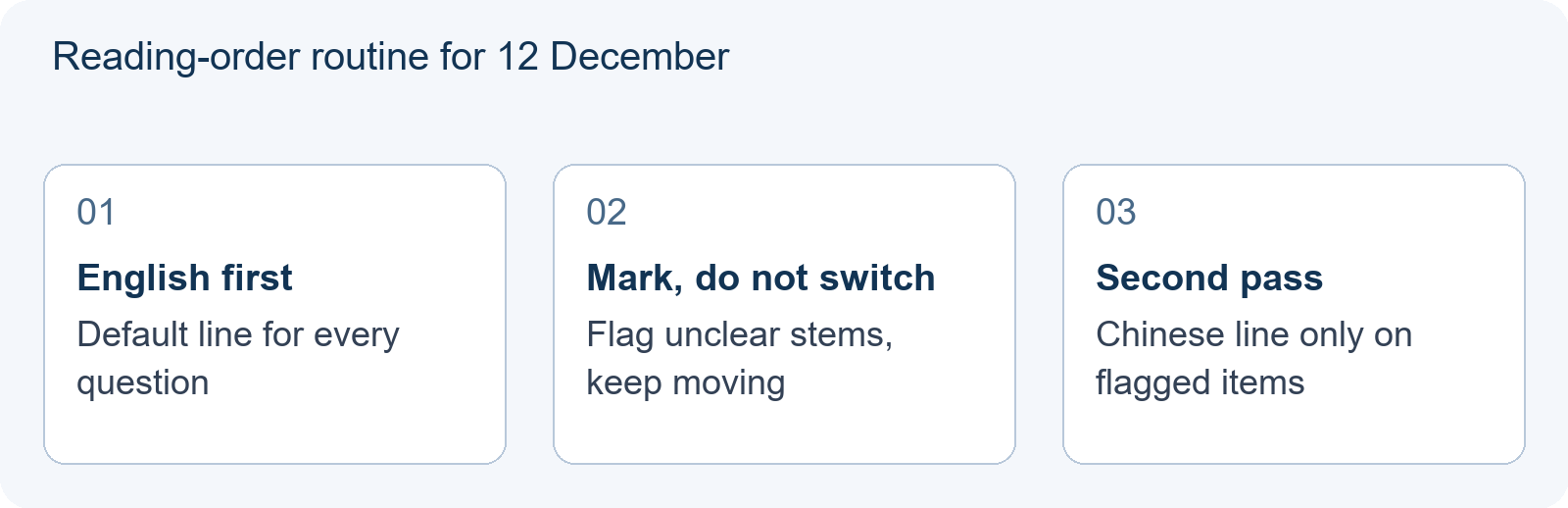
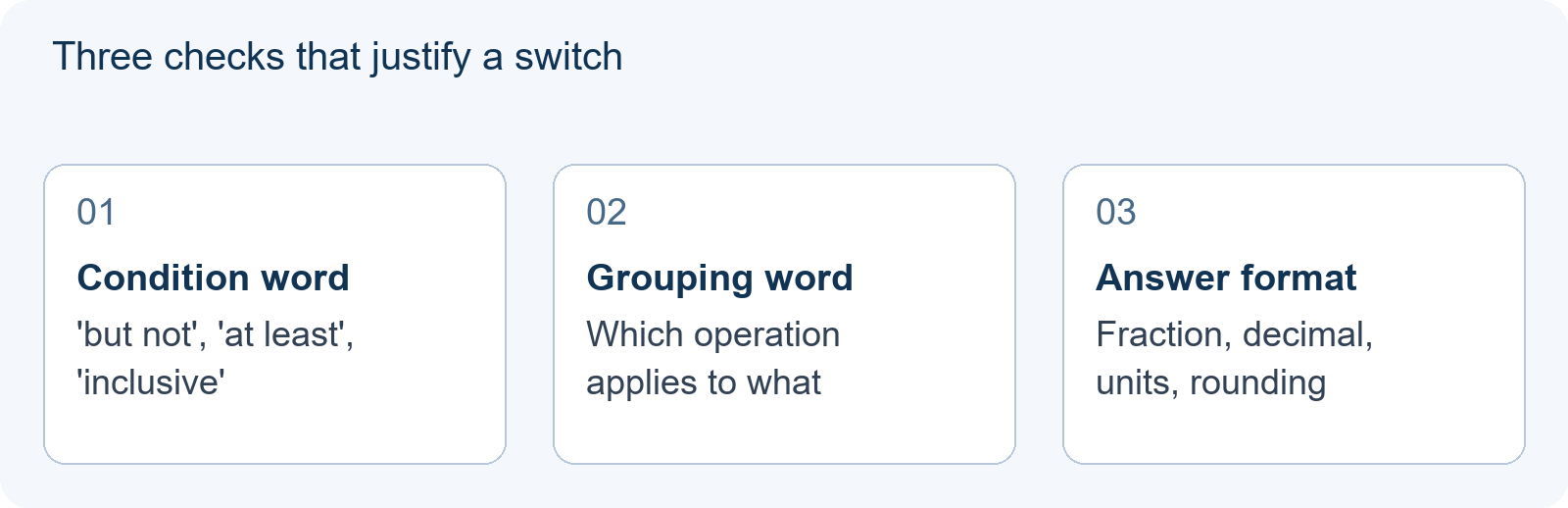
Answer first: for the Math League bilingual paper used in the 12 December 2026 preliminary, the Chinese-English format is a reading-time tool, not an instruction to read every question twice. Choose one default before exam day — read the English line first — and switch to the Chinese line only when one of three checks fails: a condition word, a grouping word, or an answer-format instruction. Two dates frame the decision. The Hanlin Course WeChat note published on 8 November 2026 states that registration for this preliminary closes on 30 November 2026, and that the paper has been changed to a bilingual Chinese-English version from this year. Everything below is a preparation perspective on how to use that bilingual paper; confirm the paper’s exact details with the organiser or your registered centre.
What the 2026 preliminary actually provides
Because the format change is recent, it is worth separating what the note states from what readers often assume. The source is the Hanlin Course WeChat note published on 8 November 2026, whose translated title is “Breaking: US Math League Preliminary Registration Opens! First Bilingual Chinese-English Paper.” The table below keeps those two columns apart on purpose.
| Item | What the 8 November 2026 note states | What it changes for reading order |
|---|---|---|
| Date and registration | Exam on 12 December 2026 (Saturday); registration deadline 30 November 2026 (Monday) | There is a fixed date to rehearse a single, repeatable routine against |
| Paper language | From this year the preliminary paper has been changed to a bilingual Chinese-English version, with a Chinese translation supplied | A second line exists for every question, but using it is a choice, not a requirement |
| Duration and volume | 75 minutes, with a relatively large question volume | Reading time is a scored resource; the note does not give a question count, so do not assume one |
| Entry | Grades 1-12 may enter | Reading maturity varies widely, so the rule must be age-appropriate |
| Diagnosed loss causes | Unfamiliar question style, slow English reading and poor time allocation | All three point at reading rhythm rather than at mathematics alone |
| Translation and vocabulary | The translation can act as a backstop, but frequently checking it consumes answering time; high-frequency maths vocabulary improves speed | Switching should be targeted, and vocabulary work is the direct fix for familiar-word gaps |
One scope note: the note describes a large question volume but does not publish an item count, does not describe a per-question time allowance, and does not say whether bilingual versions of earlier papers have been released. This article adds none of those figures.
- Contest registration
- Free past papers
- 1-on-1 trial lesson

Why the default should be the English line
The note’s own list of why students lose marks — unfamiliar style, slow English reading, poor time allocation — is a list about rhythm, not about comprehension alone. A student who reads the English line, then the Chinese line, then returns to the English line to check the answer form has read the same stem three times inside a 75-minute paper. That pattern is costly on a timed paper, and it matches the note’s warning that frequent checking consumes answering time.
An English-first default has three practical advantages. First, it produces one consistent pass, so the student’s pace stays even across the paper rather than collapsing on the questions that happen to look unfamiliar. Second, it keeps English reading practice inside the timed paper, which is the competence the note says separates comfortable entrants from slow ones. Third, when the Chinese line is eventually used, it is used on one flagged stem rather than on the whole paper, so the cost is bounded.
A coaching caveat: for the youngest entrants in the grades 1-12 range, the default should be agreed with whoever reads the paper alongside the child. The rule below assumes a student who can already read a short English stem unaided.
The three-check switch rule
Rather than deciding question by question in the moment, pre-commit to three triggers. If none of them fires, the Chinese line does not get read. If one fires, the Chinese line gets read once, a decision is recorded, and the student moves on without a second English pass.
| Check | What fires it | Action |
|---|---|---|
| Condition word | Words such as but not, at least, inclusive, except, integer | Read the Chinese line once to confirm the condition, write the condition in symbols, continue |
| Grouping word | A phrase where it is unclear which operation applies to which quantity | Read the Chinese line once to fix the bracket structure, then compute from the symbols |
| Answer format | An instruction about fractions, decimals, rounding, units or simplified form | Confirm the required form, then check it again at the end against the paper’s wording |
Two habits make the rule work. Mark the question number with a single symbol when a check fires, so a second pass can be planned rather than improvised. And write the resolved condition or bracket on the scratch paper immediately, because the point of reading the Chinese line is to leave the question with a clearer symbolic statement than the one you arrived with.
Worked teaching illustration: grouping and conditions
The two cases below are teaching illustrations written for this article. They are not reproduced contest questions and not official examples.
Case 1 — which operation owns the quantity
Let the number be x. Consider the English sentence: “The sum of 3 and a number is divided by 4.” Written in symbols this is (3 + x) divided by 4. Now consider a sentence a student might skim into the same meaning: “Three plus a number divided by 4.” In symbols that is 3 + x divided by 4, which is a different expression. With x = 5, the first gives (3 + 5) divided by 4 = 2, and the second gives 3 + 5 divided by 4 = 4.25. The two readings are not close enough to be rescued by an approximate answer.
This is precisely the situation the grouping check is for. The English line carries the grouping in its grammar, and a fast reader can lose it. A translated Chinese line such as “the sum of 3 and a number, then divided by 4” fixes the bracket structure in one pass. The correct move is to read that line once, write (3 + x) divided by 4 on the scratch paper, and compute from the symbols — not to re-read the English and re-decide.
Case 2 — a condition word that changes the count
Consider: “How many integers from 1 to 100 inclusive are divisible by 3 but not by 5?” Multiples of 3 up to 100: 3, 6, …, 99, which is 33 numbers. Multiples of 15 up to 100: 15, 30, 45, 60, 75, 90, which is 6 numbers. The answer is 33 – 6 = 27. Check by construction: the multiples of 3 removed are exactly those divisible by both 3 and 5, so the subtraction is correct.
Now suppose a fast reader takes but not as an aside and counts “divisible by 3 or by 5”. That count is 33 + 20 – 6 = 47, using 20 multiples of 5 up to 100. The gap between 27 and 47 is entirely a condition-word error, not a computation error. A translated Chinese line that says “divisible by 3 but not by 5” pins the exclusion, and the student can leave with the two counts written down.
When the Chinese line adds nothing
Just as important as knowing when to switch is knowing when not to. Let the number be x. Consider: “A number is increased by 8, and the result is tripled, giving 45.” In symbols, 3(x + 8) = 45, so x + 8 = 15 and x = 7. Check: 7 + 8 = 15, and 15 × 3 = 45. For a stem whose English already fixes the order, a translated line that merely restates that order adds no new decision; reading it changes nothing except the clock.
The same applies to routine computation items, to items whose vocabulary is already familiar, and to items where the student’s only difficulty was arithmetic. The note names prime, factor, perimeter and probability as examples of high-frequency vocabulary worth drilling, and that is the direct investment for this category: a student who recognises the word does not need the second line at all. Reserve the switch for the three checks, and treat every unnecessary switch as a small, avoidable withdrawal from the timing budget.
A 20-minute home diagnostic
This is a suggested practice routine, not a published test and not a predicted score. Its purpose is to discover which checks actually fire for a particular student, rather than to assume.
- Prepare three short stems. Ask a teacher to write three bilingual stems in the style of the student’s grade: one with a condition word, one with ambiguous-looking grouping, one routine item with familiar vocabulary. Teacher-written stems matter because released bilingual papers cannot be assumed.
- Time each stem separately. Record the time to a written symbolic statement, not the time to a final answer. Reading cost is what is being measured.
- Record what the second line changed. After each stem, write one of four words: operation, condition, format, or nothing. Only the first three justify a switch in future.
- Build a personal switch list. Collect the words that produced a change. Repeat the diagnostic three days later with fresh stems and see whether the list is stable.
If the second line repeatedly changes nothing, the student’s default should stay English-only. If it repeatedly changes the condition, the issue is vocabulary and phrasing rather than reading order, and the note’s vocabulary advice applies directly.
Exam-room routine for 12 December 2026
Translate the diagnostic into a single pass structure. On the first pass, read the English line, run the three checks, mark the number if a check fires, answer what is straightforward, and skip anything that resists — the note advises completing the basic items first and marking hard ones to skip so that everything solvable is scored. On the second pass, read the Chinese line only for the marked numbers, write the resolved condition or bracket in symbols, and finish the item. Before finalizing answers, run a format check across the answers.
The format check deserves its own minute because answer-format instructions are easy to misread in either language. If the paper asks for a fraction in simplest form, confirm your written answer is in that form; if it asks for a decimal to a stated place, confirm the rounding. The Math League Answer-List Photo Checklist Before the Online Preliminary Submit (2026-27) is a useful final screen, and the Math League Online Practice: Rehearse Answer Entry and the Final Submission Check covers answer entry and the final submission check for readers using that practice route, so reading time on the day goes to mathematics.
Questions to ask before choosing practice material
Families comparing practice options should ask narrow questions rather than broad ones, because a general “preparation course” answer will not tell you whether the bilingual-reading problem is being addressed at all.
- Are the bilingual practice stems teacher-written, or reproduced from released papers? The answer determines whether the material can be shared and whether it matches this year’s format.
- Is there a timed diagnostic that measures time to a symbolic statement, rather than time to a final answer?
- Does the practice material match the student’s grade band and the question style described in the note, or is it general competition arithmetic?
- Is answer-format rehearsal included, so the student is not interpreting instructions during the exam?
For background on choosing practice material by grade, see Math League Past Papers: How to Choose Practice Material That Matches Your Grade’s Problem Style (2026-27). Neither page replaces asking whether the bilingual element is actually covered.
General event background is available at Event background.
This is an independent preparation guide, not affiliated with, endorsed by, or sponsored by Math League.
Frequently Asked Questions
Does a bilingual paper make the 2026 Math League preliminary easier?
The note presents both a support and a time risk. It says the Chinese translation supports students new to international competitions, but it also says that frequently checking the translation consumes answering time, and it names slow English reading and poor time allocation among the common causes of lost marks. A student who reads both lines on every question in a 75-minute paper with a large question volume can end up slower than one who reads only English. A fixed reading order controls that risk.
My child’s English is weak. Should the Chinese line be the default instead?
A practical general default is still English-first, because it preserves one consistent pass and keeps the Chinese line as a bounded rescue tool rather than a second full reading. A Chinese-first personal exception is justified only if a timed comparison on teacher-written stems shows it is faster and at least as accurate. Run the 20-minute diagnostic in both modes on separate days: once reading English first and switching on the three checks, once reading Chinese first and switching to English only for answer-format instructions. If Chinese-first wins for that student, use it as an individual exception — but keep the format check, because answer instructions still need to be read carefully. The note’s warning is about uncontrolled back-and-forth checking, not about a deliberate, tested reading order.
Can we practise on released bilingual past papers for this preliminary?
No verified statement supports that. The 8 November 2026 note does not say whether bilingual versions of earlier papers exist or how they would be released. Treat bilingual past papers as unconfirmed and plan around teacher-written bilingual stems instead. If you ask a provider for material, ask directly whether the bilingual stems are teacher-written or reproduced, and use the past-paper selection guidance on this site to judge whether the underlying question style matches your child’s grade.