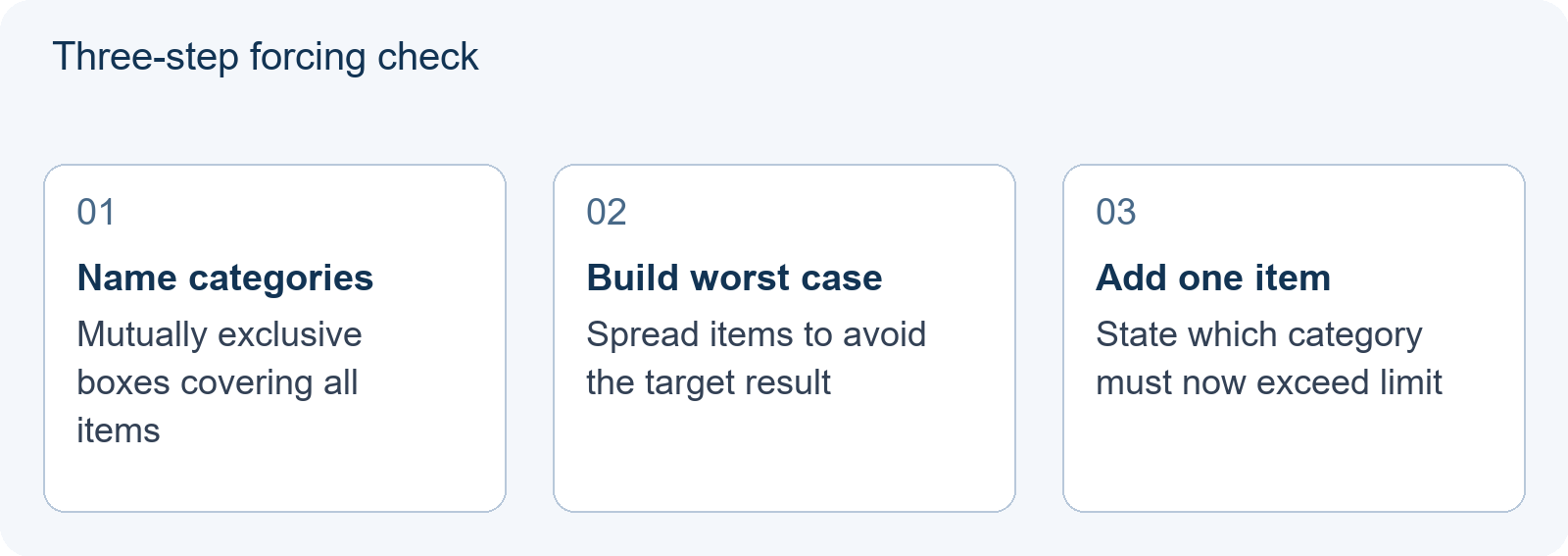
Short answer: In a Math League pigeonhole principle question, a guarantee prompt asks for the smallest number of items that makes a conclusion unavoidable. Identify the categories, build the worst case that avoids the conclusion for as long as possible, then add one item. The result is a forced conclusion, not a probability and not an ordinary “how many ways” count. Under the usual condition that every category can hold one fewer than the target, k categories and target r give the threshold k(r−1)+1.
This preparation-perspective guide is for Grades 6–12 in the 2026–27 cycle. The worked examples below are hypothetical teaching illustrations, not reproduced Math League contest problems and not scoring guidance.
What a guarantee question is actually asking
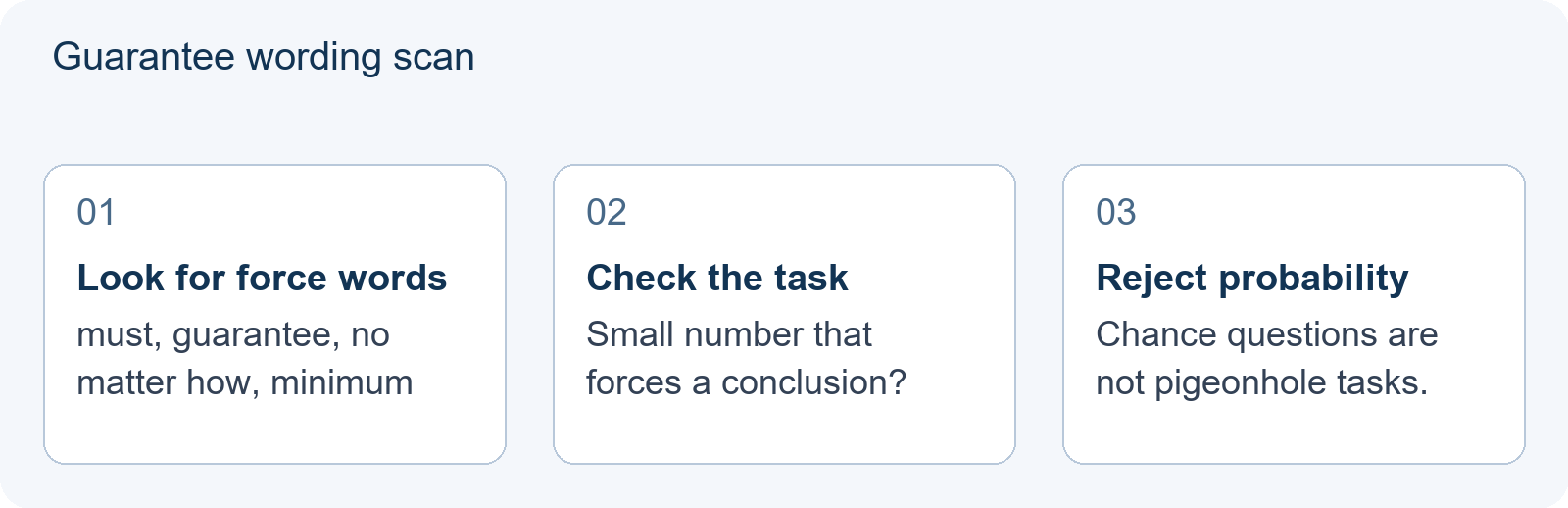
A guarantee question uses force language: “must,” “guarantee,” “no matter how,” “smallest number to be sure,” or “at least how many are needed to ensure.” The task is to find a threshold. Below that threshold, some arrangement can still avoid the conclusion. At the threshold, every possible arrangement forces it.
- Contest registration
- Free past papers
- 1-on-1 trial lesson

That is different from counting arrangements. A “how many ways” question asks you to count configurations. A probability question asks how likely an outcome is. A pigeonhole question asks what must happen. The word “at least” can appear in all three contexts, so read the whole sentence before choosing a method.
| Prompt signal | What is being asked | First move |
|---|---|---|
| “must,” “guarantee,” “no matter how,” “smallest number to be sure” | A forced conclusion | Name categories, then build the worst case |
| “how many ways,” “arrangements,” “choose” | A count of configurations | Choose the counting model |
| “probability,” “chance,” “likely” | A likelihood | Set up a probability model, not pigeonhole |
For the separate “how many ways or what probability model” decision, see Counting and Probability on Math League: The Four Questions That Decide Every Problem (2026). The present article focuses only on the guarantee frame.
The three-step worst-case check
Step 1: Name the categories. Categories must be mutually exclusive and must cover every item. In a sock drawer, the categories are colours. In a birth-month question, the categories are the twelve months. In a token question, the categories are the token colours.
Step 2: Build the worst case. The worst case is the arrangement that avoids the target conclusion as long as possible. Usually this means spreading items as evenly as possible, or more generally filling each category to one fewer than the target, up to that category’s capacity. If a category has fewer than one fewer than the target available, cap it at its actual capacity.
Step 3: Add one item and write the forcing sentence. State which category must now exceed the limit. A useful sentence has the form: “If no category reached r, at most [number] items could be placed; the next item forces some category to reach r.”
For k categories and target r, the maximum number that can avoid r in every category is k(r−1), provided each category has at least r−1 available. Therefore k(r−1)+1 forces r in some category. This formula is a compact check, not a substitute for the forcing sentence.
Teaching illustration 1: the sock drawer
Hypothetical teaching illustration, not a Math League problem. A drawer contains 10 red socks, 10 blue socks, and 10 green socks. You draw socks blindly without replacement. What is the smallest number of draws that guarantees a same-colour pair?
There are three colours and the target is two socks of one colour. The worst case is one red, one blue, and one green: three socks with no pair. Add one more sock. It must be red, blue, or green, so one colour now has two socks. The threshold is 4.
Forcing sentence: “If no colour had two socks, at most one sock per colour could be drawn, for a total of three. The fourth sock forces a same-colour pair.” The number 3 is the largest failing draw, not the guaranteed answer. A single four-draw result that happens to contain a pair does not prove the guarantee; the worst-case argument does.
Teaching illustration 2: the token bag
Hypothetical teaching illustration, not a Math League problem. A bag contains 8 red tokens, 7 blue tokens, and 9 green tokens. You draw tokens blindly without replacement. What is the smallest number of draws that guarantees three tokens of one colour?
The categories are the three colours; the target is three in one colour. To avoid a triple, put at most two tokens in each colour. That allows 2 + 2 + 2 = 6 tokens. Six draws can fail: two red, two blue, and two green. The seventh draw must be one of those three colours, so that colour reaches three. The threshold is 7.
Forcing sentence: “If no colour had three tokens, at most two per colour could be drawn, for a total of six. The seventh token forces a triple.” The formula gives 3(3−1)+1 = 7. The capacities 8, 7, and 9 are all large enough to allow the two-per-colour worst case, so no capacity cap changes the threshold.
Teaching illustration 3: birth months
Hypothetical teaching illustration, not a Math League problem. A group has 30 students. Each student has exactly one birth month among the twelve months. Show that some month contains at least three students.
There are twelve categories. If every month contained at most two students, the group could have at most 12 × 2 = 24 students. Since there are 30 students, the “at most two per month” assumption is impossible. Therefore some month contains at least three students.
The guarantee threshold for three in a month is actually 25, because 12 × 2 + 1 = 25. The group has 30, which is more than enough; the conclusion still follows. Forcing sentence: “If no month had three students, at most two per month would allow only 24 students. Thirty students force some month to contain at least three.” Do not confuse “30 forces the conclusion” with “30 is the minimum threshold”; here the minimum is 25.
Where students lose the mark
- Reporting the avoiding number as the answer. In the sock example, 3 is the largest draw that can fail. The guaranteed draw is 4.
- Treating the result as a probability. “Four draws guarantee a pair” does not mean four draws often work. It means no four-draw arrangement can avoid a pair.
- Checking one example instead of proving the forced conclusion. A draw that produces a pair is only an example. The worst-case sentence proves that failure is impossible at the threshold.
- Stopping at the average without stating the integer conclusion. The average 30 ÷ 12 = 2.5 shows that not every month can contain at most two students; the conclusion must be stated as “some month contains at least three.” The cap argument 12 × 2 = 24 makes that forcing explicit.
- Forgetting category capacity. If a colour had only one token, you could not place two of that colour in the avoiding arrangement. Cap the category at its actual capacity before adding one.
- Using overlapping categories. If an item can belong to two categories, the pigeonhole count is not clean. Redefine the categories so each item has exactly one home.
Using Math League score-report knowledge points after a miss
Math League’s Notes for Participants (2026–2027) state that after the preliminary round, students can access a personal score report showing whether each question was answered correctly, along with the corresponding knowledge points and difficulty levels. The same notes state that targeted practice questions for Grades 3–12 are generated from each student’s preliminary test paper to help address knowledge gaps.
Use that report diagnostically. Find a missed question whose knowledge point points toward counting, logic, or number sense, then reread the original wording. Ask: was this a “how many ways” question, a probability question, or a guarantee question? If it was a guarantee question, rewrite it with the three-step check: categories, worst-case arrangement, forcing sentence. Do not assume a knowledge-point label alone proves the question was a pigeonhole question; the label is a starting point, not the whole diagnosis.
For a fuller walkthrough of the report, see Reading Your Math League Score Report: How to Use Knowledge Tags to Target Practice. If the question still feels unfamiliar, the recovery sequence in Stuck on a Math League Question? The Five Recovery Moves That Turn Unfamiliar Into Solvable (2026) is a sensible next stop.
Preparing a useful question for a teacher
If you ask a teacher for a short diagnostic conversation, bring the original wording, your category list, your worst-case arrangement, and your forcing sentence. Point to the exact place where you are unsure whether the conclusion is forced. A teacher can then check the logic rather than simply supply an answer. This is preparation for learning, not a request for official scoring guidance.
A compact self-check before asking for help: Can you name every category without overlap? Can you show an arrangement at the threshold minus one that fails? Can you state which category must exceed its limit when one more item is added? If all three answers are clear, you have a proof. If one is missing, that is the part to ask about.
This is an independent preparation guide, not affiliated with, endorsed by, or sponsored by Math League.
Frequently Asked Questions
Is a pigeonhole answer a probability?
No. A pigeonhole answer is a guarantee threshold: at that number, every possible arrangement forces the conclusion. A probability answer describes how likely an outcome is, not what must happen.
How do I know whether ‘at least’ means a pigeonhole question?
Read the whole sentence. If it asks for the smallest number that must guarantee a result, or says ‘no matter how,’ use the worst-case check. If it asks for a chance or likelihood, it is a probability question, even if the words ‘at least’ appear.
Does the routine work when categories have different capacities?
Yes, provided at least one category can reach the target and the supply is large enough to exceed the capped worst case. The worst case may not be an even spread: fill each category to one fewer than the target, but stop at that category’s actual capacity. Adding one item then forces some category that can reach the target to reach it. If no category can reach the target, no number of draws guarantees it.