What “Team Round” Actually Denotes in Math League
The Math League contest structure includes both individual contests and team competitions. Team rounds require coordinated school registration and carry different eligibility requirements than individual preliminary rounds. However, no verified specific team-entry rule, school registration pathway, or eligibility framework for China schools has been confirmed in currently available sources.
What is known from past evidence: the 2026 summer programme, which has already concluded, included individual, team, relay and speed questions. This confirms that team activities exist within Math League’s programming. It does not establish that a particular team format, registration system, or school-based eligibility pathway applies to the 2026-27 season or to international schools in China specifically.
For schools and families evaluating whether team participation is achievable, this uncertainty matters. The individual preliminary pathway is well-documented: students register, complete equipment checks with two cameras and clean scratch paper, and receive score reports with targeted practice afterward. The team round pathway lacks equivalent documentation in the sources reviewed.
- Contest registration
- Free past papers
- 1-on-1 trial lesson

The Gap in Verified School Coordination Requirements
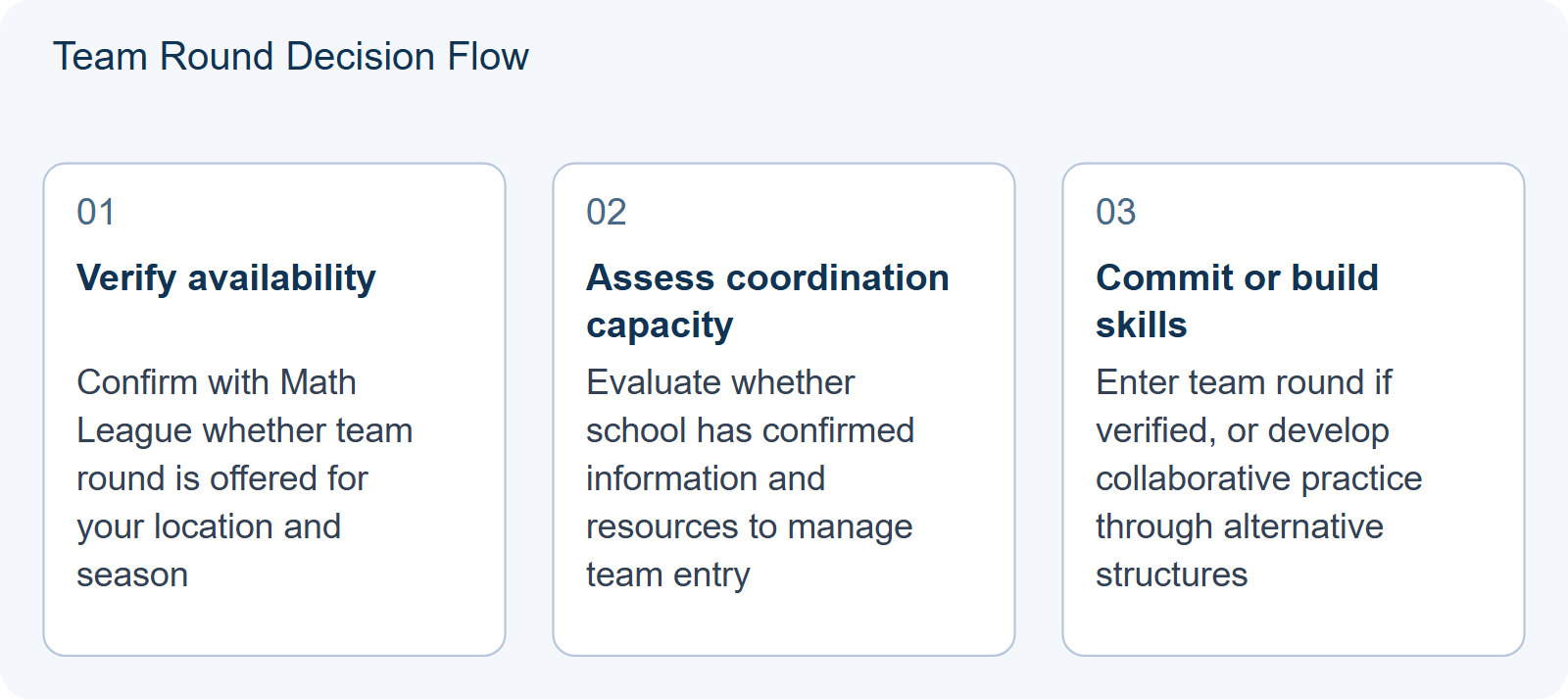
Because no specific team-entry rule has been confirmed, schools should be cautious about assuming the administrative burden of team participation. The following elements commonly associated with team competition management remain unverified for Math League’s current structure:
- Whether a designated team manager is required, and what authority or time commitment that role demands
- Whether team registration differs procedurally from individual entry, or whether multiple students simply register together
- Whether fixed competition schedules apply, or whether teams retain scheduling flexibility
- What minimum or maximum team sizes apply, if any
Schools should confirm these details directly with Math League organizers for their intended event before committing resources. Treating unverified assumptions as established fact risks planning failures and disappointed participants.
What Individual Preliminary Participation Offers
International students in China typically participate through the individual preliminary and online preliminary pathways rather than school-based team registration. This pattern reflects accessibility and clarity rather than lack of interest in collaboration.
The individual pathway offers confirmed benefits: flexible scheduling within contest windows, personal score reports with targeted practice recommendations, and progression to invitational stages based on individual merit. For students preparing under the China-region online preliminary’s no-calculator rule, individual entry provides a controlled environment to build speed and accuracy without coordinating with peers.
The round types overview provides additional context on how individual and team formats differ conceptually, even where operational details remain unspecified.
Building Collaborative Practice Without Confirmed Team Entry
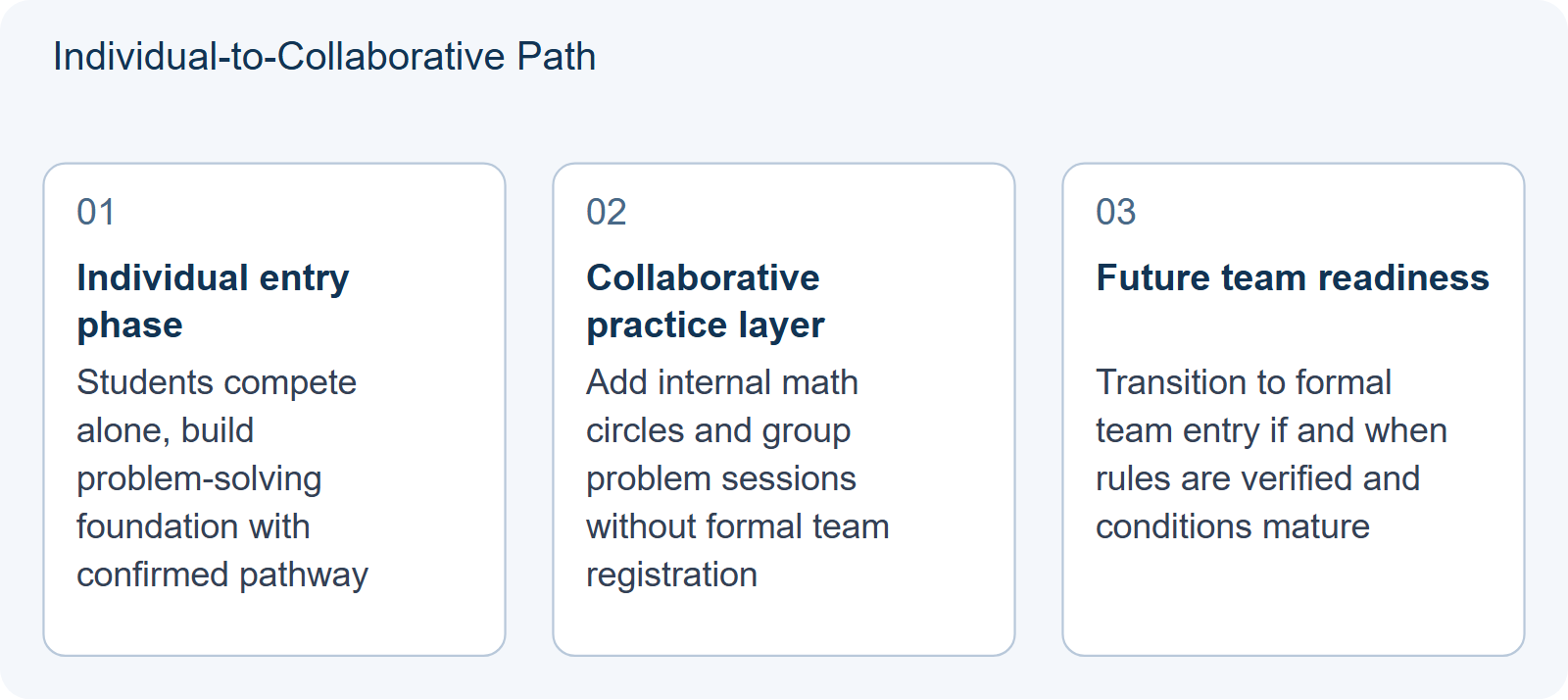
Individual preliminary participation does not preclude developing team-ready skills. Schools and families can embed collaborative problem-solving through structures that do not depend on formal team registration:
Internal Math Circles
After individual competition, students gather to discuss approaches to problems they encountered. This practice builds verbalization of mathematical reasoning, exposure to alternative solution methods, and peer accountability. It requires no external registration and functions regardless of whether formal team competition is available.
Cross-Grade Mentoring
Pairing older students with younger ones creates vertical learning relationships similar to what mixed-grade team composition might offer. Mentors solidify their own understanding through teaching; mentees gain confidence and modeling. This structure builds the interpersonal dynamics that make teams effective, without requiring simultaneous competition.
Informal Team Problem Sessions
Past team-format problems, where available, can be used in practice settings without official competition entry. Students work in groups, allocate roles, and present collective solutions. The collaborative skill developed transfers directly to any future formal team participation, should the opportunity arise.
These approaches share a key advantage: they build capacity without requiring verification of external rules that may not exist or may change.
Why Schools Default to Individual Entry—and When to Reconsider
Several factors push international schools in China toward individual preliminary participation:
- Verified pathway: Individual entry procedures are documented and tested; team entry procedures for China schools are not
- Student mobility: High turnover in international school populations makes stable group commitments difficult
- Curriculum fragmentation: IB, AP, A-Level, and other tracks create scheduling conflicts that individual entry accommodates more easily
- Administrative bandwidth: Competition coordination often falls to already stretched department heads who cannot absorb additional unverified obligations
Reconsideration becomes appropriate when a school has obtained direct confirmation from Math League organizers about team entry requirements and has assessed whether those requirements are sustainable given its particular constraints. Until then, individual entry with supplemental collaborative practice represents the lower-risk, higher-information strategy.
Questions Families Should Confirm for Their Intended Event
Before advocating for team participation, parents and school representatives should seek answers to the following from official Math League channels:
1. Is team round registration actually available for our location and season? Availability may vary by region and year; past inclusion of team activities does not guarantee current offerings.
2. What distinguishes team registration from multiple individual registrations? Clarify whether any special coordination, roster submission, or verification is required beyond students entering together.
3. What are the eligibility requirements for team members? Confirm whether grade-level restrictions, school enrollment verification, or other criteria apply.
4. How does team scoring work, and what are the competitive stakes? Understand whether team performance affects individual standing, offers separate awards, or feeds into different advancement pathways.
5. What is the timeline and fixed commitment? Determine whether team participation requires specific dates, locations, or preparation schedules that would conflict with existing obligations.
The preparation pathway guidance offers additional perspective on structuring student development regardless of whether team or individual format is ultimately selected.
Preparing Students for Either Format
Whether a student ultimately competes individually or as part of a team, certain preparatory elements remain valuable. The China-region online preliminary prohibits calculators, emphasizing number fluency and efficient manual calculation; US/Canada school contests allow non-QWERTY calculators for 2026-27 under the official 4 July 2026 notice and plan a no-calculator policy the next school year. Students should practice under conditions matching their event requirements: clean scratch paper, organized workspace, and time pressure.
For those specifically interested in team skills, emphasize communication during practice. Can the student explain their reasoning clearly? Can they identify when a peer’s approach is more efficient than their own? Can they divide a multi-part problem and integrate partial solutions? These competencies matter more than formal team registration for long-term mathematical development.
For schools evaluating where to begin, the competition entry fundamentals article covers individual registration in detail.
Conclusion: Matching Format to Verified Information
The Math League team round occupies an ambiguous position for international schools in China. Team activities demonstrably exist—the 2026 summer programme included them. Yet the specific mechanisms for school registration, eligibility, and competition in the 2026-27 season remain unverified in available sources.
The prudent approach treats this uncertainty seriously. Default to individual preliminary entry, which is documented and accessible. Supplement with intentional collaborative practice that builds team-ready skills informally. When and if official team entry rules are confirmed for a school’s specific situation, evaluate whether the additional coordination burden is justified by distinctive benefits that individual participation cannot provide.
Neither path precludes the other over time. Many students begin with individual competition, develop peer relationships through supplementary math circles, and later join formal teams if circumstances permit. The collaborative capacity built through informal structures endures regardless of competition format entered—and may prove more valuable than any single contest outcome.
Frequently Asked Questions
Is team round registration currently available for international schools in China?
This has not been verified in available sources. The 2026 summer programme included team activities, but no specific team-entry rule, school registration pathway, or eligibility framework for China schools has been confirmed for the 2026-27 season. Schools should contact Math League organizers directly for current availability.
Can students develop team skills without formal team registration?
Yes. Internal math circles, cross-grade mentoring, and informal group problem sessions build collaborative reasoning, communication, and collective strategizing without requiring official team entry. These skills transfer directly to formal team participation if it becomes available.
Does past team activity guarantee future team format availability?
No. The 2026 summer programme included team questions, but this past evidence does not establish upcoming regional team registration rules or school eligibility for subsequent seasons. Each intended event requires independent verification with organizers.