Preparing for Math League homeschool participation requires a clear distinction between general mathematical skill development and the specific logistical requirements of the contest. While the competition offers rigorous problem-solving challenges, families must navigate entry protocols carefully, as official sources do not automatically guarantee independent homeschool registration without prior confirmation from local organisers.
Understanding the Current Contest Landscape
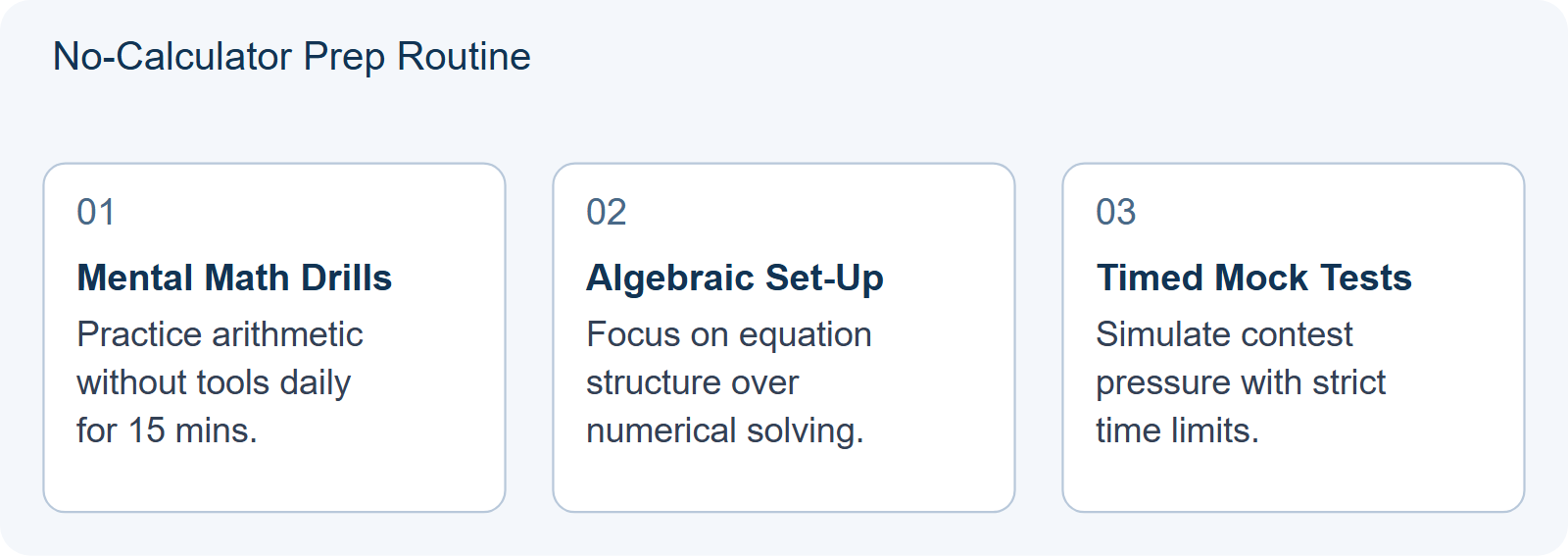
For the China-region online preliminary, the 2026–2027 participant manual prohibits calculators and other auxiliary tools. This rule significantly impacts preparation strategy for that pathway, emphasizing mental arithmetic and algebraic manipulation over computational aids. The official Math League notice dated 4 July 2026 separately allows calculators without a QWERTY keyboard in US/Canada school contests for 2026-27 and says the no-calculator policy will apply the next school year. The 2026 summer programme included individual, team, relay, and speed questions, demonstrating the variety of formats students may encounter, but this historical data does not establish upcoming regional team registration rules or school eligibility criteria. Families should focus on mastering fundamental concepts rather than assuming access to specific team-based entry routes.
Preparation Resources and Limitations
A common misconception among new participants is the immediate availability of extensive past-paper archives for pre-entry study. Official regional materials provide score reports and targeted practice after the preliminary round. There is no confirmed public repository of past contest books accessible before entry through standard channels. Therefore, preparation should rely on:
- Contest registration
- Free past papers
- 1-on-1 trial lesson

- General olympiad-style problem sets aligned with grade levels.
- Timed practice sessions simulating the no-calculator environment.
- Reviewing current rule references provided by the regional site.
Do not promise or expect exact solution coverage packs before registration. Instead, use the post-preliminary feedback loop to refine skills for subsequent rounds.
Verifying Entry Options for Homeschoolers
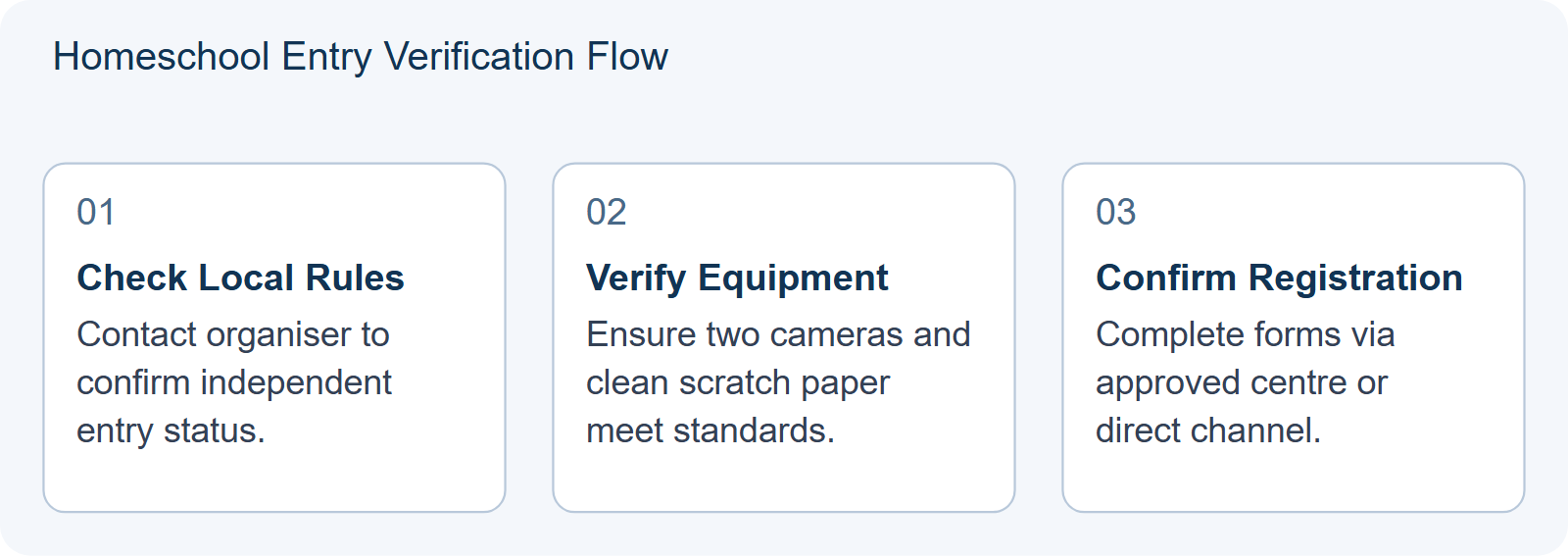
Since official documentation does not explicitly define a standalone homeschool entry pathway, proactive communication with local organisers is essential. Use the following checklist when contacting centres or regional coordinators:
| Question Category | Specific Inquiry |
|---|---|
| Eligibility | Does your centre accept independent homeschool registrations? |
| Testing Location | Can I take the exam at a designated testing center if my home setup fails equipment checks? |
| Sponsorship | Is a school sponsor required, or can parents act as proctors under specific conditions? |
| Equipment | What are the exact camera and scratch paper requirements for remote administration? |
These questions help clarify whether a Math League homeschool student can participate independently or needs affiliation with a registered school or centre.
Practical Study Strategies
Focus on high-yield topics such as fractions, ratios, and percents, which frequently appear across grades. For older students, algebraic set-up moves often beat brute force calculation. For the China-region online preliminary, calculators are banned, so practicing efficient manual computation is critical; for US/Canada school contests in 2026-27, the official 4 July 2026 notice allows calculators without a QWERTY keyboard and says the no-calculator policy will apply the next school year. Consider integrating these topics into weekly routines using resources like Fractions, Ratios and Percents on Math League.
For those balancing multiple curricula, understanding how contest dates align with academic schedules is vital. See Fitting Math League Around IB, AP and A-Level for planning insights. Additionally, reviewing the mechanics of the online preliminary round, including the two-camera setup, helps prevent disqualification due to technical errors. Refer to Math League Online Preliminary Round for detailed equipment checks.
Conclusion
Success in Math League homeschool contexts depends on realistic preparation expectations and verified entry logistics. By focusing on core mathematical fluency, adhering to no-calculator rules, and confirming organisational requirements early, families can create a structured path toward participation. Remember that Hanlin provides independent coaching support and is not officially affiliated with Math League; always defer to official regional guidelines for binding rules.
HYPOTHETICAL/ILLUSTRATIVE: The “Sponsorship vs. Proctor” Decision Matrix
To apply the logistical advice above, consider a hypothetical scenario involving two families preparing for the same regional preliminary round. Both students are in Grade 8, possess strong mental arithmetic skills, and have completed timed practice sets without calculators. However, they face different entry constraints that require distinct strategic choices regarding registration pathways.
Family A attempts to register as an independent homeschooler directly through the regional coordinator’s general email address. They assume that because their child is technically proficient, administrative hurdles will be minimal. They spend three weeks refining algebraic manipulation techniques but do not confirm proctoring requirements until one week before the exam date. Upon inquiry, they discover that their local centre requires a registered school sponsor or a certified proctor with specific equipment verification logs, which they cannot provide on short notice. Consequently, Family A must scramble to find a last-minute testing site or risk missing the preliminary round entirely, despite having adequate mathematical preparation.
Family B adopts a proactive dual-track approach. Two months prior to the contest, they contact the regional coordinator using the checklist provided in the article. They explicitly ask: “Does your centre accept independent homeschool registrations?” and “Can parents act as proctors under specific conditions?” When told that direct independent registration is currently paused due to capacity limits, they immediately pivot to Option 2: partnering with a local community learning hub that acts as a registered sponsor. Simultaneously, they verify the remote administration equipment standards (two-camera setup) early. This allows them to dedicate their study time exclusively to high-yield topics like ratios and percents, knowing the logistical framework is secure.
| Decision Factor | Family A (Reactive) | Family B (Proactive) |
|---|---|---|
| Timing of Inquiry | 1 week before exam | 2 months before exam |
| Registration Pathway | Assumed direct entry | Verified sponsor/hub affiliation |
| Preparation Focus | Split between math & admin panic | Consistent no-calculator drills |
| Outcome Risk | High (potential disqualification) | Low (confirmed eligibility) |
The critical difference lies not in mathematical ability, but in the sequencing of information gathering. Family B treated entry confirmation as a prerequisite task, similar to checking visa requirements before booking travel. Family A treated it as an afterthought. For homeschoolers, where standard school-based registration pipelines may not exist, the “unknown” variable is often organizational rather than academic.
Reusable Self-Check: Before committing to a specific study schedule, ask yourself: “If I were disqualified tomorrow solely for paperwork reasons, would my current study plan still be valid?” If the answer is no, pause content preparation and prioritize contacting organizers. Use the inquiry categories from the main article to draft your initial email. Do not wait for a response to begin studying core concepts, but do not finalize your registration strategy until you have written confirmation of your eligible pathway. This ensures that your effort in mastering fractions and algebraic set-ups translates directly into actual participation opportunities.
Frequently Asked Questions
Can homeschool students register directly for Math League?
Official sources do not guarantee direct independent registration. You must verify eligibility with your local organiser or testing centre.
Are past papers available for free download before the contest?
No. Targeted practice and score reports are typically provided after the preliminary round. Pre-entry preparation should use general olympiad resources.
Can I use a calculator during the Math League contest?
For the China-region online preliminary, no: the participant manual prohibits calculators and other auxiliary tools. For US/Canada school contests, the official 4 July 2026 notice allows calculators without a QWERTY keyboard for the 2026-27 school year and says the no-calculator policy will apply the next school year.