What the second round actually asks for
If your child may advance out of the Math League preliminary, the question is usually “what do we practise now?” The short answer for the Math League oral explanation is that the second round is not simply a harder version of the same written paper, so written-only drilling is an incomplete rehearsal.
The Hanlin Courses note Registration Opens for the Math League Preliminary: Bilingual Chinese-English Paper for the First Time (WeChat, 8 November 2026) describes the season as three stages: the preliminary, the second round, and a carnival-style final camp. On the second round specifically, the note says that only students who performed well in the preliminary are eligible, and that the stage includes answering questions plus an oral explanation of the solution, which the note says tests expression ability.
That is the whole of what the note establishes about the format. It is enough to change how you rehearse, and it is not enough to build a scoring model. The table below separates the two, because a planning risk is to invent a rubric and then train to it.
- Contest registration
- Free past papers
- 1-on-1 trial lesson

| Supported by the November 2026 note | Not stated in the note |
|---|---|
| Three stages: preliminary, second round, final camp | Any score weighting between answering and explaining |
| Second-round eligibility follows strong preliminary performance | A fixed advancement cut-off score or percentage |
| The stage includes answering questions and an oral explanation | Time limits, number of questions, or a speaking script |
| Expression ability is tested at this stage | Language standard, penalty rules, or judging criteria |
| Deep error review is linked to second-round preparation | Whether students explain alone, in pairs, or to a panel |
The note also records, as a snapshot of that season, a preliminary on 12 December 2026 with registration closing 30 November 2026; treat those as the note’s record and confirm current details with the organiser. What follows is Hanlin’s preparation perspective, not organiser guidance and not a scoring rubric.
Why a good written solver can still freeze out loud
A written solution lets the reader work at their own pace. The page holds the algebra, the diagram, and the crossed-out false start; a marker can go back and check line three. Speaking removes all of that. The listener hears the argument once, in the order it is spoken, and cannot re-read it.
This produces three failure modes to watch for, and they are coaching judgments rather than measured findings. The first is result-first mumbling: the student names a number, then circles the reasoning without ever committing to a reason. The second is narrated calculation: the student reads out arithmetic operations but never says why those operations are the right ones. The third is condition blindness: the student gives an answer that would be correct if a stated condition did not exist, and never notices the condition was load-bearing.
None of these show up reliably in written homework, because in writing the student can point at the previous line and let the layout carry the logic. The rehearsal problem is therefore not “learn more mathematics”. It is “linearise an argument you already possess”. The note’s own advice points in this direction: it warns against correcting only the final answer, and connects proper error review with preparation for the oral answer at the next stage.
For contrast, the collaborative side of Math League practice is a separate skill and is covered in our article on Math League Team Round: Building Collaborative Practice Before a Team Event. Group answer production and one-student spoken justification put pressure on different habits.
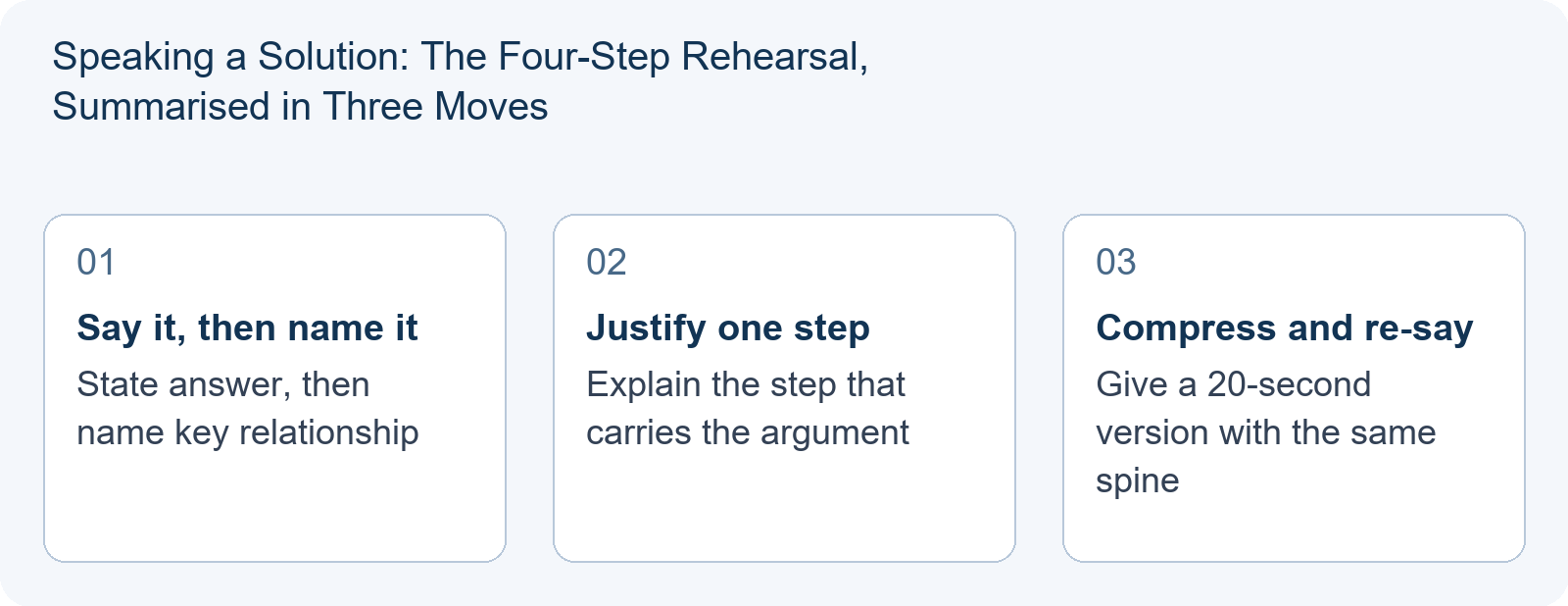
The four-step rehearsal
Treat the following as a practice scaffold, not a format anyone has published. It has four steps, and the fourth is a rehearsal discipline rather than a stage of the live answer.
- Step 1 — Say the answer. One sentence, with units or labels. No hedging chain, no “I think maybe approximately”. If the answer is a count, say what is being counted.
- Step 2 — Name the key relationship. The single mathematical idea that makes the problem tractable: constant speed, complementary counting, a remainder cycle, a two-set overlap. Naming it tells the listener where the argument is going.
- Step 3 — Justify the decisive step. Not every line. The one step where a listener could reasonably object, plus the reason it holds.
- Step 4 — Compress. After the full explanation, give a twenty-second version with the same spine. If the short version loses the reason, the full version was decoration.
In live performance the order is 1, 2, 3. Step 4 is done afterwards, in rehearsal, and its purpose is diagnostic: compression exposes whether the student has a reason or only a sequence of remembered moves.
Teaching illustration one: a constant-speed trip
Teaching illustration written for this article. It is not an actual contest problem.
Setup: a train travels 240 km in its first 3 hours at a constant speed, then continues at the same speed for another 2 hours. Find the total distance travelled.
The mathematics is short. The speed is 240 ÷ 3 = 80 km per hour. The remaining leg is 2 × 80 = 160 km. The total is 240 + 160 = 400 km, which is also 5 × 80. Three candidate answers are worth explaining aloud: two fail in different ways, and the correct one must still be justified:
- 400 km/h — right number, wrong unit. The question asks for a distance, so the answer is in kilometres.
- 160 km — correct arithmetic, wrong question. This is the remaining leg, not the total.
- 400 km — correct, and it must still be justified, not simply announced.
A full spoken version following the four steps: “The total distance is 400 kilometres. The key relationship is that distance equals speed multiplied by time, and because the speed is constant I can work with the total time. The decisive step is finding that speed: 240 kilometres in 3 hours is 80 kilometres per hour. Five hours at 80 kilometres per hour gives 400 kilometres. I checked the unit, because the question asks for distance, not speed.”
The compressed version: “Constant speed. 240 in 3 hours means 80 per hour. The trip lasts 5 hours, so 80 times 5 is 400 kilometres.”
Notice what the illustration is actually training. The arithmetic is not the difficulty. The difficulty is choosing to say “the question asks for distance, not speed” before a listener asks it, and saying “the speed is constant, so I can add the times” rather than silently adding them.
Teaching illustration two: handling the follow-up
Teaching illustration written for this article. It is not an actual contest problem.
Setup: how many two-digit whole numbers have digits that sum to 9?
The count is 9: 18, 27, 36, 45, 54, 63, 72, 81, 90. Structurally, if the tens digit is t, then t runs from 1 to 9 and the units digit is 9 − t, which runs from 8 down to 0; every one of those is a valid single digit, so there are exactly nine.
The useful rehearsal is not the answer. It is the follow-up, because follow-ups are where prepared speeches collapse.
Follow-up: “Why not ten?” A student who has memorised “nine” cannot respond. A student who understands the structure says: because 09 is not a two-digit number, so the tens digit cannot be zero, and that removes exactly one candidate from the ten pairs with digit sum 9.
Follow-up: “Where did the two-digit condition enter your argument?” Answer: at the tens digit, which is restricted to 1 through 9 rather than 0 through 9. If the question had asked about two-digit strings allowing a leading zero, the count would be 10. Saying where the condition entered is stronger than saying that it was used.
Follow-up: “Would your method survive a larger target sum?” Answer: partially. For a digit sum of 18 the tens digit runs 9 down to 9, giving just 99, so the same structure applies but the number of valid pairs collapses. A student who can say “the method is the same, the count of valid pairs changes” has understood the method.
Rehearsing two or three follow-ups per problem, out loud, is a practical use of practice time. The main answer is the part the student has already produced correctly.
A short diagnostic using a forty-five-second recording
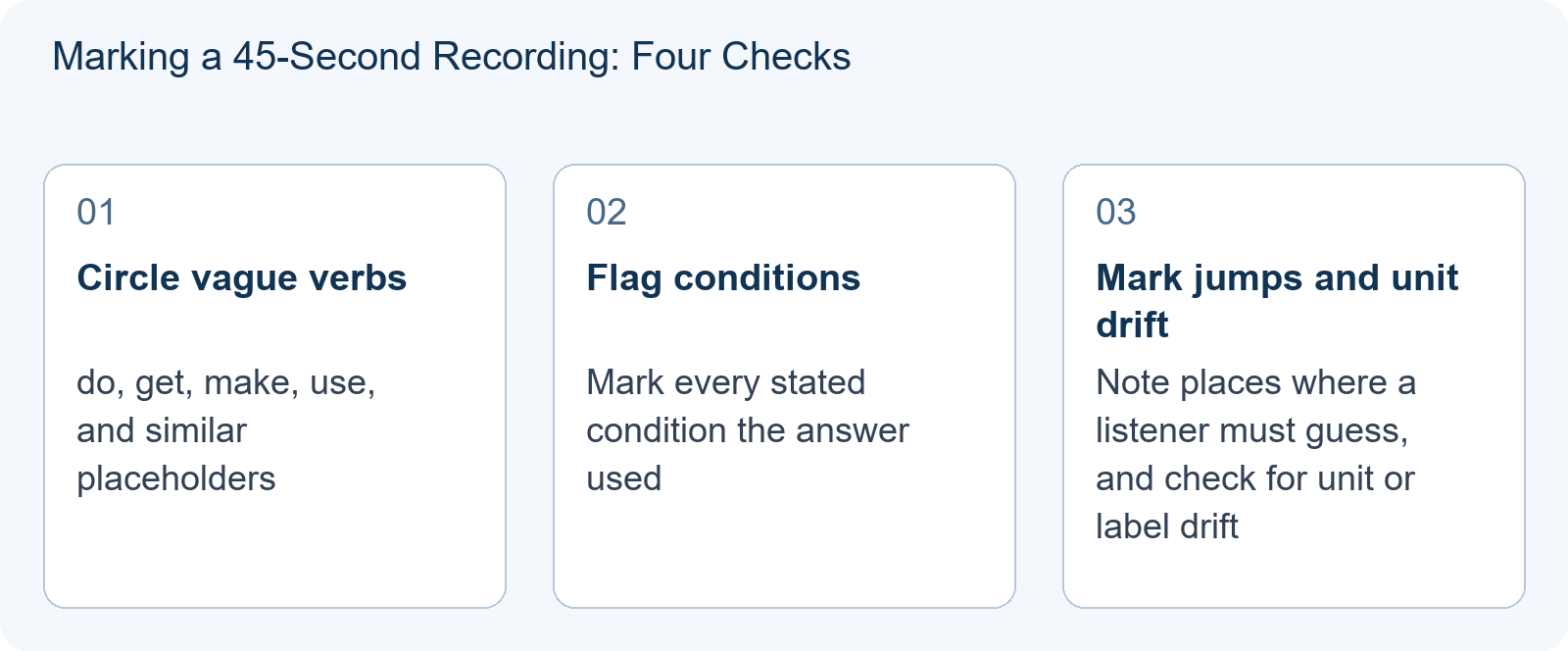
Forty-five seconds is a suggested practice length, not a published limit. The protocol: pick one problem the student has already solved correctly, allow one minute of silent thought, record one unscripted explanation, then listen back together and mark the recording rather than the mathematics.
| Mark | What to circle | What it usually means |
|---|---|---|
| Vague verbs | “do”, “get”, “make”, “use”, “work out” | A step exists in the student’s head but was never named |
| Missing conditions | Stated conditions the answer used but did not mention | The listener cannot tell which conditions were load-bearing |
| Unexplained jumps | Places where a listener must guess | An intermediate step was skipped, not omitted for brevity |
| Unit or label drift | Kilometres becoming kilometres per hour | The answer was not checked against what was asked |
Then re-record once, same problem, same length. Keep both files. The comparison between the two recordings is the progress measure, and it is honest in a way that a self-reported “I understand it now” is not. Do not score the recording; mark it. A score invites the student to perform fluency, which is exactly the failure mode you are trying to detect.
Turning corrected errors into spoken cards
A practical instruction in the note is that error review should not stop at fixing the answer: the student should identify the tested idea, the reason for the error, and a better method, and the note ties this directly to oral preparation. A one-card-per-error routine operationalises that.
Each card carries five lines: the problem, the answer the student gave, the reason that answer was wrong, the key relationship, and a one-sentence spoken version. The fifth line is the one that matters, because writing a single sentence forces the compression step. Build cards from a serious error review; the score report’s knowledge tags are a reasonable way to decide which topics deserve cards, and our guide to Reading Your Math League Score Report: How to Use Knowledge Tags to Target Practice sets out that process.
Two practical cautions. First, do not rehearse a memorised speech for a specific problem. The second round is described as testing expression, and a recitation does not demonstrate that anything was understood. Second, do not let card-writing replace solving: the card is a record of a solved problem, not a substitute for one. When choosing material to draw errors from, our notes on Math League Past Papers: How to Choose Practice Material That Matches Your Grade’s Problem Style (2026-27) are the relevant starting point, since the note describes Math League as leaning towards situational word problems, logic, counting and basic number theory rather than highly contrived tricks.
Preparing a useful course-fit or resource request
Families may ask for “second-round training” without knowing what to ask for, which makes it hard for any provider to respond usefully. The note does not describe a specific second-round training format, so scope has to be confirmed directly rather than assumed from a checklist. Bring five things to that conversation.
- Two recordings of the same problem, before and after feedback, so the listener can hear the actual starting point.
- A corrected-error list with the reason each answer was wrong, not just the right answer.
- The student’s grade and stage status, since eligibility for the second round follows preliminary performance and the appropriate starting point can vary by grade.
- One goal sentence the student writes personally, such as “stop reading out arithmetic without saying why”.
- Direct questions about scope: what is practised, how often, whether follow-up questioning is included, and how progress is reviewed.
If you approach a coach or provider, including ours, ask which of these the sessions actually address. A spoken-explanation rehearsal should involve the student talking most of the time; if the session is mostly a teacher solving problems on a page, it is written preparation with a different label, which may still be useful but is not the same thing.
What to confirm before the second round
Because the source note describes the format only in outline, the practical questions to put to the organiser are narrow: whether the explanation is delivered individually or in a group, what language is expected, what time is allowed, and what materials may be used. None of these is answered by the November 2026 note, and none should be guessed from a rehearsal plan. The preliminary paper being bilingual does not by itself establish anything about the second round’s language expectations.
The defensible plan is therefore modest and concrete: rehearse answer-plus-reason out loud, compress every explanation once, rehearse two follow-ups per problem, and keep recordings rather than scores. That is a genuine preparation for a stage described as testing expression, without inventing a rubric the organiser never published.
General event background is available at Event background.
This is an independent preparation guide, not affiliated with, endorsed by, or sponsored by Math League.
Frequently Asked Questions
Does the Math League oral explanation require perfect English?
The November 2026 Hanlin Courses note says that the second round includes answering questions plus an oral explanation and that it tests expression ability; it does not state a language standard, a fluency requirement, or how language is weighed. Because the preliminary paper is described as bilingual Chinese-English from that season onward, some families assume the second round is equally accommodating, but the note does not say so. Practise for clarity and structure, and confirm language expectations directly with the organiser rather than training to an assumed standard.
How long should a practice explanation be?
The November 2026 note does not state a length, so treat any number as a practice choice rather than a rule. A workable scaffold in this rehearsal plan is one unscripted explanation of about 45 seconds, followed by a compressed version of about 20 seconds on the same problem. The short version is the diagnostic: if it loses the reasoning, the long version was probably describing steps without justifying them. Adjust the length to the student’s age and to whatever the organiser confirms.
What should a parent listen for without scoring the child?
Listen for three things before judging surface polish. First, is the answer stated early and clearly, with units or a label? Second, is one key relationship named, such as constant speed or complementary counting, rather than a run of arithmetic? Third, are the stated conditions of the problem used explicitly, or quietly ignored? While listening, note vague verbs such as do, get, make and use; each one usually marks a step the student has not explained. Recording and marking the explanation is more informative than assigning a mark out of ten, because scoring tends to reward fluency rather than reasoning.