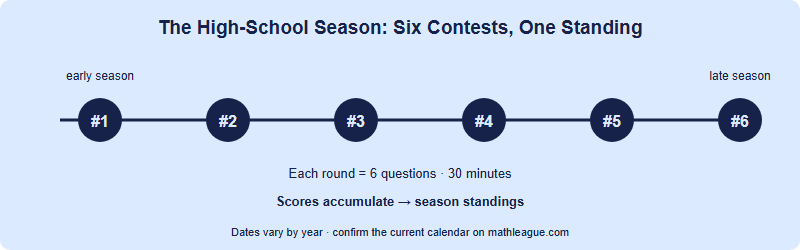
The Math League high-school program is a series of six contests spread across the school year, not a single sitting. Per mathleague.com, each contest gives grades 9–12 students six short-answer questions in a 30-minute time limit, and a school's team score on each contest is the total of its top five individual scores. Standings build up across all six rounds, so consistency over a season matters more than one good day.
What "six-contest series" actually means
If you are coming from one-shot competitions, the structure here is the thing to internalize first. Math League's high-school competition runs as six separate contests across the academic year. According to mathleague.com, "There are 6 High School Contests each year, with 6 questions per contest," and "There is a 30 minute time limit for each contest." Posted results historically number these contests #1 through #6, held in the November–April window — but exact dates change yearly, so always confirm the current calendar on the official site.
That cadence changes how you should think about preparation. A single 40-question, 75-minute exam rewards a burst of peak performance. A six-round series rewards repeatable performance: showing up six times, each time solving six dense problems under a tight clock. The math content is the same pre-calculus universe you would expect — mathleague.com lists "geometry, algebra, trigonometry, logarithms, series, sequences, exponents, roots, integers, real numbers, combinations, probability, coordinate geometry, and more" — but the test of character is whether you can keep a steady scoring line over five or six months.
- Contest registration
- Free past papers
- 1-on-1 trial lesson

If you have not yet decided that the 9–12 high-school series is your level (versus the elementary or middle-school bands), read our companion piece on which grade band is right for you first, then come back to the season mechanics below.
Inside one contest: six questions, 30 minutes, a steep tail
A single high-school contest is short and intense. Six questions, half an hour — roughly five minutes per problem if you spread the time evenly, though strong solvers bank time on the openers and spend it on the closers. The difficulty is deliberately back-loaded. Mathleague.com states plainly: "On each contest, the last two questions are generally more difficult than the first four. The final question on each contest is intended to challenge the very best mathematics students."
That single sentence is a strategy in disguise. It tells you the first four questions are where your baseline score lives, and the final question is a genuine reach that even top competitors may not finish. For most students, the right early-season target is to convert the first four cleanly and treat questions five and six as upside, rather than burning twenty minutes on the last problem and rushing the four you could have banked.
| Element | What mathleague.com states | What it means for you |
|---|---|---|
| Questions per contest | 6 short-answer questions | Every question is worth real weight; no padding |
| Time limit | 30 minutes | Pace ≈ 5 min/question; bank time early |
| Difficulty shape | Last two harder than first four; final one is the hardest | Secure Q1–Q4; Q5–Q6 are upside |
| Contests per year | 6 contests | A season, not a single exam |
| Answer style | Short answer (a value, not multiple choice) | No guessing edge; accuracy is everything |
One contrast worth flagging for students who also sit American contests: the Math League high-school rounds are short-answer, so there is no multiple-choice guessing edge to lean on. You either produce the correct value or you do not. If you want a fuller side-by-side of how this differs from a multiple-choice ladder, our overview of what Math League is sets the broader context.
How scoring works: individuals, school teams, and the top five
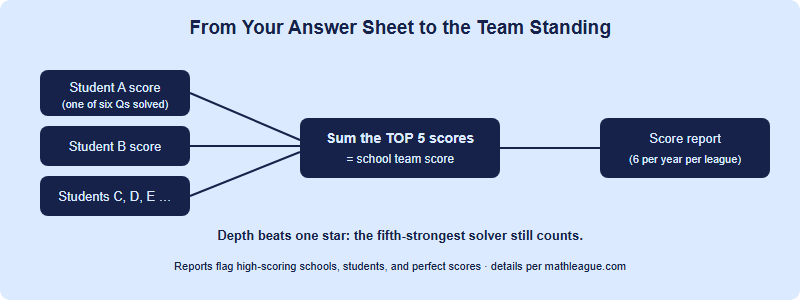
Two scores come out of every contest: your individual result, and your school's team result. Mathleague.com describes it this way — students "compete for the highest scores, while schools compete for the highest team score: the total of the top 5 scores in each school." In other words, your school's team score on a given contest is the sum of its five highest individual scores for that round.
This has a concrete implication that many first-time competitors miss: depth beats a single star. A school with one perfect scorer and four weak ones can be out-pointed by a school with five solid, consistent solvers. If you are building or joining a school team, the marginal fifth-strongest student often matters as much as the strongest. That is a very different incentive from individual-only competitions, and it is worth saying out loud to a club advisor.
Reporting is built around the same six-round rhythm. Mathleague.com notes there are "6 score reports per year for each league, showing each participating school's team scores, high scoring schools and students, and students with a perfect score." So after each contest you get a report; perfect scores are called out explicitly. How leagues, regions, or cumulative season recognition are organised can vary, so confirm the specifics that apply to your registration on the official site rather than assuming a format.
A season playbook for China-based international-school students
Here is where the six-round structure should reshape your plan — this is our first-party coaching take, not an official Math League rule. Because the standing is cumulative and the difficulty tail is steep, the highest-leverage habit is treating the early contests as graded practice with real stakes. You do not need to peak in November; you need to start the line and lift it.
- Contests #1–#2 (open the season): Lock down the first four questions of every round. Track exactly which of Q1–Q4 you miss and why — arithmetic slip, topic gap, or time. That error log is your study syllabus.
- Contests #3–#4 (build the middle): Now attack question five reliably. By mid-season your baseline should be "four secured, fifth attempted with intent." This is also where a school team's fifth-strongest solver should be visibly improving.
- Contests #5–#6 (close strong): Treat the final question as a real reach without sacrificing the four you own. A late-season jump on Q5–Q6 is upside on top of an already steady score — not a rescue mission.
For students juggling A-Level, IB, or AP coursework, the 30-minute format is a gift: it slots into a single free period and is realistic to rehearse weekly. Pull official-style past problems, sit them under a strict half-hour clock, and grade against the "secure the first four" rule above. If you want a structured term-by-term build rather than ad-hoc drilling, our study roadmap lays out a progression you can map onto the six-contest calendar.
A note on honesty: a strong Math League season is a credible signal of mathematical consistency, but it is not a guaranteed-admission ticket anywhere, and no one — us included — can promise a result. What it does do is give you six dated, comparable data points showing a rising line of problem-solving under time pressure. For a Chinese international-school applicant, that documented trajectory is the genuinely useful artifact, more than any single trophy.
Registering and confirming the current-year details
Math League is school- and league-based, and registration runs through the official site. Mathleague.com offers options to "Register for Contests, Purchase School Products," to "Check Registration and Download Registration Form," and for "Reporting Contest Scores." Beyond that, the exact enrolment path, any participation fees, the precise contest dates, and how your particular league or region is organised are details that change and that we will not guess at — confirm them on mathleague.com (or with your school's contest coordinator) before you commit.
The durable facts you can build a plan around today are the ones verified above: six contests a year, six questions in 30 minutes each, a steep difficulty tail, top-five team scoring, and six score reports. Math League was, per its own about page, "formed in 1977 by Steven R. Conrad and Daniel Flegler," and runs contests for grades 4 through 12 — the 9–12 series described here is its high-school tier.
Frequently asked questions
How many contests are in the Math League high-school series?
Six contests per school year, per mathleague.com. Each contest has six short-answer questions with a 30-minute time limit, and there are six score reports per year for each league.
How is a school's team score calculated?
It is the total of the top five individual scores at the school on that contest, according to mathleague.com. Depth matters: five steady solvers can out-point one star plus four weak scores.
Are the questions multiple choice?
No — the high-school contests use short-answer questions, so there is no guessing edge. The last two of the six are harder than the first four, and the final question is the toughest.
Do I have to register, and where?
Math League runs through schools and leagues; registration and the registration form are handled on mathleague.com. Confirm the current process, dates, and any fees on the official site before committing.
This is an independent guide operated by Hanlin Education for China-based international-school students. It is not affiliated with, endorsed by, or sponsored by the official Math League (mathleague.com). Contest structure, dates, fees, and registration can change — always confirm current details on mathleague.com. Confirmed errors are corrected within 7 working days.