A Math League season is a ladder, not a single test. For China-based students the path generally runs from school-year regional rounds into an annual summer championship that draws teams from China and beyond — with eligibility thresholds and an open-book style semifinal that catch unprepared students off guard. This guide maps how advancement works, what an open-book round actually rewards, and which logistics you must confirm on mathleague.com before you build a plan, because exact dates, scores and routes change year to year.
The shape of a season: two stages, not one
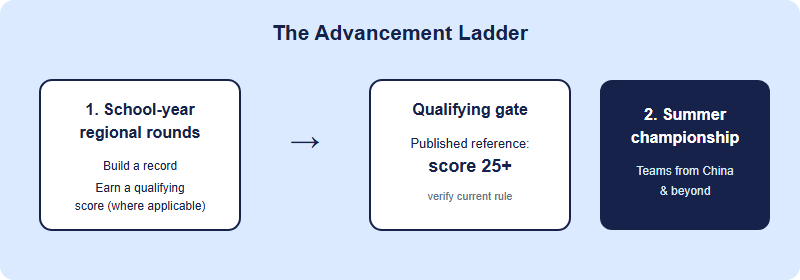
The single biggest misunderstanding among new families is treating a math competition as one event you “sit.” In Math League, the school-year contests and the summer championship are connected stages of a longer arc. The foundational guide to what Math League is describes two participation routes for students in China: local school-year regional rounds, and qualifying for an annual summer championship that brings together teams from China and beyond.
That two-stage shape changes how you should plan. The school-year rounds are where you build a track record and, where applicable, earn a qualifying result. The summer championship is the showcase event with a higher bar to enter. If you think of the season as one isolated test, you will under-invest in the early rounds that actually open the door later.
- Contest registration
- Free past papers
- 1-on-1 trial lesson

One eligibility detail Math League publishes is concrete and worth internalising early: for the summer program, the organisation lists a minimum qualifying score of 25 or higher on the relevant grade contest or algebra test. The exact thresholds, which contests count, and how qualification maps for international participants can differ — so treat 25 as the published reference point and verify the current rule for your grade and route on the official site.
Stage one: the school-year regional rounds
The school-year rounds are the working part of the season — the contests your cohort sits during the academic year. For high school, Math League runs a series of at least six contests across the season rather than one decisive sitting, which means your record builds over time and a single off-day need not define you. The lower grade bands have their own school-year structure; check the grade-band guide to see which level applies to you.
For China-based students, the practical takeaway is to treat every regional sitting as both a result and a rehearsal. Because the season is multi-contest, you get genuine feedback loops: review after each round, fix the recurring error type, and arrive at the next contest sharper. That iterative rhythm — rather than one heroic cram — is exactly what the study roadmap argues produces strong, durable results.
Two logistics matter here and are not safe to assume. First, how a China-based student or school registers for the regional rounds: Math League explicitly notes that students in Asia should not register through its standard page and should instead contact the organisation — so the registration route is region-specific. Second, which results actually count toward summer qualification. Both of these must be confirmed directly with the official site rather than inferred.
Stage two: the summer championship
The summer championship is the higher-stakes showcase. Math League’s published 2026 International Summer Challenge gives a concrete picture of the online format: it is described as a 10-to-15-question short-answer contest (60 minutes) paired with a 60-question speed round (45 minutes), priced at US$66 per grade level, and scheduled for Sunday, 16 August 2026, 12–2 PM Eastern Time. Note that “Summer Challenge” and any in-person “championship” can be distinct offerings; confirm exactly which event your route leads to.
For students in China, the Eastern Time start is a detail worth flagging on the family calendar early: a US-afternoon slot converts to a late-night sitting in China, so plan rest and logistics accordingly. And as with the regional rounds, the official site is explicit that Asia-based participants should email rather than register through the default channel — so do not assume the public sign-up button is the right door for you.
It is also worth being clear-eyed about cost and commitment before you start, because the two-stage shape has budget implications. The published Summer Challenge fee is per grade level, and a student who sits multiple school-year rounds first is committing time across the whole academic year, not just one weekend. None of that is a reason to avoid the ladder — the multi-contest format is precisely what makes Math League forgiving of an off day — but families should treat the season as a planned, costed commitment rather than a single impulse sign-up. Confirm the current fee, what it includes, and whether a separate in-person championship carries its own cost, all on the official site, before you commit the calendar.
| Item (per mathleague.com) | Published reference value | What to verify yourself |
|---|---|---|
| Summer Challenge date | Sun, 16 Aug 2026, 12–2 PM Eastern | Current-year date & your local-time conversion |
| Summer Challenge format | 10–15 Q short answer (60 min) + 60 Q speed (45 min) | Whether your grade/route uses this exact format |
| Fee | US$66 per grade level | Current fee & what it covers |
| Qualifying score reference | 25 or higher on relevant contest/algebra test | Exact threshold & which contests count for you |
| Registration route (Asia) | Do not use default page — email the organisation | The correct contact & process for your school/student |
The open-book semifinal: a different game
One feature that consistently surprises students is that part of the advanced/championship experience can be open-book in style. The study roadmap flags this directly: there is an open-book semifinal strategy, and the point of it is that an open-book round rewards understanding methods over memorising formulas. If you walk in expecting that having your notes available makes it easy, you have misread the format.
Open-book rounds are designed so that lookup alone will not save you. The questions assume you can find a formula in seconds; what they test is whether you know which method to deploy and how to execute it under time pressure. A student who has memorised procedures without understanding them actually does worse here, because they burn minutes flipping pages for something they cannot then apply.
How to prepare for an open-book round:
- Build a thin, indexed reference — a one-page sheet you have organised yourself, so you can locate a method instantly rather than thumbing through a textbook mid-contest.
- Practise with notes available so lookup becomes muscle memory, not a panic search you attempt for the first time on contest day.
- Train the judgement, not the recall — drill “which method does this problem want?” so the open book is a confirmation tool, not a crutch you lean your whole weight on.
- Time your lookups — if finding a formula takes more than a few seconds, your reference is badly organised; fix the index, not your memory.
Planning backward from the championship
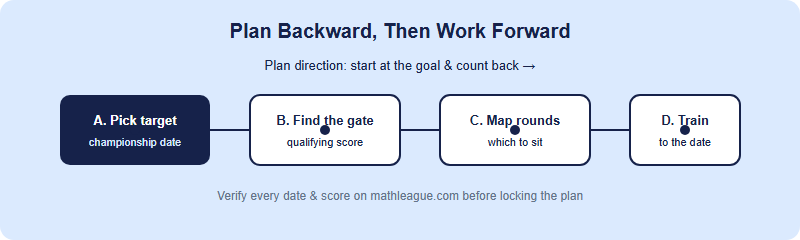
The most effective way for a China-based family to use this structure is to plan backward. Start from the championship or Summer Challenge you are aiming at, confirm its current date and qualifying rule on the official site, then count back to identify which school-year rounds you need to sit and roughly what result clears the gate. That turns a vague “do well at maths competitions” goal into a dated, checkable plan.
Because every value in this article — dates, the 25-score reference, the US$66 fee, the registration route — is the kind of fact Math League updates, the single most important habit is to treat mathleague.com as the source of truth and re-verify before each stage. Build the plan on the structure described here; pin the exact numbers from the official site; and confirm with the organisation directly how Asia-based registration works for your school or student.
FAQ
How do I qualify for the Math League summer championship?
Math League publishes a minimum reference score of 25 or higher on the relevant grade contest or algebra test, but exact thresholds and which contests count vary — confirm the current rule on mathleague.com.
Can students in China just register online like everyone else?
No — Math League states that Asia-based students should not use the default registration page and should email the organisation instead. Confirm the correct route before signing up.
What is the open-book semifinal really testing?
Methods over memorising formulas. Having notes available does not make it easy; it rewards knowing which approach to use and executing it fast under time pressure.
When is the 2026 Summer Challenge?
Math League lists Sunday, 16 August 2026, 12–2 PM Eastern Time, online, at US$66 per grade level. China families should convert the time and verify the current details.
This is an independent guide operated by Hanlin Education for China-based international-school students. It is NOT affiliated with, endorsed by, or sponsored by the official Math League (mathleague.com). Advancement routes, qualifying scores, dates, fees and registration procedures vary by year and region — confirm current details on mathleague.com before registering or competing. Any errors will be corrected within 7 working days.