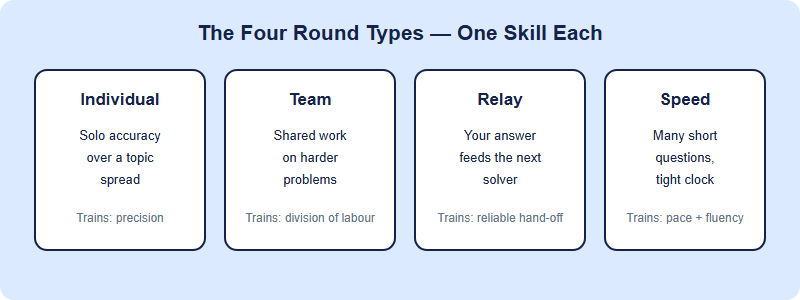
Math League contests are not one long test — at the regional level they are built from several distinct round types, and Math League’s own materials describe a structure that can include individual questions, team questions, relay questions, and speed questions. Each round rewards a different skill: accuracy, collaboration, hand-off discipline, and raw pace. This guide breaks down what each one asks of you and gives a focused training plan for international-school students in China. Exact question counts and timings vary by event and year, so always confirm on mathleague.com.
Why round types matter more than your raw score
Most students prepare for a math competition the way they prepare for a school exam: sit down, do problems, check answers. That works for the individual round, but it leaves three other round types untrained. A strong individual solver can still lose points on a relay because they never practised the hand-off, or on a team round because they never agreed who does what. Round type is the hidden variable that separates two students with identical problem-solving ability.
Math League is deliberately built this way. Unlike a pure olympiad — which the foundational guide to what Math League is explains is a different, proof-heavy track — Math League’s regional format blends solo accuracy with team coordination and timed pace. That blend is part of why it works well for a school cohort: it gives different kinds of students a place to shine. But it also means your preparation has to be broader than “do more problems.”
- Contest registration
- Free past papers
- 1-on-1 trial lesson

The four round types below are the building blocks Math League references. Note that not every event uses every round, and the precise number of questions, minutes, and how rounds are weighted differ between the elementary, middle, and high-school programs and from year to year. Treat the structural descriptions here as a map of what kinds of rounds exist, and verify the specific rules for your event on the official site before contest day.
The individual round: where precision pays
The individual round is the closest to a normal test. You work alone across a spread of topics — arithmetic and number sense in the lower grades, scaling up through algebra, geometry, and beyond as the grade band rises. The skill it rewards is plain accuracy: getting the answer exactly right, in exactly the form the question asks for.
For China-based students the most common avoidable loss here is not difficulty — it is answer formatting. A short-answer contest may expect a fraction in lowest terms, an exact radical rather than a decimal, or a specific unit. Knowing the maths but writing “2.5” where the key wants “5/2” still costs the point. This is also a theme in the Math League study roadmap, which stresses reading the full question before committing an answer.
How to train it: do official past papers under a timer, then review every miss in two columns — “got the maths wrong” versus “got the maths right but lost the point on form or reading.” For most students the second column is bigger than they expect, and it is the cheaper one to fix.
The team round: dividing labour without dropping problems
In a team round, several students attack a set of harder problems together and submit shared answers. The maths is usually tougher than the individual round, on the assumption that several brains and more time are in play. The skill is not solving — it is coordination: deciding who takes which problem, who checks, and how you avoid two people redoing the same question while a third sits untouched.
The classic team-round failure is everyone swarming problem 1 because it looks interesting, then running out of clock with three problems blank. A team that simply assigns problems and rotates a checker will usually beat a team of stronger individuals who never agreed on a method.
How to train it: practise as the team you will actually compete with, not alone. Run a timed set and assign roles before the clock starts: a first-pass solver per problem, plus one “rover” who checks finished work and picks up whatever is left. Debrief afterwards on the process (“we lost two minutes deciding”) as much as the maths.
The relay round: your answer becomes the next student’s input
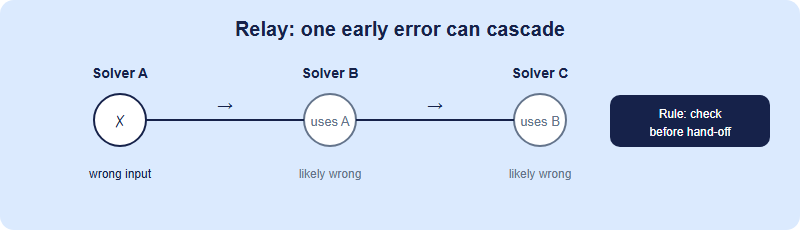
The relay is the round most international students have never seen, and the one where structure beats brilliance most clearly. In a relay format, one student’s answer is passed to the next student, whose problem uses that answer as an input — so an early mistake can cascade down the chain. Speed matters, but reliability matters more: a fast wrong answer poisons everyone downstream of you.
This changes the optimal strategy in a way that surprises strong solvers. In an individual round it can be worth a quick guess; in a relay, a confident-but-wrong hand-off is worse than a slightly slower, verified one. The discipline is: solve, check, then pass — and communicate clearly when you do.
How to train it: build short relay chains in practice (three linked problems where each uses the previous answer). Make the rule explicit — no hand-off without a quick self-check — and track how often a single early error wiped out the rest of the chain. Seeing that cascade once teaches the lesson better than any lecture.
The speed round: pace and fluency under a tight clock
The speed round flips the difficulty dial: instead of a few hard problems, you face many short ones against a short clock. Math League’s Summer Challenge illustrates the type concretely — its published format pairs a 10-to-15-question short-answer contest (60 minutes) with a 60-question speed round (45 minutes). That is roughly 45 seconds per question, so hesitation is the enemy.
The skill here is fluency, not cleverness: instant recall of arithmetic, common fraction-decimal-percent conversions, perfect squares, and basic algebraic manipulation, so your hand keeps moving while your reasoning stays light. Students who are strong but slow often underperform on speed rounds purely because they treat every easy question like a puzzle.
How to train it: short, frequent drills beat occasional marathons — the same “three short sessions a week” principle the study roadmap recommends. Practise mental-arithmetic and conversion sets against a stopwatch, and deliberately skip-and-return rather than stalling on any single item. The goal is a steady rhythm where no question eats more than its fair share of the clock.
| Round type | What it tests | Most common loss | Best single drill |
|---|---|---|---|
| Individual | Solo accuracy across topics | Answer-format / misreading errors | Timed past papers + two-column error log |
| Team | Coordination on harder problems | Swarming one problem, blanks elsewhere | Role-assigned timed sets with your real team |
| Relay | Reliable hand-off down a chain | Fast wrong answer cascading downstream | Linked 3-problem chains, check-before-pass rule |
| Speed | Pace and computational fluency | Treating easy items like puzzles | Stopwatch arithmetic/conversion sets, skip-and-return |
Putting it together: a balanced week
The mistake is to train only what you are already good at. A strong individual solver who never rehearses relays and teams is leaving the most coachable points on the table, because round-specific discipline improves far faster than raw problem-solving ability. A practical weekly split for a China-based competitor: two short individual/speed sessions (precision and pace), one team-or-relay session with your actual squad (coordination and hand-off), and one review block where you log errors by type — maths, format, reading, or process.
Which rounds your specific event actually uses depends on the program and grade band, and the exact counts and timings change year to year — so before you finalise a plan, confirm the current structure for your contest on mathleague.com, and check which grade band you are entering using the grade-band guide. Train the round, not just the maths, and the points that have been quietly slipping away tend to come back.
FAQ
Does every Math League contest use all four round types?
No. Individual, team, relay and speed are round types Math League references, but which rounds appear depends on the event and grade band. Confirm your contest's structure on mathleague.com.
How fast is the speed round?
It varies by event. The 2026 Summer Challenge format lists a 60-question speed round in 45 minutes — about 45 seconds per question — so fluency and rhythm matter more than depth.
Why is the relay round considered the trickiest?
Because one student's answer feeds the next student's problem, an early error can cascade. A verified, slightly slower hand-off usually beats a fast but wrong one.
How should a team prepare for the team round?
Practise as your real team, assign problems and a checker before the clock starts, and debrief on process — not just on the maths you got wrong.
This is an independent guide operated by Hanlin Education for China-based international-school students. It is NOT affiliated with, endorsed by, or sponsored by the official Math League (mathleague.com). Round structures, question counts, timings and rules vary by event and year — confirm current details on mathleague.com before registering or competing. Any errors will be corrected within 7 working days.