There are two honest ways to prepare for Math League: self-study and coaching. Of the major maths competitions, Math League is the most self-study-friendly — it is curriculum-aligned, so a strong classroom student can begin alone. This independent guide does not start by selling a course. It breaks the demands down by grade band, gives a four-phase roadmap, and shows exactly when coaching adds value and when it does not.
First, know what you are preparing for
Math League is not an olympiad — it rewards speed and accuracy on curriculum-aligned problems, which is why prep is different from BMO-style olympiads:
| Demand 1 · Grade-band content | Grades 4–5 and 6–8 are multiple-choice; 9–12 is a six-contest season of short-answer. Content tracks school maths, one band ahead. |
| Demand 2 · Speed & exact answers | Short time limits and exact short answers — at 9–12, an un-simplified fraction or missing unit loses a correct idea. Pacing and precision matter as much as maths. |
| Demand 3 · Season & the China/summer path | School-year regional rounds and the international summer tournament. Choosing the right band and planning the season is half the work. |
Because the content is curriculum-aligned, the honest truth is that self-study goes a long way here — more than for an olympiad. What coaching adds is pacing, gap-filling and consistency, not a skill you cannot get alone.
- Contest registration
- Free past papers
- 1-on-1 trial lesson

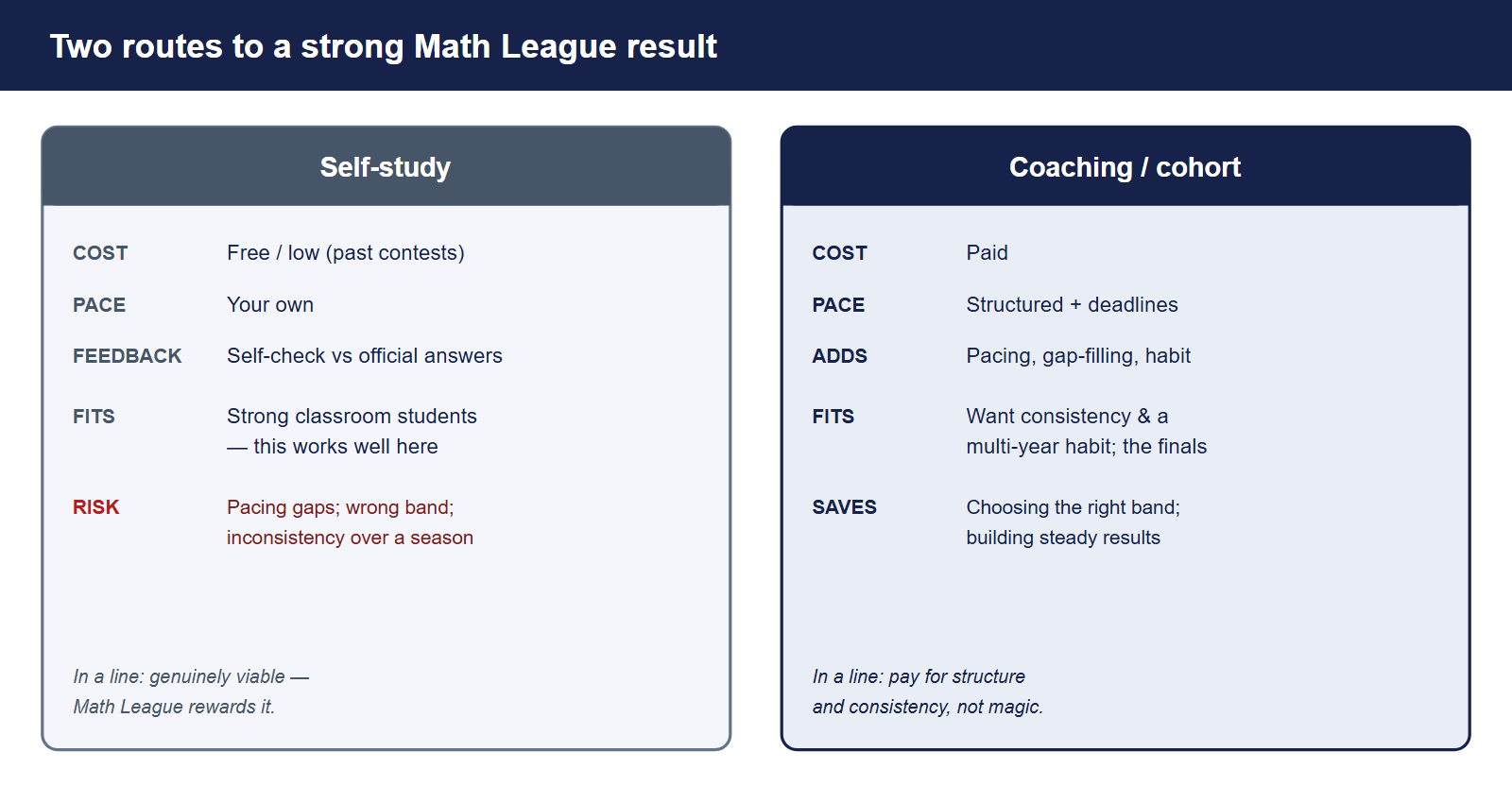
Self-study vs coaching: how to choose
An honest test: if your child is a strong classroom maths student, can drill official past contests, and self-marks against the answer key, self-study is genuinely strong — Math League is designed to be accessible. Coaching is worth it when you want consistency across a season, the right band, and a multi-year habit — particularly at 9–12, where six contests reward steady results over one good day. We will say plainly: this is the competition where the honest answer is most often “you may not need a coach.”
The four-phase roadmap below works for both routes: self-studiers follow it; coached students use it to check a program covers each phase.
A four-phase roadmap (~16 weeks)
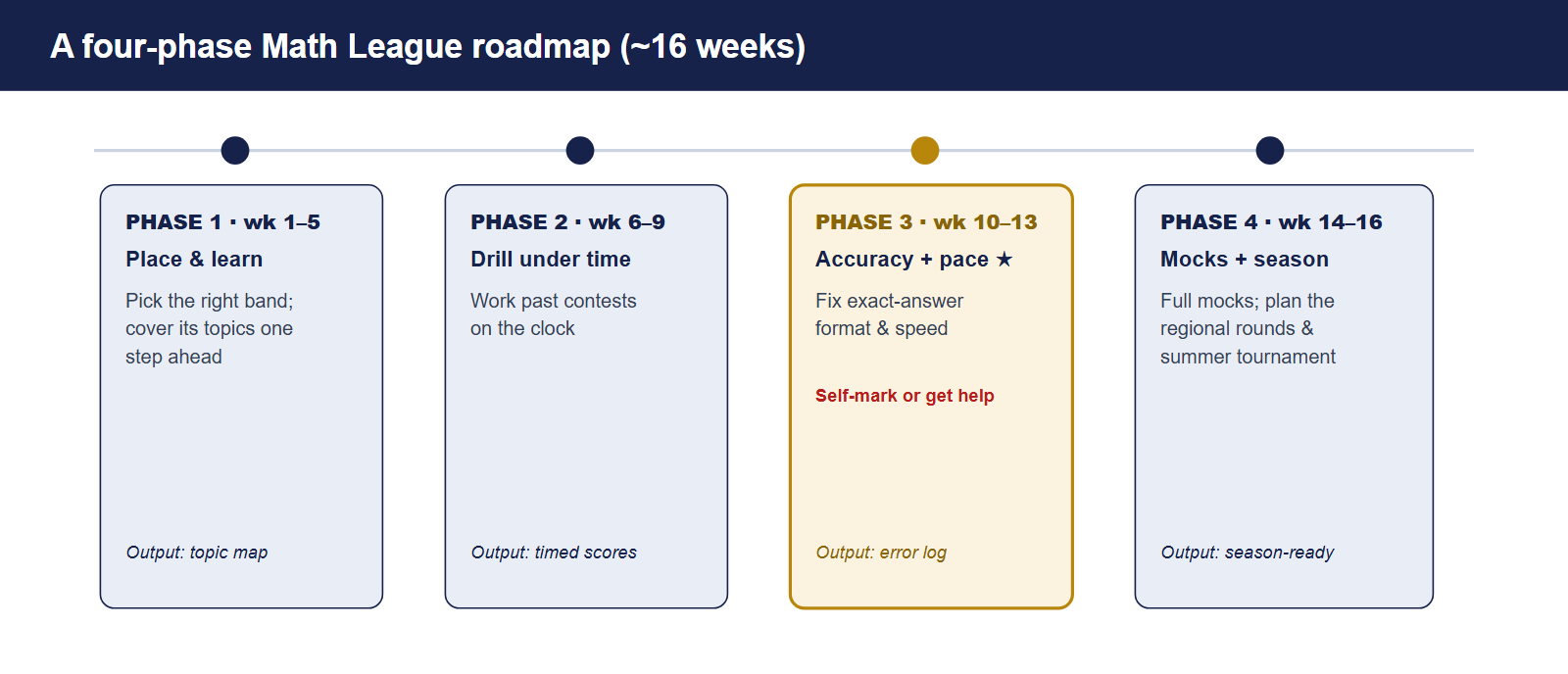
Phase 1 (Place & learn) picks the right band and covers its content one step ahead. Phase 2 (Drill) works past contests on the clock. Phase 3 (Accuracy + pace) fixes the exact-answer format and speed — largely self-markable, which is why Math League is so self-study-friendly. Phase 4 (Mocks + season) plans the regional rounds and the summer tournament.
Math League vs the AMC
Families often confuse the two. The AMC is an olympiad-leaning, high-school-focused contest that leads to AIME and USA(J)MO. Math League spans grades 4–12 and stays close to the curriculum — broader, earlier, and lower-barrier. They are not rivals: a grade-6 student can begin Math League now and add the AMC later. If you want a multi-year habit from elementary on, Math League fits; if you are chasing the senior olympiad track, that is the AMC’s lane.
What good Math League prep looks like (a checklist you can use either way)
| ✅ 1 · Right band | Does it place the student in the correct grade band, not a generic “maths class”? |
| ✅ 2 · Real practice | Is preparation built on official past contests under real time limits? |
| ✅ 3 · Season & path clear | Does it walk the regional rounds, the six-contest 9–12 season and the summer tournament? |
| ✅ 4 · Transparent results | Are results specific (advancement rate, percentile bands) — not a vague “many winners”? |
| ✅ 5 · Honest about value | Does it admit self-study can work here, rather than overselling coaching? |
About our cohort (disclosure + real results)
To be transparent: this is an independent guide, and we run a Math League preparation cohort — so this section is a disclosure of commercial interest. We coach because we have verifiable, real Math League outcomes (Hanlin internal data, anonymised):
In 2024–25 Math League, our students reached the Top 8% / Top 25% / Top 50% with an ~85% Stage-1 advancement rate; at Stage 2, 8 students placed in the Top 8% and 15 advanced to the final.
These are actual Math League outcomes — not numbers borrowed from another competition. Our cohort adds pacing, the right band and a steady season rhythm — and we will always tell a strong self-studier honestly if they do not need us.
The mistakes that cost students marks
When students lose marks at Math League, it is rarely the maths — it is one of three avoidable habits. Rushing the easy questions: the early items are the cheapest marks, and careless mis-reads happen there most. Messy exact answers (9–12): an un-simplified fraction or missing unit costs a correct idea its mark. Treating one weak contest as the season: the 9–12 level is scored across six contests, so one off day matters far less than steady results. Fixing these three is usually worth more than drilling extra topics.
Is a Math League result worth it for applications?
For most families, the honest answer is yes — as a habit rather than a trophy. Math League’s value is that it is low-barrier and repeatable: a grade-4 student can start and grow with it through grade 12. That continuity — sustained engagement, not a one-off certificate — is exactly what university readers like to see. It is not the olympiad path, and should not be presented as such; used well, it builds the consistency that makes harder contests possible later.
Frequently asked questions
Do I need coaching to do well at Math League?
Often not. Math League is curriculum-aligned and the most self-study-friendly of the maths competitions; a strong classroom student can prepare from official past contests. Coaching adds pacing, the right band and consistency, not a skill you cannot get alone.
Which grade band should my child enter?
Grades 4–5, 6–8 and 9–12, each with its own format and depth. Place by current grade and comfort; the right band is one of the most important early decisions.
Is Math League the same as the AMC?
No. The AMC is olympiad-leaning and high-school-focused, leading to AIME and the USA(J)MO. Math League spans grades 4–12 and stays close to the curriculum. Many students do both at different ages.
Are your Math League results real and how can I check?
Yes — actual Math League outcomes from our cohort (Hanlin internal data, anonymised), such as an ~85% Stage-1 advancement rate and 8 students in the Top 8% at Stage 2. We do not relabel results from other competitions as Math League results.
Can coaching guarantee advancement?
No. Any “guaranteed advancement” claim is a red flag. Results depend on the student; honest coaching only commits to the process — the right band, real timed practice and a clear season plan.
This is an independent guide to Math League, operated by Hanlin Education. We are not affiliated with the official Math League (mathleague.com). This article describes our own preparation cohort, so it is a disclosure of commercial interest. The results cited are real Math League outcomes from our cohort (Hanlin internal data, anonymised) — actual Math League results, not borrowed from other competitions. Confirm current dates, bands and rules on mathleague.com; confirmed errors are corrected within 7 working days.