Math League can be a genuine, if modest, signal on a university application — evidence of sustained interest and ability in mathematics — but it is not a golden ticket, and no single competition guarantees admission anywhere. For a China-based international-school student, the honest answer is that Math League matters most as one consistent thread in a coherent academic profile, presented truthfully. This guide explains what it actually signals, how to write about it without overclaiming, and where it fits alongside the rest of your application.
Set expectations first: what a competition can and cannot do
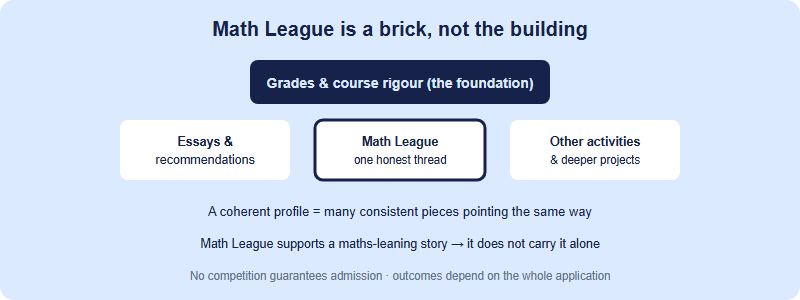
Begin with the uncomfortable truth, because it saves families a lot of misplaced effort. Admissions outcomes at selective universities depend on grades, course rigour, essays, recommendations, the whole profile and a large amount of institutional context — no extracurricular, Math League included, can override that, and anyone promising otherwise is selling something. What a well-handled competition record can do is contribute a clear, credible data point: this student chose to do mathematics beyond the syllabus, repeatedly, and can show it.
That distinction matters. A reader of an application is asking, in effect, “is this person genuinely engaged with their stated interests, and is there evidence?” Math League answers that question for a maths-leaning applicant — modestly but honestly. It is a brick, not the building. Treated that way, it is valuable; treated as a guarantee, it disappoints.
- Contest registration
- Free past papers
- 1-on-1 trial lesson

So the right goal is not “win Math League to get into a top university.” It is “build a real interest in mathematics, let Math League be one honest piece of evidence for it, and present that evidence well.” Everything below follows from that framing.
What Math League actually signals
Used properly, a Math League record signals three things that admissions readers genuinely value, and it is worth being precise about each rather than vague about all.
| Signal | What it shows a reader | What it does NOT show |
|---|---|---|
| Sustained interest | You pursued maths across a multi-contest season, not once | That you are guaranteed admission anywhere |
| Ability under pressure | You can solve unfamiliar problems within a time limit, in English | That you out-rank every other applicant |
| Initiative | You sought out challenge beyond the school curriculum | That it replaces strong grades or course rigour |
Notice that the strongest of these is sustained interest, and it comes directly from Math League’s structure. Because the high-school programme is a series of at least six contests across the year rather than one sitting (see the overview of how Math League works), a multi-season record is itself evidence of consistency — exactly the quality a one-off result cannot convey. A student who competed across two or three years tells a story that a single certificate cannot.
For China-based students specifically, the English-language dimension adds a quiet bonus: competing in Math League demonstrates you can do rigorous problem-solving in English under time pressure, which is relevant context for an English-medium university. The vocabulary and answer-formatting guide exists because that language layer is real — and clearing it is itself a small, credible signal.
How to present it honestly
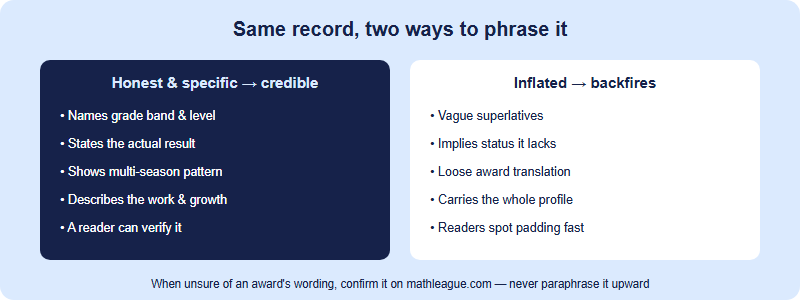
The fastest way to weaken a competition record is to inflate it. Admissions readers see thousands of applications and recognise padding instantly; an overclaimed line does more harm than a modest, accurate one. The rule is simple: state exactly what is true, with specifics, and let it stand.
Do:
- Be specific and accurate — name the grade band, the level, and the actual result. “Competed in the Math League grades 9-12 series across two seasons” is concrete and verifiable.
- Show consistency over time — a multi-year record is your strongest asset; lead with the pattern, not a single peak.
- Describe the work, not just the rank — what you learned, how you trained, the problem types you grew to enjoy. Reflection reads as genuine interest.
- Connect it to a wider story — link Math League to the maths or STEM direction the rest of your application supports, so it reinforces a theme rather than floating alone.
Do not:
- Imply official status or affiliation you do not have, or dress an independent guide's programme up as the competition itself.
- Inflate a placement or use vague superlatives (“top mathematician”) that you cannot substantiate.
- Translate awards loosely — describe the level and result in terms a reader can check, not in grander language than the facts support.
- Lean your whole application on it — if Math League is doing all the work, the profile underneath is too thin.
If you are unsure how to label a particular result, the safe default is to describe it factually and, where the exact award name or tier matters, confirm the wording against mathleague.com rather than paraphrasing it into something it is not. Accuracy is not just ethical here; it is strategically smarter.
Choosing the right level so the record is credible
A record is only a useful signal if it reflects a genuine, sustained engagement — which is why choosing the right grade band early matters for the admissions story later. A student placed in a level that is too hard may compete once and quietly stop, leaving nothing to point to; a student in the right band competes happily across seasons and builds the consistency that actually reads well. The grade-band guide is the place to get this decision right.
The same logic applies to preparation. The point of a steady, sustainable study habit — the kind the study roadmap describes — is not only better contest results; it is a longer, more authentic engagement with the subject, which is precisely what gives a competition record its admissions value. A profile built on real interest holds together under scrutiny. One assembled hastily for the application does not.
A realistic bottom line for China families
Math League is worth doing if your child genuinely likes mathematics: it builds skills, it is a constructive use of the school year, and it gives an English-medium application one honest, consistent signal of interest and ability. It is not worth doing as a cynical box-tick aimed at a guaranteed result, because that is both unpleasant for the student and transparent to readers. Set expectations accordingly, present the record truthfully, and let it play its real role — a credible supporting thread in a profile that stands on its own merits.
As with every operational detail, verify award names, levels and current programme specifics on the official site before you write them into an application, so the version you present is the version that is true.
What the funnel looks like in one coached cohort
Percentages are easier to read against a real group, so here is the shape of the progression in the cohort this desk coached — our own record, not official Math League statistics, and a small sample rather than a representative one.
| Season | First stage | Second stage |
|---|---|---|
| 2025-26 | 3 in the top 8%, 3 in the top 25%, 7 in the top 50%; 13 advanced | 7 Honor Roll of Distinction, 1 Honor Roll Certificate; 8 advanced to the US finals |
| 2024-25 | 1 in the top 8%, 5 in the top 25%, 6 in the top 50% | 8 in the top 8%, 7 in the top 25%; 15 advanced to the finals |
Two things are worth reading out of that table, and neither is “we get students in”. First, the second stage is where the record actually forms: a top-50% first-stage finish still advanced in both seasons, but the recognisable line on a transcript — Honor Roll of Distinction — came later. A student who treats the first stage as the destination has misread the structure.
Second, the two seasons look different in shape, and that is the honest point. In 2024-25 more students converted at the second stage; in 2025-26 more arrived there in the first place. Year-to-year cohort variation of that size is normal in a group this small, which is exactly why no coaching record — ours included — should be read as a probability of your own result.
FAQ
Will Math League get my child into a top university?
No competition guarantees admission. Math League can be a credible supporting signal of sustained maths interest, but outcomes depend on grades, rigour, essays and the whole profile.
What does Math League actually signal to admissions readers?
Sustained interest in mathematics, ability to solve problems under time pressure in English, and initiative beyond the curriculum — strongest when shown across multiple seasons.
How should I describe Math League on an application?
Factually and specifically: name the grade band, level and real result, show consistency over time, and confirm any award wording on mathleague.com rather than inflating it.
Is one season of Math League enough to matter?
A multi-season record is far stronger because it demonstrates consistency. One season is fine as a start, but the admissions value grows with sustained, genuine engagement.
This is an independent guide operated by Hanlin Education for China-based international-school students. It is NOT affiliated with, endorsed by, or sponsored by the official Math League (mathleague.com). Admissions outcomes are never guaranteed and depend on the whole application; award names, levels and programme details vary by year and region — confirm current details on mathleague.com before relying on them. Any errors will be corrected within 7 working days.