A Math League year runs on two clocks: a school-year contest season spread across the academic year, and a summer event that lands in August. For a China-based family, knowing the rough shape of that calendar — and planning backward from it — is the difference between a calm, prepared season and a last-minute scramble. This guide maps the typical rhythm month by month and shows where to place prep, but every specific date, deadline and fee is a value you must confirm on mathleague.com, because Math League sets them fresh each year.
Why a planning calendar matters more than a single date
New families often ask one question — “when is the Math League contest?” — as if there is a single exam to circle. There is not. Math League’s school-year contests run across the academic year, and the summer event sits separately in the warmer months. Because the season is distributed, the useful unit of planning is not a date but a calendar: a view of the whole year that tells you when to start preparing, when results arrive, and when the higher-stakes summer event opens.
This matters especially for China-based students for two reasons. First, the registration route for Asia is region-specific — Math League directs Asia-based participants to contact the organisation rather than use the default sign-up page — so you cannot assume the same deadlines or sign-up window that an American school sees. Second, the summer event is published with a US Eastern Time start, which converts to a late-night sitting in China; that is a logistical fact best discovered months ahead, not the night before.
- Contest registration
- Free past papers
- 1-on-1 trial lesson

The goal of this article is therefore a working calendar you can adapt. Use the structure here to block out your year, then pin the exact dates from the official site and confirm the Asia registration window directly with the organisation.
The shape of the year: two seasons
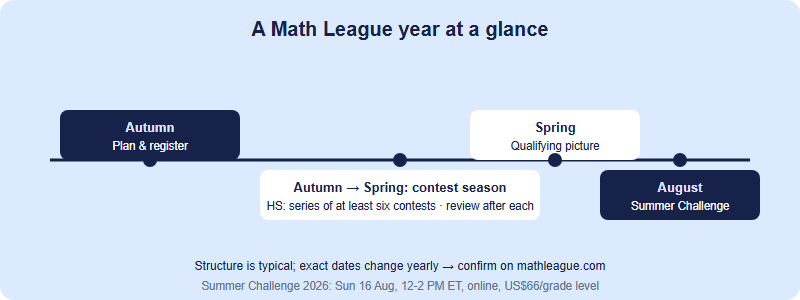
At the highest level, a Math League year breaks into a school-year season and a summer season. The school-year contests are the working part — for high school, Math League runs a series of at least six contests across the year rather than one decisive sitting, so the season unfolds over months and your record builds round by round. The lower grade bands have their own school-year structure; the grade-band guide shows which level applies to your child.
The summer season is anchored by the published 2026 International Summer Challenge, which Math League lists as an online event on Sunday, 16 August 2026, 12–2 PM Eastern Time, priced at US$66 per grade level, with a format of a 10-to-15-question short-answer contest (60 minutes) plus a 60-question speed round (45 minutes). There is also a long-running in-person International Summer Tournament, held since 2012 at The College of New Jersey, that has drawn around 250 students from China, Japan, Canada and the United States. “Summer Challenge” and the in-person “tournament” can be distinct offerings — confirm which one your route leads to.
| Window | What typically happens | What a China family should do |
|---|---|---|
| Late summer / early autumn | New season information is published; schools plan participation | Decide grade band; confirm the Asia registration route |
| Autumn → spring | School-year contest season (HS: a series of at least six contests) | Sit rounds; review after each; build a track record |
| Across the season | Results and standings accumulate round by round | Fix the recurring error type before the next round |
| Spring / early summer | Qualifying picture for the summer event becomes clearer | Check the qualifying reference (Math League lists 25+) for your route |
| August | Summer Challenge (2026: Sun 16 Aug, 12–2 PM ET, online) | Convert ET to China time; plan rest; register via the Asia route |
Read that table as a template, not a timetable. The columns describe the recurring rhythm of a Math League year; the exact dates that fill them change annually and regionally, so verify each on the official site.
Planning backward: from August to the autumn you start
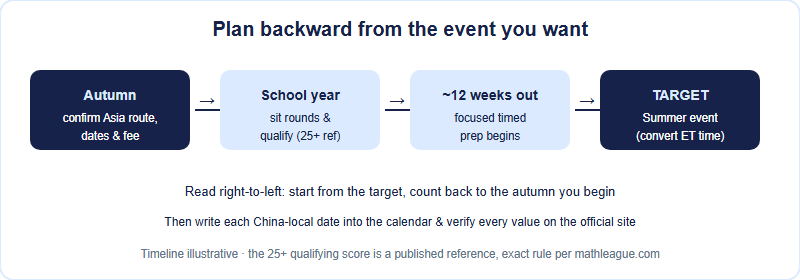
The most effective way to use this calendar is to plan in reverse. Pick the event you are aiming at — most often the Summer Challenge or, where applicable, the in-person tournament — confirm its current date and any qualifying rule on the official site, then count back to decide when to begin. Working backward turns a vague intention into a dated plan with checkpoints.
A worked example using the published values shows how this feels in practice:
- Target (per mathleague.com): Summer Challenge, listed for Sunday 16 August 2026, 12–2 PM Eastern Time. In China, that ET afternoon slot falls late at night — block the family calendar and plan sleep around it.
- ~12 weeks out: begin focused preparation. A structured run-up, rather than a final-week cram, is exactly what the study roadmap recommends.
- Earlier in the school year: sit the regular-season rounds that build your record and, where relevant, the qualifying result. Math League publishes a reference qualifying score of 25 or higher on the relevant grade contest or algebra test — treat that as the published anchor and confirm the exact rule for your route.
- Autumn, before anything else: confirm the Asia registration route, the current fee, and the dates. None of these are safe to assume from how other competitions or other regions work.
Because the start time is in US Eastern Time, do the time-zone conversion early and write the China local date and time into your calendar, not just the ET figure. A sitting that begins in the US afternoon can land in the small hours in China, and a tired student underperforms regardless of preparation.
Building prep into the calendar without burning out
A distributed season is a gift if you use it well. Because high-school students sit a series of contests rather than one make-or-break exam, you get repeated feedback loops: each round is both a result and a rehearsal. The discipline that pays off is simple — after every contest, review calmly, identify the single recurring error type, and target it before the next round. Over a season, that compounds into real improvement without any single week of panic.
Spread the load to match the calendar:
- Across the school-year season: steady weekly practice plus a focused review after each contest. Consistency beats intensity over a months-long season.
- In the run-up to the summer event: shift toward timed, full-format practice so the speed round and time pressure feel familiar before contest day.
- In the final week: taper. Light review, good sleep, and a clear plan for the late-night ET start matter more than one last heavy session.
If you are weighing how much structured support to add around this calendar, the overview of how Math League works and a self-study-versus-coaching comparison can help you decide — the right answer depends on the student, not on a one-size formula.
The one habit that holds it all together
Every concrete number in this article — the 16 August date, the US$66 fee, the 25-score reference, the Eastern Time start — is the kind of detail Math League revises year to year. So the calendar you build should be structural (when to plan, when to compete, when results land, when the summer event opens) while the exact figures are re-checked against the official site each season. Build the rhythm from the template here; pin the numbers from mathleague.com; and confirm the Asia registration window with the organisation directly before you commit.
FAQ
When are Math League contests held?
School-year contests run across the academic year and the summer event lands in August. Exact dates change yearly and by region, so confirm the current calendar on mathleague.com.
When is the 2026 Math League Summer Challenge?
Math League lists Sunday, 16 August 2026, 12–2 PM Eastern Time, online, at US$66 per grade level. China families should convert the time and verify the current details.
How far ahead should a China student start preparing?
Planning backward from your target event with roughly a 12-week focused run-up works well, layered on steady practice across the school-year season. Adjust to the student.
Do China students follow the same registration dates as US schools?
Not necessarily — Math League directs Asia-based participants to a region-specific route. Confirm the correct window and process with the organisation before signing up.
This is an independent guide operated by Hanlin Education for China-based international-school students. It is NOT affiliated with, endorsed by, or sponsored by the official Math League (mathleague.com). Contest dates, deadlines, fees and registration procedures vary by year and region — confirm current details on mathleague.com before registering or competing. Any errors will be corrected within 7 working days.