Math League’s grades 4-5 band is the youngest official entry point into a contest founded in 1977 and run for grades 4 through 12. For a China-based family, it is where a curious primary-school student first meets timed, English-language competition mathematics in a low-stakes, age-appropriate format. This guide explains who the elementary band actually suits, what a young-learner contest involves, how to start sensibly, and which logistics — registration route, dates, fees — you must confirm on mathleague.com, because those values change year to year.
Who the grades 4-5 band is really for
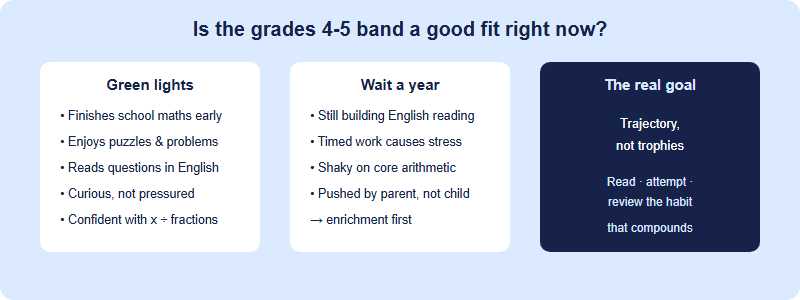
The elementary band is not a miniature version of the high-school olympiad track, and treating it that way is the most common mistake parents make. Its job is to give a young learner a first positive experience of competition maths: arithmetic fluency, number sense, simple geometry and word problems, sat under a gentle time limit in English. If your child enjoys puzzles, finishes the school maths book early, and is comfortable reading questions in English, the grades 4-5 band is a natural place to begin.
It is equally important to know when not to push. A student who is still building basic English reading, or who finds timed work stressful at this age, is better served by a year of unpressured enrichment first. The grade-band guide exists precisely so families pick the level that matches the child in front of them rather than the grade on the form. The elementary band should feel like an interesting challenge, not an anxiety machine.
- Contest registration
- Free past papers
- 1-on-1 trial lesson

One framing helps China families calibrate: in primary school, the goal is trajectory, not trophies. A grade-4 student who learns to read a problem carefully, attempt it, and review the answer afterwards has gained something far more durable than a single ranking. That habit is what later pays off if they progress toward the grades 6-8 band and beyond.
What the elementary contest looks like
Math League’s elementary contests are short, age-scaled events — a fixed set of questions answered within a modest time limit, designed so a strong primary student can attempt most of them without specialist training. The emphasis is on accuracy and clear thinking rather than the heavy, multi-step proofs that appear higher up the ladder. Because the exact question count, time limit and contest dates for the grades 4-5 band are the kind of detail Math League sets each year, treat them as values to confirm on the official site rather than numbers to assume.
What you can rely on is the shape of the experience. The contest is self-contained, sat in English, and pitched at the curriculum a strong 9-to-11-year-old is meeting at school — extended slightly to reward genuine number sense. There is no calculator-heavy gimmickry and no expectation of competition jargon. A child who can add, subtract, multiply and divide confidently, reason about simple fractions and shapes, and read a word problem carefully has the tools to engage.
The table below separates what is structurally true about the elementary band from the specifics you must verify for the current year.
| Aspect | What is structurally true | What to verify on mathleague.com |
|---|---|---|
| Band | Grades 4-5 is the youngest official level (Math League serves grades 4-12) | Whether your child's grade maps to this band this year |
| Format | Short, fixed set of age-scaled questions under a time limit, sat in English | Exact question count & time limit for grades 4-5 |
| Content | Arithmetic, number sense, simple geometry, word problems | Any published topic guidance for the current contest |
| Dates | Regular-season contests run across the school year | The specific grade 4-5 contest date(s) for your region |
| Registration (Asia) | Asia-based students use a region-specific route, not the default page | The correct contact & process for your school/student |
| Fee | Participation carries a cost | Current fee & what it covers |
How to start from China
The single most important logistical fact for China-based families is that Math League directs Asia-based participants to a region-specific route rather than the standard online registration page used elsewhere — students in Asia are told to contact the organisation directly. So before you click any public sign-up button, confirm the correct channel for your school or individual student. This applies to the elementary band just as it does to the older levels.
Practically, schools often run Math League contests as a cohort, which is the smoothest path for a grade-4 or grade-5 student: a teacher coordinates registration, timing and invigilation, and your child sits the contest with classmates. If your school does not yet offer it, the action is to ask the school, then verify the individual or group route on the official site. Either way, the registration mechanics, dates and fee are details to pin from mathleague.com, not to assume from how other competitions work.
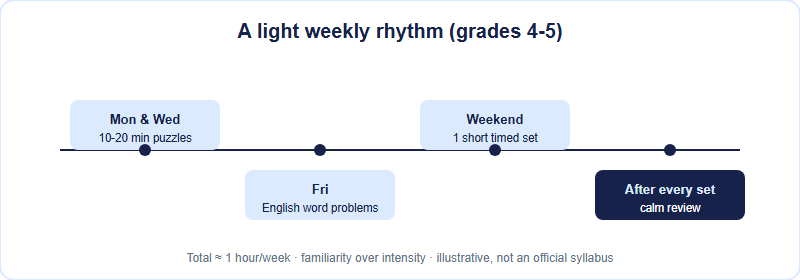
A short readiness runway helps. In the weeks before a first contest, have the child do a little timed practice so the clock is not a surprise, make sure they can comfortably read English word problems, and rehearse the simple discipline of writing answers clearly. None of this needs to be intense — at this age, the aim is familiarity, not drilling.
A light, age-appropriate prep approach
The wrong move at grades 4-5 is to import a high-school competition study plan. The right move is small, consistent, and enjoyable. Three or four short sessions a week, ten to twenty minutes each, doing varied problems the child finds interesting, will do more than a heavy weekend block that turns maths into a chore. The broader study roadmap makes the same case for every level: steady review beats heroic cramming — and that is doubly true for young learners whose relationship with the subject is still forming.
Focus the practice on the four things the elementary contest actually rewards:
- Arithmetic fluency — quick, accurate work with the four operations, so simple steps do not eat the clock.
- Reading the question in English — the skill of turning a word problem into a calculation, which for many China students is the real bottleneck, not the maths itself.
- Number sense — estimating, spotting patterns, and sanity-checking whether an answer is plausible.
- Reviewing afterwards — going back over missed problems calmly, which is where the learning actually happens.
Keep score lightly. A young learner who improves their own past result, or simply enjoys the puzzles more this term than last, is on exactly the right path. Rankings will matter later; right now, the win is a child who looks forward to the next contest.
Where the elementary band leads next
The point of starting at grades 4-5 is not the elementary contest itself — it is the runway it builds. A student who has had two or three relaxed, positive seasons at the elementary level arrives at the broader Math League ladder already comfortable with the format, the English, and the rhythm of competing. When they reach the grades 6-8 band, the step up is in content, not in the basic experience of sitting a contest, which they have long since normalised.
For China-based families, that is the strongest argument for the elementary band: it is a low-cost, low-pressure way to find out whether a child genuinely enjoys competition mathematics, and to build the habits that compound if they do. Keep the experience light, let the child lead, and pin every operational detail — dates, the registration route for Asia, and the current fee — from the official site before each season.
FAQ
What is the youngest grade for Math League?
Math League serves grades 4 through 12, so grades 4-5 is the youngest official band. Whether your child's grade maps to it this year should be confirmed on mathleague.com.
How many questions are on the grades 4-5 contest?
The exact question count and time limit are set per year and per region, so treat them as values to confirm on the official site rather than fixed numbers to assume.
Does my grade-4 child need special competition training?
No. Strong arithmetic, number sense and the ability to read English word problems are enough to engage; the aim at this age is a positive first experience, not heavy drilling.
How do students in China register for the elementary band?
Math League directs Asia-based participants to a region-specific route, not the default page. Confirm the correct contact and process on mathleague.com before signing up.
This is an independent guide operated by Hanlin Education for China-based international-school students. It is NOT affiliated with, endorsed by, or sponsored by the official Math League (mathleague.com). Grade bands, contest formats, dates, fees and registration procedures vary by year and region — confirm current details on mathleague.com before registering or competing. Any errors will be corrected within 7 working days.