The Math League grades 6-8 band is the middle rung of a contest founded in 1977 and run for grades 4 through 12 — and it is the one China families most often overlook, jumping from a primary-school start straight toward high-school olympiad talk. That is a mistake. For an 11-to-14-year-old, the middle-school band is where competition mathematics stops being a novelty and starts building the reasoning habits the grades 9-12 series later demands. This guide explains what the middle contest involves, who it suits, and how to grow a student across three grades — while flagging which specifics you must confirm on mathleague.com.
Why the middle-school band is the pivot point
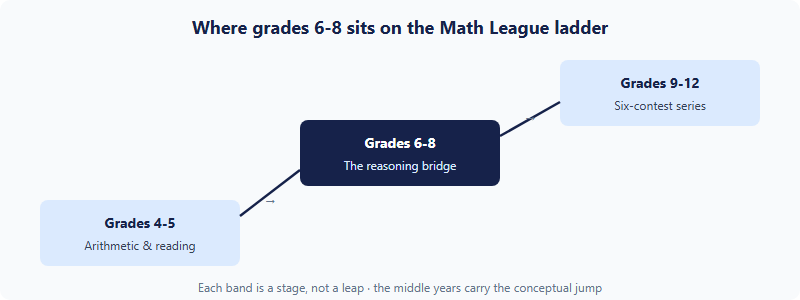
Every ladder has a step where the character of the climb changes, and for Math League that step is grades 6-8. Below it, the grades 4-5 elementary band rewards arithmetic fluency and careful reading; above it, the grades 9-12 series rewards multi-step problem solving under real pressure. The middle band is the bridge between the two — the years in which a student moves from "can I compute this accurately?" to "can I see which idea unlocks this problem?"
That transition is exactly why skipping it is costly. A China student who competes happily at grades 4-5 and is then pushed toward high-school competition material often stalls, because the conceptual jump is too large to make in one leap. The grades 6-8 band exists to make that jump in three manageable stages instead. Treated as the pivot it is, middle school is where a genuine mathematician is quietly built; treated as a box to skip, it becomes the gap that later shows up as a plateau.
- Contest registration
- Free past papers
- 1-on-1 trial lesson

There is a second reason the band matters specifically for international-school families. Grades 6-8 is the age at which many students meet timed, English-language competition mathematics seriously for the first time — reading the question, not just solving it, becomes the real constraint. Clearing that layer at 12 or 13, when the stakes are modest, is far easier than discovering it at 15 in the middle of the high-school series.
What the grades 6-8 contest actually looks like
Math League's own competition-format page describes the middle-school contest as a short, self-contained event: a fixed set of multiple-choice questions answered within a modest time limit, sat in English, with no penalty designed to punish a careful guess. The site publishes the middle band as more questions than the elementary band, with the exact count and timing set per year — a noticeably brisker pace than the elementary band's slower, fewer-question paper — but because Math League sets contest specifics fresh each year and by region, treat the exact count, timing and calculator policy as values to confirm on the official site for your contest rather than numbers to assume.
What you can rely on is the shape of the experience, and it differs from both neighbouring bands in ways worth understanding. The elementary contest rewards speed and accuracy on familiar arithmetic. The high-school series, by contrast, uses fewer questions with more depth. The middle band sits between: enough questions that pace matters, but problems that increasingly require a genuine idea rather than a memorised procedure. A strong middle-schooler will find the opening questions approachable and the closing ones genuinely challenging.
The table separates what is structurally true about the middle band from the specifics you should verify for the current year.
| Aspect | What is structurally true | What to confirm on mathleague.com |
|---|---|---|
| Band | Grades 6-8 is the middle level (Math League serves grades 4-12) | Whether your child's grade maps to this band this year |
| Format | Short multiple-choice contest under a time limit, sat in English | Exact question count & time limit for the current contest |
| Pace | Brisker than grades 4-5; the site publishes more questions than the elementary band, with the exact count and timing set per year | Current-year timing and any per-region variation |
| Guessing | No penalty designed to punish a careful guess | The exact marking rule for your contest |
| Calculators | Set per contest — confirm for your sitting | Current calculator policy for your sitting |
| Content | Number, algebra, geometry, counting & probability at middle-school depth | Any published topic guidance for the current contest |
Who the band suits — and how grade 6, 7 and 8 differ
The honest entry test for grades 6-8 is not a grade on a form; it is a pair of questions. First, can the student read a multi-sentence word problem in English and turn it into mathematics without help? Second, do they enjoy a problem that does not yield to the first thing they try? A student who answers yes to both is ready, whether they are in grade 6 or grade 8. A student who is still shaky on either is better served by another season at the elementary level, or a term of unpressured enrichment first — the grade-band guide is built for exactly this decision.
Within the band, the three grades are not interchangeable, and planning across them is what separates a coherent three-year run from a scattered one. A useful way to think about it:
- Grade 6 — settle the format. The priority is normalising the experience: the clock, the English phrasing, the multiple-choice answer discipline. Content stays close to a strong school curriculum; the win is a student who finishes the contest calm rather than rattled.
- Grade 7 — widen the toolkit. This is the year to deliberately broaden across the core domains, so the student meets a variety of problem types and stops relying on a single favourite method. Pace becomes a real skill: with more questions than depth allows time for, choosing what to attempt matters.
- Grade 8 — reach toward depth. By the final middle year, the strongest students should be handling genuine multi-step problems and previewing the kind of thinking the grades 9-12 series rewards. This is the bridge year in the truest sense.
None of this requires importing a high-school study plan — that is the opposite error from skipping the band, and just as counterproductive. The middle years reward breadth and steady exposure far more than heavy specialisation. A student who meets a wide range of problems at a comfortable rhythm will out-develop one who grinds narrow olympiad material too early.
What to study: the four domains that dominate
Middle-school competition mathematics draws, in the main, from four broad areas, and a student who is comfortable across all four is well placed regardless of the exact question mix on the day. This is general mathematical territory rather than a Math-League-specific syllabus, so use it as a study map, not a promise about any particular contest — the official site is the place to check for any published topic guidance for your year.
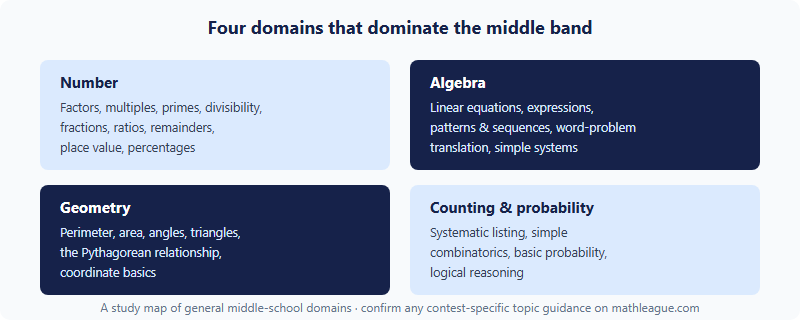
The practical instruction that follows from this map is simple: spread attention across all four domains rather than over-investing in the one the student already likes. Middle-schoolers who are strong at, say, number work will happily do more of it and quietly avoid geometry — and it is precisely the avoided domain that costs them marks. A short, honest audit of which of the four feels weakest, followed by deliberate practice there, is the highest-return move in the whole band.
A sustainable way to prepare across three grades
The preparation principle that works at every level of Math League works here too: steady rhythm beats heroic cramming. The broader study roadmap makes the full case, but for the middle band the specifics are worth stating plainly. Three short sessions a week — one timed section from an official past paper, one honest review of every question missed (asking why, not just noting the right answer), and a little targeted work on the weakest domain — will develop a student faster than a single long weekend block that turns mathematics into a chore.
Two middle-school-specific habits pay off disproportionately. The first is pace awareness: because the contest asks more questions than a slow, perfectionist approach has time for, students must learn to move on from a stubborn problem and return to it, rather than sinking the clock into one item. The second is reviewing in English: for many China students the bottleneck is not the mathematics but the reading, so reviewing why a word problem was misread is as valuable as reviewing the calculation. Both habits, learned at 12 or 13, transfer straight into the high-school series.
Across the three years, keep the emphasis on trajectory. A grade-6 student who competes calmly, a grade-7 student who has widened their toolkit, and a grade-8 student who is starting to enjoy genuinely hard problems together form the runway to the wider Math League ladder. That is the real prize of the middle band — not any single result, but a student who arrives at high school already fluent in the experience of competing.
FAQ
What grades does the Math League middle-school band cover?
Grades 6-8. Math League serves grades 4 through 12, and the middle band sits between the grades 4-5 elementary level and the grades 9-12 series.
How many questions are on the grades 6-8 contest?
Math League's competition page publishes the middle band as more questions than the elementary band, with the exact count and timing set per year, but specifics are set per year and region, so confirm the current count and timing on mathleague.com.
Is there a penalty for guessing on the middle-school contest?
Math League states there is no penalty designed to punish a careful guess, so a reasoned attempt on an uncertain question is sensible. Confirm the exact marking rule for your contest on the official site.
Should a grade-6 student use a high-school study plan?
No. The middle years reward breadth and steady exposure across core domains far more than early narrow specialisation; importing a high-school plan too soon tends to backfire.
This is an independent guide operated by Hanlin Education for China-based international-school students. It is NOT affiliated with, endorsed by, or sponsored by the official Math League (mathleague.com). Grade bands, contest formats, question counts, timings, calculator policies, dates and fees vary by year and region — confirm current details on mathleague.com before registering or competing. Any errors will be corrected within 7 working days.