Short answer: The explain-it-back technique helps students who solve problems confidently in Chinese but hesitate or make errors in English. By verbalizing each reasoning step aloud and then writing it in English, you expose hidden vocabulary gaps and logic jumps before they cost points on the 12 December 2026 preliminary. This 10-minute weekly drill builds the bilingual fluency needed for the second round’s oral explanation requirement.
Why Solving in Chinese Does Not Guarantee English Success
Many students in China first encounter Math League problems through Chinese translations. They develop strong intuition for the contest’s scenario-based questions—word problems about pizza slices, bus schedules, or garden layouts. Yet the same students often struggle on the bilingual paper, not from weak mathematics but from translation lag: the mental friction of converting a Chinese solution path into English mathematical expression.
The 2026-27 preliminary introduces a bilingual paper for the first time, according to ‘Major Announcement: Math League Preliminary Registration Opens! First-Ever Chinese-English Bilingual Paper!’ (Hanlin Courses WeChat, 8 November 2026). Students can read Chinese translations, but the second round includes oral explanation. This creates a diagnostic need: identify the exact moment where Chinese reasoning and English output diverge.
- Contest registration
- Free past papers
- 1-on-1 trial lesson

The Explain-It-Back Protocol
The explain-it-back method is a structured self-interview. After solving any practice problem, you force yourself to teach your solution back to an imaginary listener—first in Chinese, then in English. The gap between the two versions reveals your actual weakness.
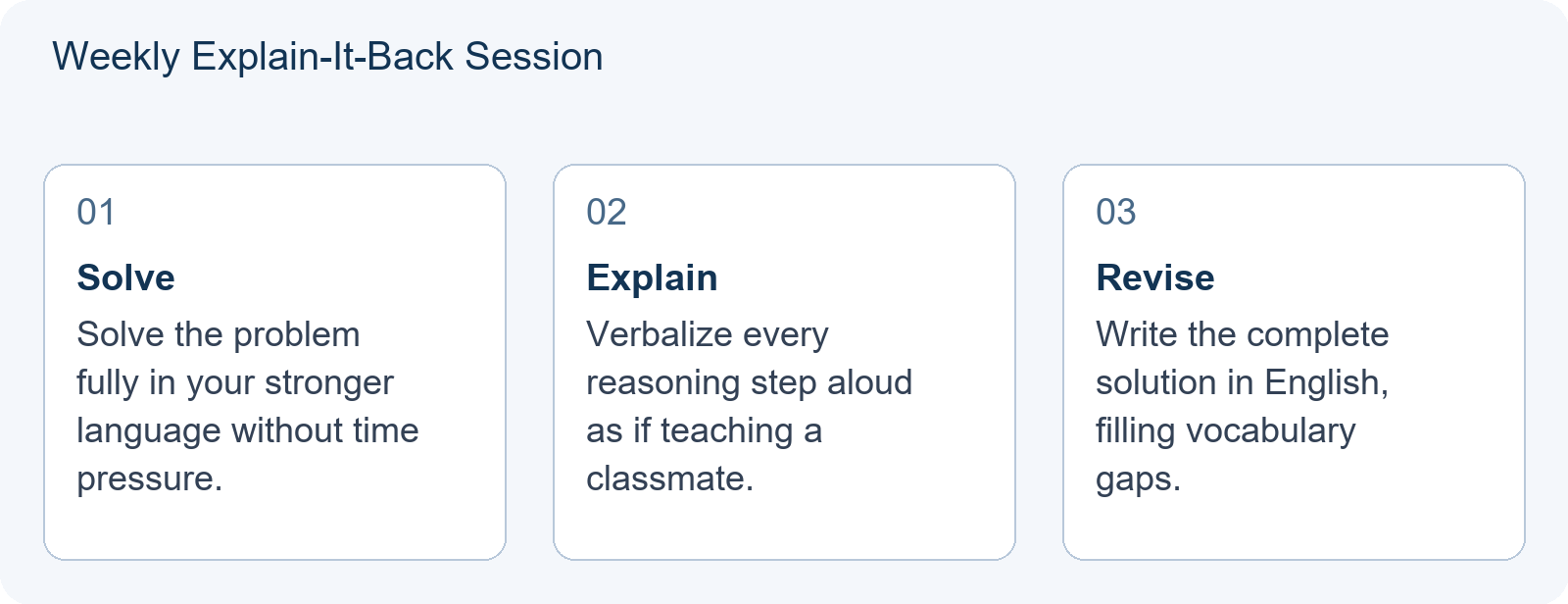
Here is the four-phase protocol we use in coaching sessions:
| Phase | Time | Task | What to Capture |
|---|---|---|---|
| Solve | 0–2 min | Solve normally in your stronger language | Final answer and key intermediate values |
| Explain | 2–5 min | Verbalize the full reasoning chain aloud | Every “because” and “therefore” in the logic |
| Follow-up | 5–7 min | Answer a probing question about your method | Whether you truly understood or memorized a pattern |
| Revise | 7–10 min | Write the complete solution in English | Vocabulary gaps, awkward phrasing, missing justifications |
The total session lasts ten minutes. The first two phases establish that you understand the problem deeply. The follow-up question prevents pattern-masking—answering “why did you choose LCM rather than simple multiplication?” forces genuine comprehension. The final revision phase is where most students discover their English-specific stumbling blocks.
Common Diagnostic Patterns from Coaching
After running this protocol with students preparing for the Math League Bilingual Paper 2026-27, we observe three recurring failure modes:
Pattern 1: The Vocabulary Cliff
A student solves a counting problem perfectly in Chinese. When asked to explain in English, they stall at “How do I say ‘pairwise coprime’?” They know the concept—pairwise coprime—but lack the English term. On test day, this becomes either a skipped question or a misread condition.
Pattern 2: The Shortcut Trap
A student uses a Chinese textbook shortcut: “When you see remainder problems with 3 and 5, use LCM 15.” They explain this fluently in Chinese. But when pressed in the follow-up phase—”Why does LCM give the cycle length?”—they cannot justify it. The English revision then collapses because there is no genuine logical chain, only pattern-matching.
Pattern 3: The Precision Drop
A student writes in Chinese: “The probability is 1/6 because there is one favorable outcome out of six total.” Their English revision becomes: “Probability is 1/6, very small.” They lost the causal connector, the enumeration logic, and the comparative framing—all in one language switch.
These patterns map directly to the demands of the second-round oral explanation, where students must explain their reasoning aloud.
A Worked Teaching Illustration
Here is an original teaching example we use to demonstrate the protocol. It is not an official contest problem.
Teaching illustration: A bakery has three types of pastries: croissants, muffins, and tarts. Each customer buys exactly two different types. After serving several customers, the baker notices that every possible pair of types has been chosen by at least one customer. What is the minimum number of customers needed?
Phase 1 — Solve (Chinese): The pairs are {croissant, muffin}, {croissant, tart}, {muffin, tart}. Three pairs, so three customers minimum.
Phase 2 — Explain aloud: “We need to cover all combinations of two types from three types. The number of combinations is C(3,2) = 3. Each customer selects one combination. Therefore, minimum customers equals 3.”
Phase 3 — Follow-up question: “What if the problem said ‘at least two different types’ instead of ‘exactly two’?”
Pause here. Many students initially miss that a customer could buy all three types. The follow-up exposes whether their original answer was reasoned or lucky.
Phase 4 — English revision:
There are three types of pastries. A customer buys exactly two different types, so each customer chooses one pair from the possible pairs: croissant-muffin, croissant-tart, or muffin-tart. Since there are C(3,2) = 3 possible pairs and each customer covers one pair, we need at least 3 customers to ensure every pair is chosen.
Compare this to a typical student draft: “3 customers because 3 pairs.” The revision phase forces the full logical scaffolding into English.
Building Your Weekly Drill
For optimal results, start this protocol six weeks before any preliminary. Speed comes from eliminating hesitation, not rushing calculations.
| Week | Focus | Success Metric |
|---|---|---|
| 1–2 | Phase 1–2 only: Solve and explain aloud in Chinese, then English | English explanation takes ≤3 minutes without dictionary use |
| 3–4 | Add Phase 3 follow-up: Prepare two probing questions per problem | Answer follow-up without returning to the original solution |
| 5–6 | Full protocol: Complete English written revision | Revision contains no undefined terms; a peer could learn from it |
When to Use the Chinese Line Strategically
The bilingual paper offers a Chinese translation, but use it strategically. We advise: read the English first, mark vocabulary unknown, confirm with Chinese, then solve. This trains English acquisition rather than translation dependency.
Students who skip the explain-it-back protocol often report: “I understood the problem, but my English answer was marked wrong.” Invariably, their understanding was procedural; their English output was incomplete. The protocol catches this before exam day.
Diagnosing Your Own Explain-It-Back Gaps: A Self-Scoring Rubric
The protocol works only if you can spot where your Chinese and English explanations diverge. Students often feel they “understood” a problem when they actually executed a memorized pattern. This section provides a concrete rubric to self-diagnose whether your explain-it-back session is building real bilingual fluency or merely reinforcing translation habits.
After completing the four-phase protocol, score your English revision against three criteria: logical completeness, causal explicitness, and vocabulary precision. Each criterion uses a simple 0–2 scale. A total score below 4 signals a specific gap to address before the 12 December 2026 preliminary.
| Criterion | Score 0 | Score 1 | Score 2 |
|---|---|---|---|
| Logical completeness | Skipped steps; listener cannot reconstruct the solution | All steps present but some compressed or reordered | Every deduction explicit; a peer could write the solution from your explanation alone |
| Causal explicitness | No “because” or “therefore”; only statements of fact | Some causal links present, others implied | Every transition justifies why the next step follows |
| Vocabulary precision | Key terms missing, approximated, or misused | Terms present but some awkward or circuitous | Standard mathematical terms used naturally and correctly |
Here is how to apply the rubric to a genuine student revision. Consider this English draft produced after solving the bakery problem in Chinese: ‘3 customers because 3 pairs.’ Scoring: logical completeness 1 (the answer and count appear, but the pairing logic is unexplained), causal explicitness 0 (no justification for why there are 3 pairs or why each customer covers one), vocabulary precision 1 (‘pairs’ is intelligible but ‘combinations’ is more precise). Total 2. The diagnosis: this student has the correct intuition but compresses the reasoning into a label.
The immediate next practice task targets the lowest-scoring criterion. For causal explicitness, the student must rewrite one sentence adding a because-clause: ‘We need 3 customers because there are C(3,2) = 3 ways to choose 2 different pastries from 3 types, and each customer selects exactly one pair.’ If vocabulary precision were the weakness, the task would be to replace ‘pairs’ with ‘combinations’ and state the formula C(3,2) aloud.
A common misinterpretation: students score themselves high on logical completeness because they “would have” explained a step if asked. The rubric demands what you actually wrote or said. Record your explain-it-back sessions on your phone for thirty seconds during the verbal phase; playback reveals hedges and omissions that memory suppresses.
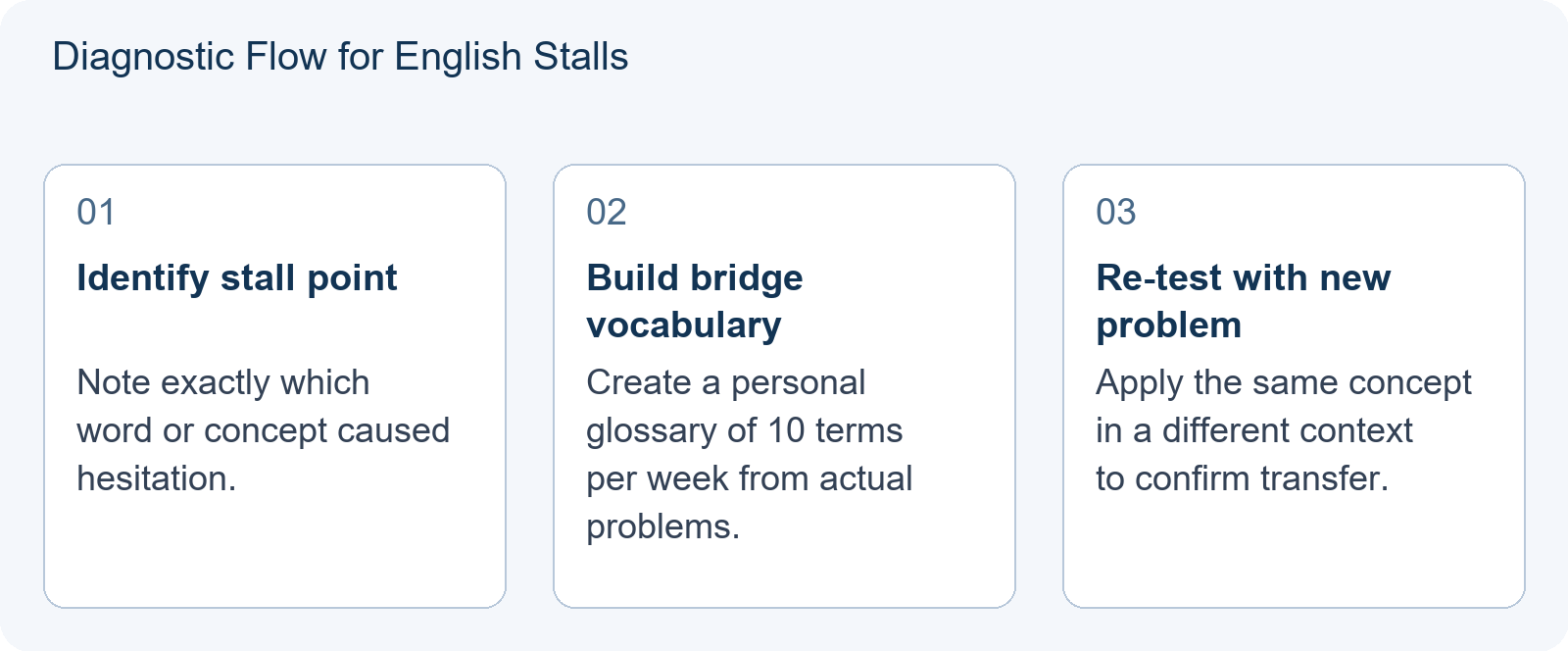
Over six weeks, track your scores in a simple table. If logical completeness stays at 1 while causal explicitness improves, you are translating Chinese reasoning without restructuring it for English mathematical register. If vocabulary precision lags, build a personal glossary from your revisions: not generic word lists, but terms you actually needed and lacked, such as “pairwise coprime” or “mutually exclusive.”
The rubric also prevents a subtle trap: the illusion of fluency from bilingual students who speak conversational English well but compress mathematical reasoning. A student who says “It’s obvious” in fluent English scores 0 on causal explicitness regardless of accent or speed. The protocol’s value lies in exposing that mathematical English is a separate register, not merely Chinese thought in English words.
General event background is available at Event background.
This is an independent preparation guide, not affiliated with, endorsed by, or sponsored by Math League.
Frequently Asked Questions
Does this method work if my English is very basic?
Yes. Start with single-sentence explanations: ‘I used LCM because the events repeat.’ The protocol builds complexity gradually. Basic English with complete logic beats advanced vocabulary with missing steps.
How does this relate to the second round’s oral component?
The second round includes oral explanation of solutions. The explain-it-back protocol is essentially solo rehearsal for that format. Students who practice ten minutes weekly often report calmer second-round performance.
Can I use this for other competitions like AMC 8?
The method transfers, but AMC 8 does not have an oral round. The English-writing phase remains valuable for showing work clearly, which AMC 8 scoring rewards.