You can verify Math League answers in under 30 seconds per problem by combining two methods: inverse operations (plugging your answer back into the original condition or reversing each step) and estimation bounds (setting quick upper and lower limits before you calculate, then confirming your exact answer falls inside). The 2026-27 preliminary round on 12 December gives students 75 minutes with substantial question count, making time management and accuracy under pressure essential. These verification habits catch the arithmetic slips and misread answers that cost points on problems students otherwise know how to solve.
The Cost of Not Checking: Common Error Types in Math League
Math League problems reward careful reading and precise execution. Based on the competition structure for the 2026-27 season, the preliminary round uses bilingual Chinese-English papers with 75 minutes to complete a large question set (Hanlin Course, WeChat, 8 November 2026). Students who finish problems but skip verification often lose points to predictable error types.
Sign errors rank among the most frequent. A student solves 3x − 7 = 14 and arrives at 3x = 7 so x = 7/3, rather than 3x = 21 and x = 7. The specific slip matters less than the pattern: a sign or arithmetic error that feels right in the moment.
- Contest registration
- Free past papers
- 1-on-1 trial lesson

Unit confusion causes similar losses. A problem asks for minutes; the solver produces hours. A percentage problem requests the original amount; the solver gives the discounted price. These errors survive because the calculation itself is correct—the wrong quantity was computed.
Transcription errors plague answer entry. The scratch work shows 42; the answer sheet receives 24. Or a fraction 7/12 becomes 12/7 when transferred. With online preliminary formats requiring typed or selected answers, these slips have immediate consequences.
The 2026-27 preliminary uses a bilingual paper format, which may reduce reading-time pressure but does not eliminate execution errors. For details on how the bilingual paper works in practice, see Math League Bilingual Paper 2026-27: When to Use the Chinese Line in the 12 December Preliminary.
Method One: Inverse Operations
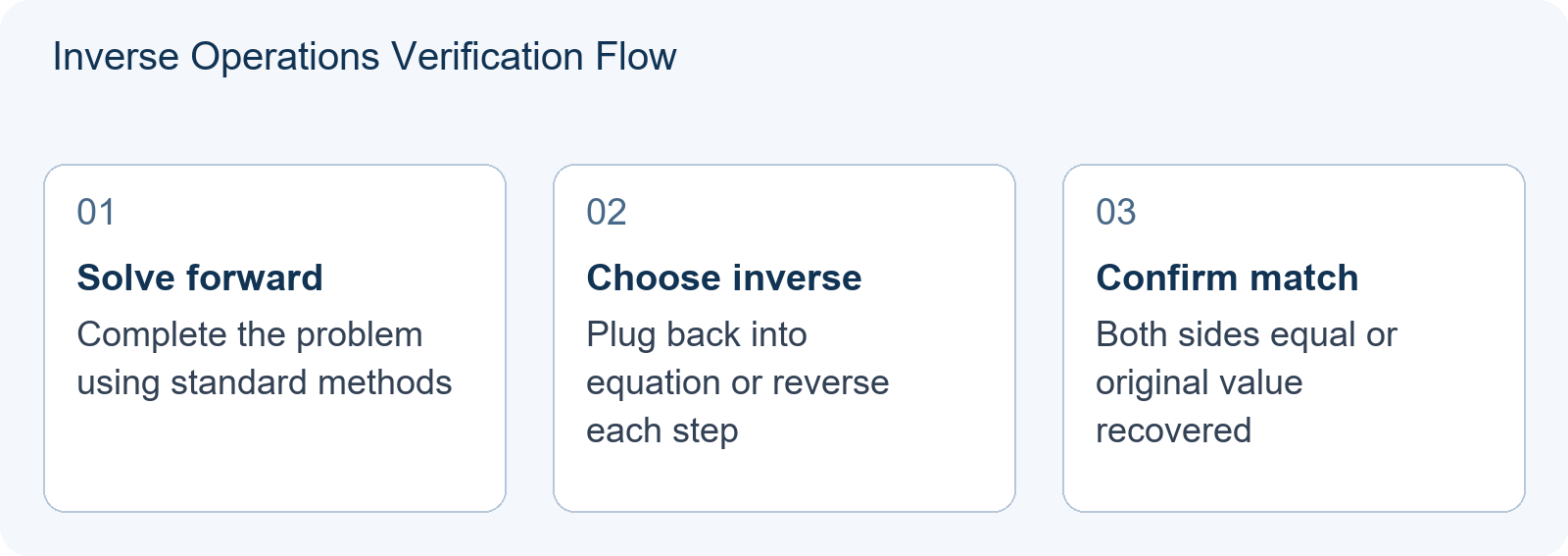
Inverse operations reverse the mathematical action to verify a result. If addition was used, subtract. If multiplication was used, divide. If a square was taken, square-root. This method excels when the problem presents a clear equation or when the answer can be substituted back into original conditions.
When to Plug Back
Use direct substitution when the problem asks you to solve for a variable and the answer choices or your computed result can be tested in the original equation. This is fastest when the equation is linear or simple polynomial.
Teaching illustration: Solve 2(x − 3) + 5 = 3x − 4.
A student works through: 2x − 6 + 5 = 3x − 4, so 2x − 1 = 3x − 4, thus 3 = x.
Plug back: 2(3 − 3) + 5 = 2(0) + 5 = 5. Right side: 3(3) − 4 = 9 − 4 = 5. Both sides equal 5. Verification complete in seconds.
When to Reverse the Step
When direct substitution is awkward—perhaps due to complex fractions or nested operations—reverse each transformation step by step.
Teaching illustration: A problem states: “A number is multiplied by 4, then 7 is added, then the result is divided by 3 to get 15. Find the original number.”
Forward solution: Let n be the number. Then (4n + 7)/3 = 15. So 4n + 7 = 45, thus 4n = 38, and n = 9.5.
Reverse verification: Start with 15. Multiply by 3: 15 × 3 = 45. Subtract 7: 45 − 7 = 38. Divide by 4: 38/4 = 9.5. The original number checks.
Time-Efficient Inverse Checks
If an inverse check takes longer than solving the problem a second time, switch to estimation or flag the problem for later. The 75-minute time limit rewards efficiency. Inverse operations should feel automatic, not become a second full solution.
For pacing strategies that build verification windows into your contest plan, see Math League Preliminary Time Budget: A 75-Minute Three-Pass Plan for 12 December 2026.
Method Two: Estimation Bounds
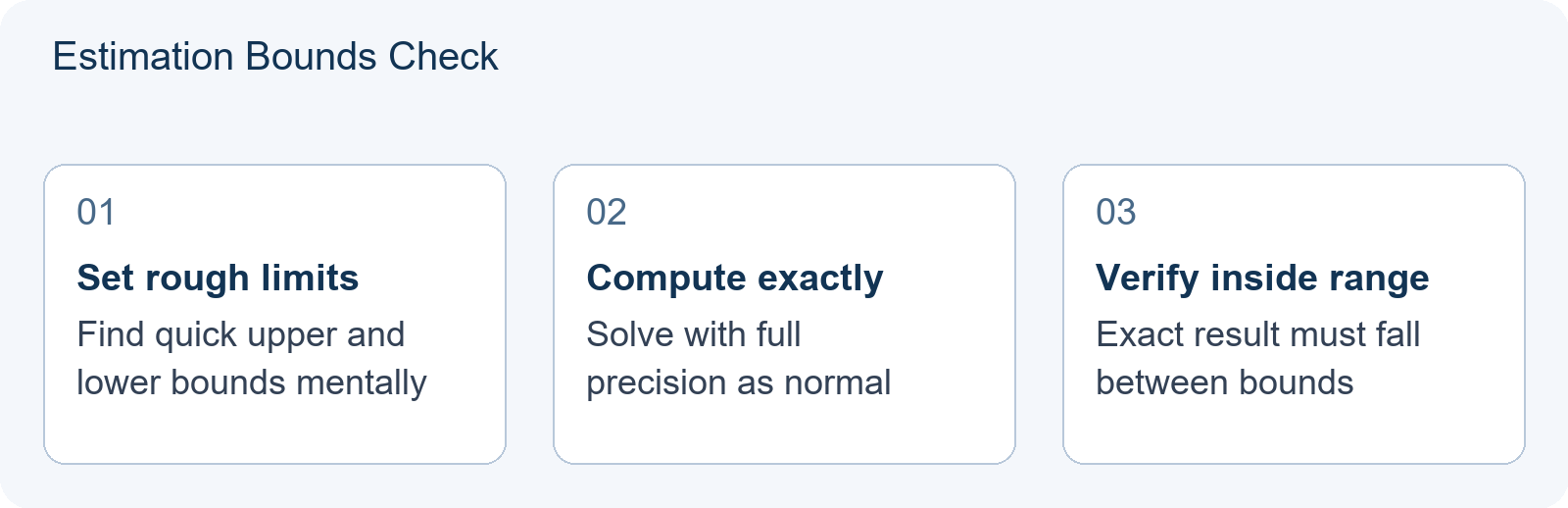
Estimation bounds set quick upper and lower limits before calculating, then confirm the exact answer falls inside. This method catches order-of-magnitude errors, decimal point slips, and impossible results that somehow emerge from correct-looking steps.
Setting Limits Before Calculating
Before touching a calculator or writing detailed steps, ask: what would be obviously too large? Obviously too small? These anchors need only be rough.
Teaching illustration: What is 23% of 487?
Before calculating: 20% of 500 would be 100. So the answer should be somewhat less than 100, maybe around 110–115. 25% of 480 would be 120. So bounds: between 100 and 120.
Exact calculation: 0.23 × 487 = 112.01. The result falls comfortably inside. If a student somehow computed 1,120 or 11.2, the bounds would catch it instantly.
Confirming After Calculating
The confirmation step compares exact against estimated. Discrepancies trigger recalculation, not guesswork.
Teaching illustration: A rectangle has length 18.7 cm and width 6.3 cm. Find its area.
Bounds: Round to 20 × 6 = 120, or 19 × 6 = 114. The exact answer should be slightly above 110.
Exact: 18.7 × 6.3 = 117.81. This fits. A student who wrote 1,178.1 or 11.781 would recognize the error immediately.
Percentage and Ratio Sanity Checks
Percentage problems especially benefit from estimation. A result over 100% when finding a part of a whole, or a discount exceeding the original price, signals error.
Teaching illustration: A $240 jacket is discounted by 15%. What is the sale price?
Bounds: 10% of 240 is 24, so 15% is about 36. The discount should be under $50. Sale price must be above $200.
If a student computed 240 × 0.15 = 360 instead of 36, or subtracted to get 240 − 15 = 225 (confusing percentage with dollars), the bounds catch it. Correct: 240 − 36 = 204.
For more on percentage structures in Math League problems, see Fractions, Ratios and Percents on Math League: The Four Question Shapes and the Conversion Moves That Save Marks (Grades 4-12, 2026-27).
Decision Tree: Which Method Fits Which Problem Type
| Problem Type | Recommended Method | Why It Works |
|---|---|---|
| Linear equations, simple algebra | Inverse operations (plug back) | Direct substitution is fastest; arithmetic is reversible |
| Multi-step word problems | Reverse the step | Each operation can be undone in sequence |
| Percentage, ratio, proportion | Estimation bounds | Order-of-magnitude catches decimal and unit errors |
| Geometry area/volume | Estimation bounds | Round dimensions, compare against exact formula result |
| Combinatorial counting | Inverse logic (smaller case) | Check if answer makes sense for a reduced version |
| Numerical computation | Both methods combined | Estimate first, compute exactly, verify with inverse or re-estimation |
Combinatorial problems resist simple inverse operations but yield to sanity checks. If a problem asks “how many ways” and your answer exceeds the total number of objects, or is negative, or fails for a smaller case you can enumerate mentally, the error is obvious.
Worked Example 1: Catching a Sign Error via Inverse Substitution
Teaching illustration: Solve for y: 5 − 2y = 3y + 15.
A student rushes and collects terms incorrectly: 5 − 15 = 3y − 2y, so −10 = y, thus y = −10.
Inverse check with y = −10:
- Left side: 5 − 2(−10) = 5 + 20 = 25
- Right side: 3(−10) + 15 = −30 + 15 = −15
25 ≠ −15. The error is caught. Re-solving correctly: subtract 3y from both sides and add 2y to both sides, or simply move terms: 5 − 15 = 3y + 2y, so −10 = 5y, thus y = −2.
Verify y = −2:
- Left side: 5 − 2(−2) = 5 + 4 = 9
- Right side: 3(−2) + 15 = −6 + 15 = 9
Match confirmed. Total verification time: brief enough to fit within contest pacing.
Worked Example 2: Spotting an Impossible Percentage via Order-of-Magnitude Check
Teaching illustration: In a school of 840 students, 35% participate in Math League. Of those participants, 20% also join the science club. How many students do both activities?
A student computes: 840 × 0.35 = 294 participants. Then 294 × 0.20 = 58.8, rounds to 59.
But suppose the student mistakenly calculates 840 × 0.35 = 2,940 (decimal error), then 2,940 × 0.20 = 588.
Estimation bounds catch this:
- 35% is roughly one-third. One-third of 840 is about 280.
- 20% is one-fifth. One-fifth of 280 is about 56.
The answer should be in the 50–60 range, certainly under 100. The erroneous 588 exceeds the total school population and violates the bound instantly.
Even without the decimal slip, the estimation confirms 59 is reasonable. The exact answer 58.8 rounds to 59, which sits inside the estimated range.
Building Speed: The 75-Minute Pacing Model
The 2026-27 Math League preliminary allots 75 minutes. The source note from Hanlin Course (WeChat, 8 November 2026) emphasizes that “the preliminary duration is 75 minutes, with substantial question volume”—75 minutes with substantial question count. This structure rewards students who build verification into their rhythm rather than treating it as an afterthought.
A practical three-pass approach:
- First pass (50–55 minutes): Solve all problems you can answer confidently. Mark uncertain problems. Do not verify extensively yet—just quick estimation bounds on problems that invite them.
- Second pass (15–20 minutes): Return to marked problems. Attempt skipped items. Use inverse operations on algebraic solutions.
- Third pass (3–5 minutes): Dedicated verification window. Run inverse checks on solved equations. Confirm estimation bounds on numerical answers. Check answer transcription.
The dedicated verification window prevents the common pattern of finishing with two minutes left, panicking, and skipping checks entirely. Building in 3–5 minutes as non-negotiable verification time transforms accuracy.
For the full three-pass plan with minute-by-minute guidance, see Math League Preliminary Time Budget: A 75-Minute Three-Pass Plan for 12 December 2026.
Preparing Your Personal Verification Toolkit
Effective verification is personal. Some students invert operations mentally; others need written reversal. Some estimate naturally; others must practice bounds-setting deliberately.
Before the 12 December preliminary, try this rehearsal:
- Select five past problems from your grade level.
- Solve normally, then apply the decision tree: inverse operations for algebraic problems, estimation bounds for numerical ones.
- Time each verification. Aim for brief inverse checks and quick estimation confirmations.
- Log which error types you catch. Sign errors? Unit confusion? Transcription? Target your weakest category.
This rehearsal builds automaticity so verification does not consume cognitive resources during the contest. The goal is not merely to check answers but to check them efficiently enough to preserve time for genuine difficulties.
For families preparing registration and seeking to understand how the preliminary round operates for China-based students, including the online format and two-camera setup, see Math League Online Preliminary Round (12 December 2026): The Two-Camera Setup, What Voids a Result, and a Home Rehearsal Plan for China Families.
General event background is available at Event background.
This is an independent preparation guide, not affiliated with, endorsed by, or sponsored by Math League.
Frequently Asked Questions
How long should each answer check take during the actual contest?
Aim for brief inverse operation checks and quick estimation bound confirmations—typically under half a minute. If a check takes longer than solving the problem again, flag the problem and return later or rely on your initial confidence. The 75-minute preliminary rewards efficient verification, not exhaustive re-calculation.
Can I use both methods on the same problem?
Yes, and for high-stakes problems or uncertain answers, you should. Estimation bounds work well as a first screen; inverse operations provide deeper confirmation for algebraic solutions. Combining both is especially valuable on multi-step word problems where multiple error types can compound.
What if my estimated bounds are too wide to catch my specific error?
Tighten your estimation skill with practice. Start by rounding to one significant figure, then progress to two. For percentage problems, use benchmark fractions (25% = 1/4, 20% = 1/5, 10% = 1/10). If bounds remain too loose for comfort, switch to inverse operations or solve a second time by a different path.