Short answer. For a two-set Math League Venn diagram question, the union — everyone in at least one set — is A + B − both. For three sets it is A + B + C − AB − AC − BC + ABC. Once the union is known, the “neither” group is total − union, and “only A” is A minus the part of A that overlaps. The reliable sequence is not “add the groups and hope”; it is label every region, sum the regions, compare with the stated total, then answer the exact question. This is a Hanlin preparation perspective for Grades 6–12 in the 2026–27 season, not official scoring guidance or a claim about an official Math League question taxonomy.
Why does adding the groups double-count?
A Venn diagram counts memberships, not people. If a student is in both the chess club and the Go club, that one student appears once in the chess count and once in the Go count. Adding the two club totals therefore counts that student twice. Subtracting the “both” group once removes the duplicate membership and leaves one count for the student.
The same logic explains the three-set signs. Start with A + B + C. A student in all three sets is counted three times. The three pairwise overlaps AB, AC and BC each contain that student, so subtracting all three pair terms removes the student three times — one subtraction too many. Adding ABC once restores a single count. That is why the formula is not simply A + B + C − AB − AC − BC.
- Contest registration
- Free past papers
- 1-on-1 trial lesson

| Question | Two sets | Three sets |
|---|---|---|
| At least one set | A + B − AB | A + B + C − AB − AC − BC + ABC |
| Neither set | Total − union | Total − union |
| Only A | A − AB | A − AB − AC + ABC |
Here AB means “in A and in B,” including any member who is also in C when three sets are present. If a question says “only A and B,” it means the pair-only region, so the all-three group must be removed.
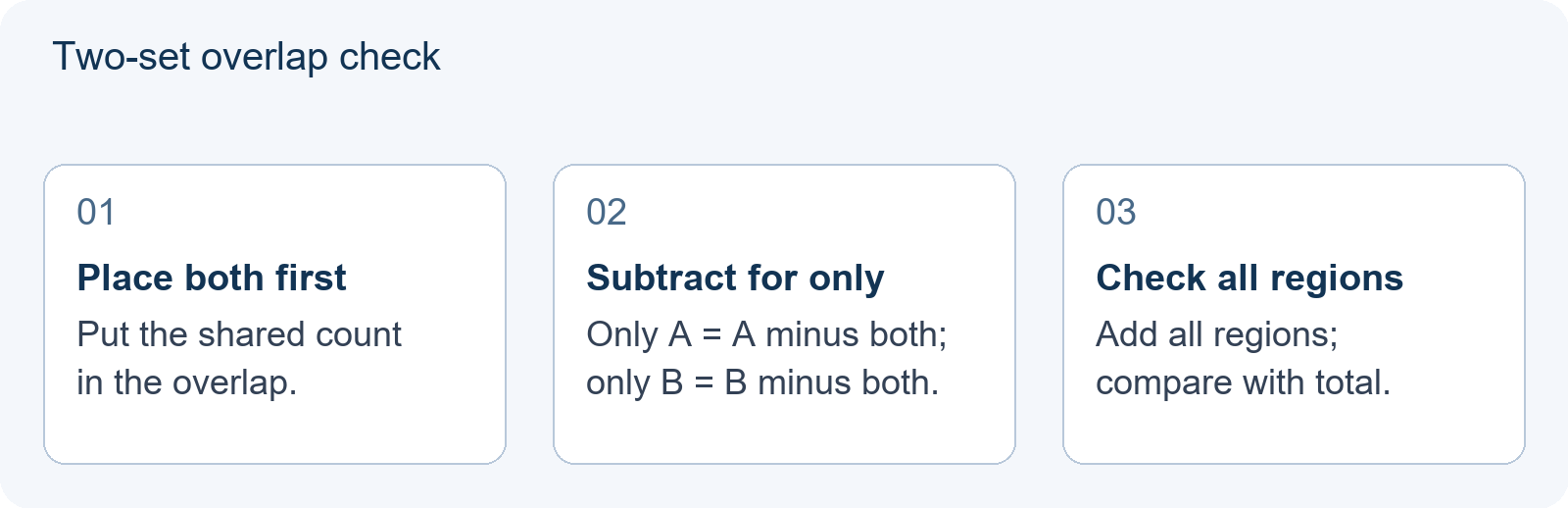
Two-set routine: place “both” before subtracting
Teaching illustration, hypothetical and not an official Math League question: 30 students are asked about chess and Go. 18 play chess, 15 play Go, and 7 play both. Find how many play at least one game and how many play neither.
Do not begin with 18 + 15 = 33, because the seven “both” students have been counted twice. Place 7 in the overlap first. Then only chess is 18 − 7 = 11, and only Go is 15 − 7 = 8. The three regions are 11, 7 and 8. Their sum is 26, so 26 students play at least one game. The total group is 30, so neither is 30 − 26 = 4.
The formula check is 18 + 15 − 7 = 26. The region check is 11 + 7 + 8 + 4 = 30, which matches the stated total. Both checks matter: the formula gives the union, while the region sum confirms that no student was omitted or counted twice.
If the question asks “how many play chess but not Go,” the answer is 11, not 18. If it asks “how many play exactly one game,” add the two only-regions: 11 + 8 = 19. The arithmetic is easy; the common error is answering the wrong region after doing correct arithmetic.
Three-set routine: work from the center outward
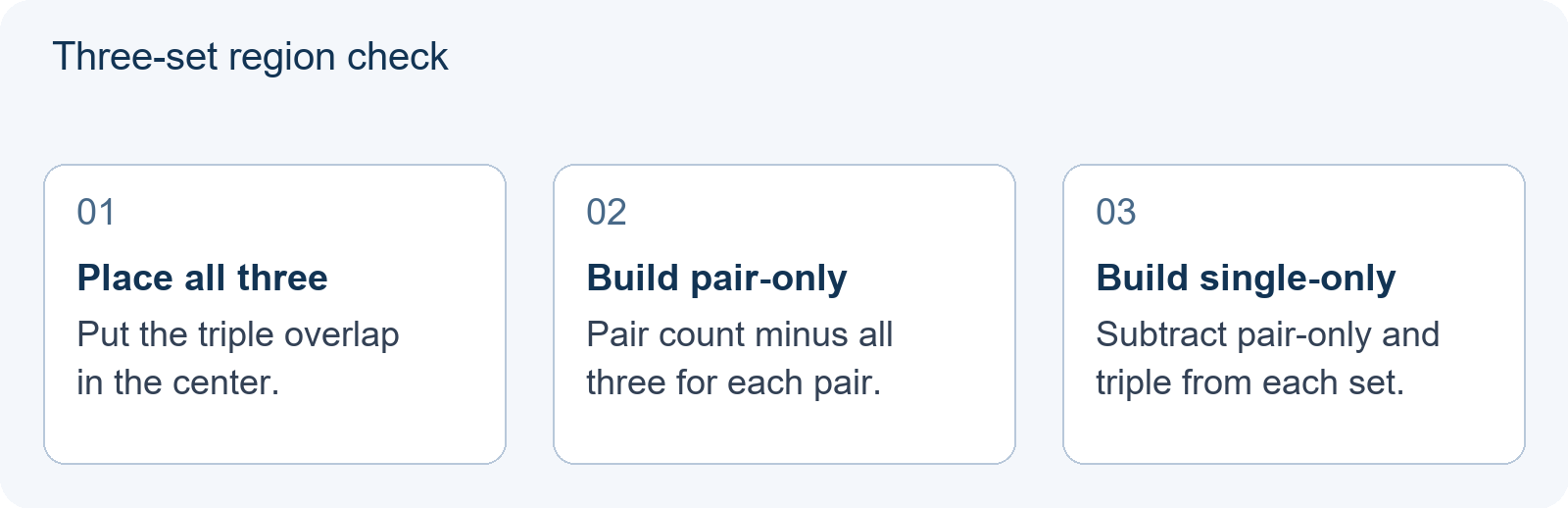
Teaching illustration, hypothetical and not an official Math League question: 40 students choose among activities A, B and C. 20 choose A, 18 choose B, 16 choose C, 8 choose A and B, 7 choose A and C, 6 choose B and C, and 3 choose all three. Find the number who choose at least one activity and the number who choose none.
Place the all-three count, 3, in the center first. Then build the pair-only regions. The A-and-B count of 8 includes the 3 who also choose C, so A and B only is 8 − 3 = 5. Similarly, A and C only is 7 − 3 = 4, and B and C only is 6 − 3 = 3. Only after those regions are placed should you build the single-only regions: A only is 20 − 5 − 4 − 3 = 8; B only is 18 − 5 − 3 − 3 = 7; C only is 16 − 4 − 3 − 3 = 6.
| Region | Count |
|---|---|
| A only | 8 |
| B only | 7 |
| C only | 6 |
| A and B only | 5 |
| A and C only | 4 |
| B and C only | 3 |
| All three | 3 |
| Neither | 4 |
The union is the sum of the first seven regions: 8 + 7 + 6 + 5 + 4 + 3 + 3 = 36. Therefore neither is 40 − 36 = 4. The formula check is 20 + 18 + 16 − 8 − 7 − 6 + 3 = 36. The region sum and the formula agree, and 36 + 4 = 40.
A student who subtracts every pair but forgets to add the all-three region gets 33, not 36. That is the most common three-set error. Another error is subtracting 3 from each single set twice. The center-outward order prevents both mistakes because each region is placed once and then used as a known quantity.
What should you ask before you calculate?
First, identify the exact target: “both,” “only one,” “at least one,” or “neither.” These are different regions. Second, check whether the total group is given. If the total is given, the union lets you find neither. If the union is given and one group count is missing, the same formula can be solved backward. Third, decide whether a phrase such as “A and B” includes the all-three group. In a three-set problem, standard wording usually does include it unless the question says “only A and B.” Fourth, note whether the question gives pair counts that already exclude the all-three group; if so, do not subtract the center again.
A useful habit is to rewrite the question in region language before touching numbers: “Find the sum of A only, B only and C only” or “Find total minus the union.” This takes ten seconds and prevents the most expensive error — solving for the wrong region.
Time-pressure checks that catch a wrong diagram
Use three quick checks. First, estimate the union before computing: it must be at least as large as the largest single set and no larger than the sum of all set counts. A union smaller than the largest set is impossible; a union larger than the sum is also impossible. Second, check that no region is negative. A negative “only” region means a pair overlap was subtracted from a set that did not actually contain it, or the all-three group was handled in the wrong order. Third, add every region and compare with the stated total. If the region sum does not equal the total, the diagram is not finished.
Under time pressure, do not skip the region sum because it feels slow. It is usually faster than discovering at the answer choices that no option matches. If two answer choices differ by exactly the overlap count, the question is probably testing whether you subtracted the overlap once or twice.
How to use post-preliminary score tags for overlap practice
Math League’s published Notes for Participants for 2026–2027 states that after the preliminary round students can access a personal score report showing whether each question was answered correctly, along with the corresponding knowledge points and difficulty levels. It also states that targeted practice questions for Grades 3–12 are generated from each student’s preliminary test paper to address knowledge gaps. These are post-preliminary resources; they do not replace the contest rules or official scoring.
Use the score report as a diagnostic, not as a verdict. If an overlap question is marked incorrect, classify the miss before practising more: wrong formula, wrong region, misread “only,” or an arithmetic slip. The site’s guide to Reading Your Math League Score Report: How to Use Knowledge Tags to Target Practice explains how to turn knowledge tags into a practice target. For a Venn topic, choose one two-set and one three-set question, draw the full region table, and only then compare with the answer.
When selecting fresh papers, use the site’s guidance on Math League Past Papers: How to Choose Practice Material That Matches Your Grade’s Problem Style (2026-27) rather than mixing every grade level. If the broader counting decision tree is still unclear, the article Counting and Probability on Math League: The Four Questions That Decide Every Problem (2026) covers when a question is about arrangements, choices or overlapping groups. Venn work is a narrower skill than general counting, so keep the two routines separate.
Preparing a focused course-fit or resource question
Before asking a teacher or programme for help, bring four things: the original question wording, your first attempt, your region table, and the score-report tag if one is available. Ask a precise question: “Did I define AB as including the all-three group?” or “Is my pair-only region correct?” This is more useful than asking for a general review of counting. A teacher can then check the set-up rather than re-teach a whole topic.
Do not ask for a predicted score or a guarantee that a particular practice set will raise a result. Ask instead whether your region labels match the question’s wording and whether your total check is valid. The goal is a repeatable check you can use independently, including when no one is available to confirm an answer.
Final check: for two sets, subtract the overlap once; for three sets, subtract the three pair terms and add the all-three term once; then sum the regions and compare with the total. That single discipline turns a confusing overlap problem into a short, verifiable calculation.
This is an independent preparation guide, not affiliated with, endorsed by, or sponsored by Math League.
Frequently Asked Questions
What formula should I use for a two-set Math League Venn diagram question?
Use union = A + B − both for “at least one,” then neither = total − union. For “only A,” use A − both. Check by adding every region and comparing with the total.
Why is the three-set formula not just A + B + C − AB − AC − BC?
Because the all-three group is included in AB, AC and BC. Subtracting all three pair terms removes that group three times; adding ABC once restores a single count. The full union is A + B + C − AB − AC − BC + ABC.
Can I use this routine for every Math League counting question?
No. It is a focused routine for overlapping-set questions. Arrangements, paths and independent choices need a different counting decision tree; use the overlap check only when the question is about membership in groups.