Families preparing for 2026-27 Math League events are seeing two different calculator messages. One comes from the mathleague.com US/Canada school-contest system: a July 2026 notice allows a calculator without a QWERTY keyboard for the 2026-27 school year. Another comes from the mathleague.world Asia-Pacific online preliminary participant manual: calculators, mobile phones, books, reference materials, and other auxiliary tools are not allowed. Both messages can be true because they govern different programmes and formats. The practical answer for any student is therefore not a single global rule; it is a programme-and-event check.
What the July 2026 notice actually says
On 4 July 2026, mathleague.com published a notice titled ‘Calculators Allowed 2026-2027 School Year.’ The notice admitted an error: the blue sheet ‘HS Contest Procedures,’ under ‘Materials Allowed,’ said that a calculator without a QWERTY keyboard could be used, but the printed contests said calculators were strictly prohibited. To remedy that contradiction, Math League allowed students to use a calculator on the contests for the 2026-27 school year. The same notice also said that the ‘no calculator’ policy would be implemented for the next school year.
For the mathleague.com US/Canada school-contest context, therefore, 2026-27 is a calculator-allowed year with a stated forward plan to remove calculators. That is not a permanent settlement, and it is not a statement about every Math League programme in the world. Families should treat the notice as the governing source for the school contests it describes and keep checking the manual for their own event.
- Contest registration
- Free past papers
- 1-on-1 trial lesson

Why this is two regional regimes, not one universal rule
The Asia-Pacific online preliminary manual for 2026-2027 says that no paper or electronic books (including dictionaries), materials, calculators, mobile phones, or other auxiliary tools are allowed. That language is absolute for the online preliminary it governs. It does not say ‘except for the 2026-27 correction’ and it does not adopt the mathleague.com school-contest allowance.
A student in the Asia-Pacific online preliminary must prepare as if no calculator is available. A student in a US/Canada school contest, by contrast, may use a calculator that lacks a QWERTY keyboard. The safest reading is that the July 2026 allowance and the next-year no-calculator announcement belong to the mathleague.com US/Canada school-contest source; the Asia-Pacific online manual has its own no-calculator rule. Do not blend the two, and do not describe either one as a universal Math League policy.
What ‘without a QWERTY keyboard’ means in practice
The permission is not ‘any calculator.’ It is a calculator without a QWERTY keyboard. QWERTY is the standard English keyboard layout. The restriction is aimed at devices that allow easy text entry, note storage, or communication. For practice, students should look at the physical keyboard. If the device has a QWERTY keyboard, the stated permission does not cover it. If the device has only number keys and function keys, it may fit the permission, but students should still confirm with the contest administrator or the latest programme notice.
Do not assume that a graphing calculator is automatically banned; many graphing calculators do not have a QWERTY keyboard. Do not assume a phone is acceptable either, because the Asia-Pacific online manual separately bans mobile phones and auxiliary tools. The practical rule is simple: read the exact device wording for your programme and match the physical device to that wording.
Scope check: contest-day allowance versus online preliminary ban
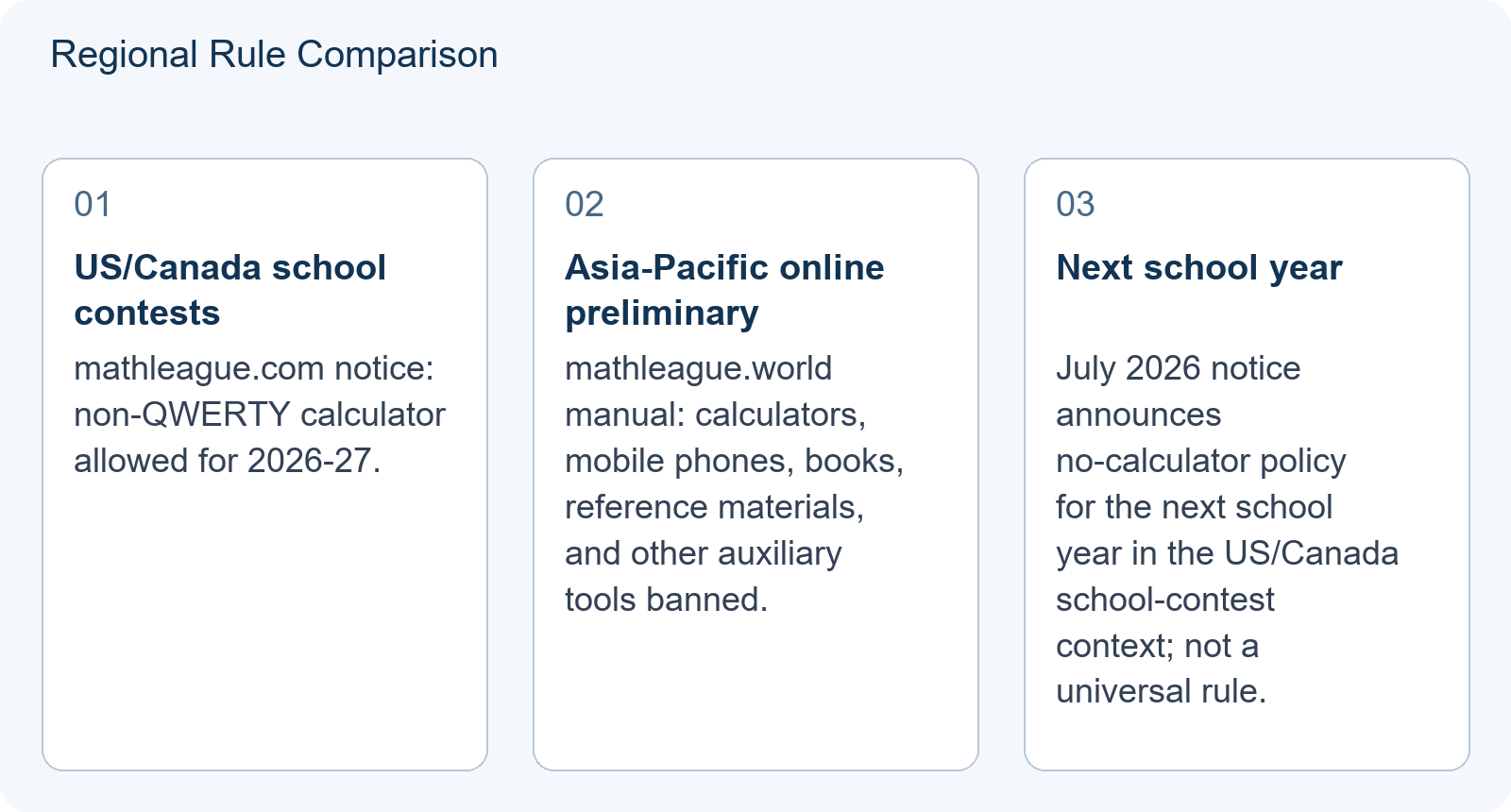
| Context | Region or format | Calculator status for 2026-27 | Governing source |
|---|---|---|---|
| School contests | US/Canada | Allowed if the calculator has no QWERTY keyboard | mathleague.com notice, 4 July 2026 |
| Online preliminary | Asia-Pacific | Prohibited along with mobile phones, books, reference materials, and other auxiliary tools | mathleague.world participant manual, 2026-2027 |
| Next school year | US/Canada school-contest source | No-calculator policy announced for the next school year | mathleague.com notice, 4 July 2026 |
This table is the core of the confusion. The US/Canada school-contest row and the Asia-Pacific online preliminary row are not two versions of the same rule. They are separate rules for separate programmes. The next-school-year row belongs to the same mathleague.com notice that allowed calculators for 2026-27; it should not be pasted onto the Asia-Pacific online preliminary manual, which already bans calculators.
Decision framework for students and parents
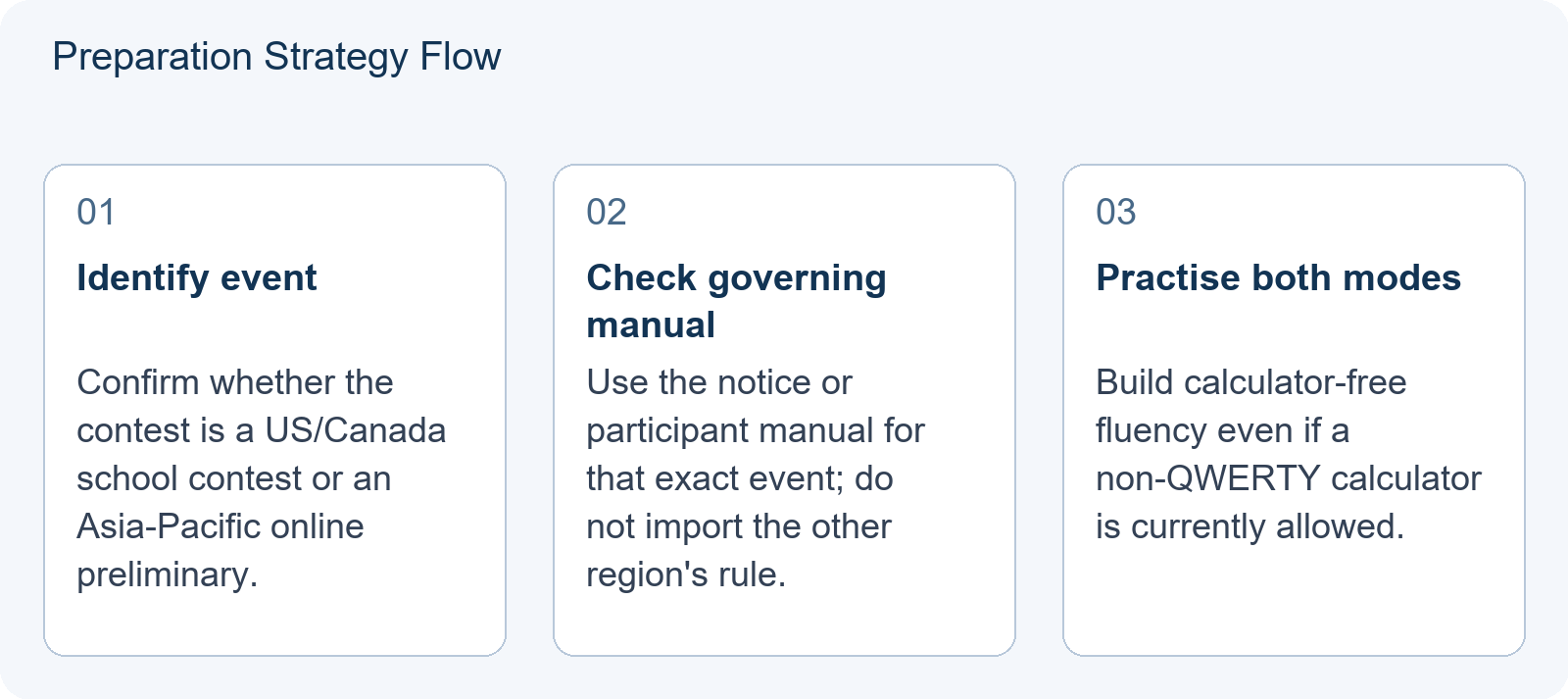
- Identify the programme and event. Is the student entering a US/Canada school contest, or an Asia-Pacific online preliminary? If a family cannot answer this, they cannot choose the right calculator rule.
- Read the governing manual or notice for that exact event. Do not use a general blog summary, a previous year’s rule sheet, or a rule from another region.
- Check the device against the exact words. For the US/Canada school contests, the stated permission is for a calculator without a QWERTY keyboard. For the Asia-Pacific online preliminary, the manual bans calculators and auxiliary tools.
- Prepare for the next-year switch. Even if a calculator is allowed this year, build no-calculator fluency so the announced change does not become an emergency.
- Re-check before contest day. Official notices can be updated. Confirm the latest version with the school, registration unit, or programme manual.
Practice plan for 2026-27: dual fluency without wasting time
The most useful preparation is not ‘calculator practice’ versus ‘no-calculator practice’ as rival camps. It is a deliberate switch between the two. Students who only use a calculator become slow when it is removed. Students who never use one may miss checking opportunities when it is allowed. A balanced weekly plan can cover both.
Block 1: calculator-allowed set-up practice. Take a short mixed set and allow the calculator only for arithmetic, not for thinking. The goal is to practise choosing a method, writing the equation, and using the calculator as a checking tool. If the answer is wrong, the student should still be able to say where the set-up failed.
Block 2: no-calculator fluency practice. Use the same topic with arithmetic that can be simplified mentally. Rehearse estimation, factor pairs, fraction-to-decimal anchors, and percentage anchors. A useful existing resource is the Math League Without a Calculator: The Number-Fluency Drill Set for the 2026-27 Season, which is designed for this kind of rehearsal.
Block 3: compare and correct. Solve a small set once without a calculator, then once with one. Compare not just scores but error types. If a calculator changes the answer, the problem is usually in the set-up or in a manual arithmetic step. If it only saves time, the student has found a genuine efficiency gain.
Teaching illustration, not an actual contest problem: for 17 × 24, a no-calculator method is 17 × 20 + 17 × 4 = 340 + 68 = 408. Another teaching illustration: 48% of 250 is found by taking 50% (125) and subtracting 2% (5), giving 120. These are not Math League questions; they show the mental split and anchor method that make no-calculator work faster.
Looking ahead to the announced next-year no-calculator switch
The July 2026 notice did not simply allow calculators and stop there. It also said the ‘no calculator’ policy would be implemented for the next school year. For the US/Canada school-contest source, that means the current allowance is a bridge, not the destination. Students who become dependent on calculator keystrokes during 2026-27 may find the following season much harder if the no-calculator policy takes effect as announced.
For the Asia-Pacific online preliminary, the practical horizon is simpler: the current manual already bans calculators for that event. A student preparing for that online round should not wait for a future switch; the no-calculator habit is already required. This is why families must separate the two regimes before they build a study plan.
Common mistakes to avoid when reading conflicting notices
Mistake 1: treating the July 2026 allowance as universal. It comes from the mathleague.com school-contest notice. The Asia-Pacific online manual has a separate rule. For background on the no-calculator change, see Math League Rules and the 2026 No-Calculator Change: Contest-Day Format Rules for China Students (2026).
Mistake 2: assuming an online preliminary allows calculators because a school contest does. The online manual for the Asia-Pacific preliminary bans calculators and auxiliary tools. Online logistics also include camera and room checks; the Math League Online Preliminary Round (12 December 2026): The Two-Camera Setup, What Voids a Result, and a Home Rehearsal Plan for China Families guide covers that different reader problem.
Mistake 3: ignoring the next-year warning. The notice says the no-calculator policy will be implemented for the next school year. That is enough reason to keep calculator-free practice alive now, even if a calculator is allowed in 2026-27.
Mistake 4: bringing a QWERTY device to a school contest with a non-QWERTY rule. The permission is narrow. Check the physical keyboard, not the brand name.
Mistake 5: failing to re-check the manual before contest day. Rules can be corrected or updated. The July 2026 notice itself was a correction. A family that reads only an older message can easily arrive with the wrong expectation.
Mistake 6: using a phone as a calculator in an online preliminary. The Asia-Pacific manual bans mobile phones and other auxiliary tools. Even if a phone app looks like a simple calculator, it falls under that prohibition.
Checklist: confirm the rule for your specific event
- Confirm whether the event is a US/Canada school contest or an Asia-Pacific online preliminary.
- Open the current official notice or participant manual for that event.
- Write down the exact calculator wording: allowed without QWERTY, or prohibited.
- Match the physical device to that wording, or remove all electronic aids if prohibited.
- Run one no-calculator practice block each week, even if a calculator is currently allowed.
- Re-check the manual one week before the contest and again the day before.
The bottom line is not that one source is right and the other is wrong. The bottom line is that ‘Math League’ is not a single rulebook in these notices. The mathleague.com US/Canada school-contest notice allowed non-QWERTY calculators for 2026-27 and announced a no-calculator policy for the next school year. The mathleague.world Asia-Pacific online preliminary manual bans calculators now. Students who prepare for the correct event, and who practise both with and without a calculator, will be ready for either rule without mixing them up.
Frequently Asked Questions
Can I use a calculator in the Math League Asia-Pacific online preliminary round?
No. The 2026-2027 participant manual for that online preliminary states that no calculators, mobile phones, books, reference materials, or other auxiliary tools are allowed. This does not by itself settle the rule for US/Canada school contests, which have their own notice.
Why did mathleague.com allow calculators for US/Canada school contests in July 2026?
The mathleague.com US/Canada school-contest notice said the blue sheet ‘HS Contest Procedures’ allowed a calculator without a QWERTY keyboard, while printed contests said calculators were prohibited. To remedy the contradiction, students were allowed to use a calculator on the contests for the 2026-27 school year. The same notice announced a no-calculator policy for the next school year in that school-contest context.
Does the announced no-calculator switch apply to every Math League contest next year?
The July 2026 notice does not establish a universal worldwide rule. It is a mathleague.com US/Canada school-contest notice; the Asia-Pacific online preliminary manual has its own no-calculator rule. Check the manual or notice for your specific programme before assuming the switch applies.