Math League’s rules are simple but strict. Grades 4–8 sit a 30-minute multiple-choice paper; high schoolers face a season of six 30-minute short-answer contests. From September 2026, calculators are banned on every contest. And on the short-answer papers there is no partial credit — form and exactness decide the mark. Math League has run since 1977 for grades 4–12; always confirm current rules on mathleague.com.
The format rules, by grade band
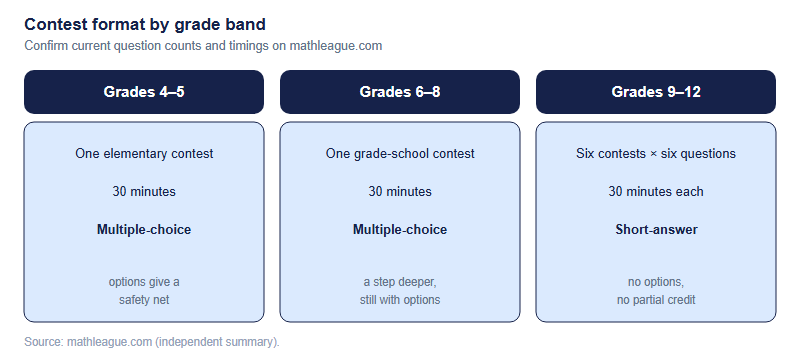
Everything else follows from the format, so start there. Math League groups students into bands, and the rules differ between them — most importantly, whether the paper is multiple-choice or short-answer. If you are unsure which band your child belongs in, our grade-band guide covers placement; here we focus on the rules once you are in.
| Band | Contest structure | Time | Answer style |
|---|---|---|---|
| Grades 4–5 | A single elementary contest. | 30 minutes. | Multiple-choice. |
| Grades 6–8 | A single grade-school contest. | 30 minutes. | Multiple-choice. |
| Grades 9–12 | A season of six contests, six questions each. | 30 minutes per contest. | Short-answer (no options). |
| Algebra 1 | A separate Algebra 1 contest track. | Confirm on mathleague.com. | Confirm on mathleague.com. |
The single most consequential rule here is the multiple-choice-versus-short-answer split. At 4–8, options give a safety net and a way to work backwards. At 9–12, you write the exact answer with nothing to check against — which is why the high-school series feels like a different competition even when the mathematics is familiar. This is also why moving up a band is a bigger step than moving up a grade: a student can be entirely ready for grade-9 content and still need a season to adjust to writing exact answers without the reassurance of options. Treat the exact question counts and timings as current-year specifics and confirm them on mathleague.com.
- Contest registration
- Free past papers
- 1-on-1 trial lesson

The big 2026 change: no calculators
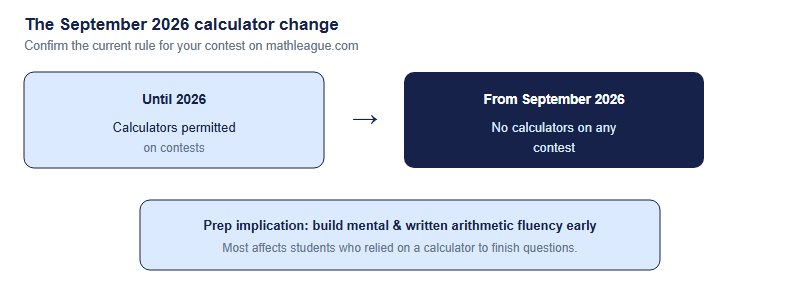
The most important rule change in years is short and blunt: beginning in September 2026, Math League no longer allows the use of calculators on any of its contests. If your child prepared in an earlier year when a calculator was permitted, the ground has shifted — every band now sits its paper by hand.
This matters more for China-based students than the sentence suggests, because many arrive strong at set-up but reliant on a calculator to finish. Under the new rule, a question you can plan perfectly can still lose its mark if the by-hand arithmetic wobbles under the clock. The fix is not clever; it is early. Rebuild mental-maths and clean written working now, so the ban is a non-event by contest day. The study roadmap shows where arithmetic fluency belongs in a season’s preparation. Confirm the calculator rule for your specific contest on mathleague.com before you sit it.
Two practical notes make the transition painless. First, practise the way you will compete: from now on, do timed past papers with the calculator in another room, so by-hand computation is trained under real conditions rather than discovered on contest day. Second, the skills that matter are narrow and learnable — confident times tables and mental multiplication, quick fraction and percentage work, tidy long multiplication and division, and sensible estimation to catch slips. None of this is olympiad training; it is the arithmetic backbone the new rule quietly rewards, and a few focused weeks usually settle it.
Scoring rules on the day: exact answers, no partial credit
On the high-school short-answer contests, the marking rule is unforgiving by design: an answer is right only if it is in the exact form the contest expects, and there is no partial credit for a correct method with a slipped final step. A value that is correct but written in the wrong form — an un-reduced fraction, a rounded decimal where an exact value was wanted, a missing unit — simply scores zero. This is a rule, not a style preference, and it catches strong solvers more often than weak ones.
It is worth being concrete about how much this rule costs unwary students. A short-answer contest gives no credit for reasoning the marker never sees — only the final written answer is scored — so a brilliant method that ends in an un-reduced fraction earns exactly the same as a blank. That asymmetry rewards a habit more than a talent: leave a few seconds at the end of every question to ask whether the answer is in the form the question wanted, with the right units and fully simplified. Strong students lose most here precisely because they trust the maths and skip the check.
The practical consequence is that the last thirty seconds of each question matter as much as the first two minutes: check the form before you move on. We keep the mechanics of answer form to a separate guide so this article stays about the rules, but the headline rule is worth memorising — on short-answer papers, right maths in the wrong form is a wrong answer. For a fuller picture of how the contests are scored and recognised, see our foundational overview of what Math League is, and confirm current marking rules on mathleague.com.
Conduct on the day: what to bring, what to leave
Beyond format and marking, a few conduct rules are worth knowing before contest day. Specifics are set by Math League and by the site running your contest, so treat the list below as the typical shape and confirm the details with your contest coordinator or on mathleague.com:
- Bring: pencils, an eraser, and (from September 2026) a readiness to compute by hand — no calculator.
- Do not bring / do not use: calculators, phones or any device that could compute or communicate; contests are proctored and an honour standard applies.
- Timing: each contest is a fixed 30 minutes; there is no stopping the clock, so pacing is part of the rules, not just strategy.
- Where you sit it: at your registered school or centre, under supervision; the season of six high-school contests is spread across the year rather than sat in one day.
None of this is exotic, but the combination — fixed clock, proctored, no devices, exact answers — is what turns familiar mathematics into a contest. Knowing the rules in advance means none of them is a surprise that costs marks.
One rule of thumb ties it together: arrive knowing the shape of the paper. Because the clock is fixed and unforgiving, the students who look calm on contest day are simply the ones for whom nothing is new — the format, the no-calculator rule and the answer conventions were all settled in practice, so the only thing left to do in the room is the mathematics.
The rules China students most often get wrong
From coaching China-based students, four rule-related habits cost the most marks — and all four are avoidable once named:
- Assuming a calculator is allowed. After September 2026 it is not, on any contest. Practising with one and competing without one is the most predictable own goal there is.
- Writing the right value in the wrong form. On short-answer papers this scores zero. Build a reflex to reduce fractions, keep exact values exact and add units before moving on.
- Treating one weak contest as the season. At 9–12 the result is built across six contests, so one off day matters far less than steady accuracy — a rule of the format that changes how you should feel mid-season.
- Entering the wrong band. The rules and depth differ by band; sitting a band too high wastes a season. Place carefully using the grade-band guide.
A pre-contest rules checklist
| Check | Why it matters |
|---|---|
| ✓ Confirmed my band and its format | Multiple-choice at 4–8 vs short-answer at 9–12 changes how you answer. |
| ✓ Preparing with no calculator | Calculators are banned from September 2026 on every contest. |
| ✓ Answer-form reflex trained | No partial credit on short-answer — wrong form scores zero. |
| ✓ Comfortable with a fixed 30-minute clock | The clock does not stop; pacing is part of the rules. |
| ✓ Confirmed the current rules on mathleague.com | Formats, fees and rules are revised year to year. |
Frequently asked questions
Can you use a calculator in Math League?
From September 2026, no — Math League no longer allows calculators on any of its contests. Build mental and written arithmetic fluency instead; confirm the current rule on mathleague.com.
How long is a Math League contest?
Grades 4–8 sit a 30-minute paper; high schoolers take six separate 30-minute contests across the season, six questions each. Confirm current formats on mathleague.com.
Is there partial credit on Math League?
On the short-answer high-school contests, no — an answer is right only in the exact expected form, so units and simplification matter as much as the maths. Confirm on mathleague.com.
Are Math League contests multiple-choice?
Grades 4–8 contests are multiple-choice; the high-school series is short-answer. Rules can change, so confirm the current format for your band on mathleague.com.
This is an independent guide operated by Hanlin Education for China-based international-school students. It is not affiliated with, endorsed by, or sponsored by the official Math League (mathleague.com). Formats, the calculator rule, fees and dates change each year — confirm current details on mathleague.com. Any confirmed error is corrected within 7 working days.