Math League is moderately hard by design. It is curriculum-aligned, not an olympiad, so most questions sit about one step beyond a strong classroom student — but time pressure, a deliberate difficulty ramp inside each paper, exact short answers, and (from September 2026) no calculators make it genuinely testing. It rewards accuracy and speed far more than exotic tricks. Math League has run since 1977 for grades 4–12; confirm current specifics on mathleague.com.
The short answer: challenging, but not an olympiad
Families often arrive with one of two wrong pictures: either “it is just harder school homework” or “it is an olympiad my child could never touch.” Both miss. Math League’s problems track the school curriculum, usually about a year ahead, so a capable classroom student recognises most of the mathematics. What makes it a contest rather than a worksheet is the packaging: a tight clock, answers that must be exact, and a run of harder questions at the end that separate strong students from very strong ones. If you have not met the format yet, our guide to what Math League is sets the scene.
So the honest one-line answer is: Math League is challenging but accessible. A student who is comfortable and a bit ahead in class can start, score respectably, and improve steadily — which is exactly why it works as a multi-year habit from grade 4 onward, rather than a single high-stakes gate. The difficulty is real, but it is the kind you can train.
- Contest registration
- Free past papers
- 1-on-1 trial lesson

How difficulty is built into a single paper
The most useful thing to understand is that a Math League paper is not uniformly hard. It ramps. The early questions are deliberately approachable, the middle is solid curriculum work a step ahead, and the last few are the ones that decide rank. Knowing this changes how you sit the contest: the early marks are the cheapest and must not be thrown away, while the final questions are where extra thinking time pays off.
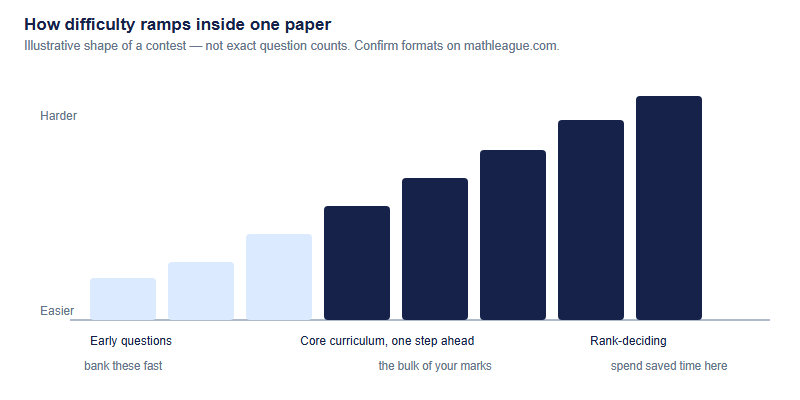
This ramp is why “how hard is it?” has no single number. For most of the paper the honest answer is “hard enough to be interesting, not hard enough to be scary.” It is the tail that hurts — and the tail is also where the most improvement is available, because those questions reward practised technique rather than raw talent.
This shape also dictates a simple sitting strategy that lowers the felt difficulty: take two passes. On the first pass, move briskly and bank every question you can do cleanly, resisting the urge to wrestle a hard one while easy marks are still on the table. On the second pass, return to the tail with the time you saved. Students who instead answer strictly in order often stall on a mid-paper problem and never reach questions they could have solved — turning a moderately hard paper into a punishing one through pacing alone rather than mathematics.
Difficulty by grade band
The feel of the difficulty changes across the bands, less because the mathematics leaps and more because the format gets less forgiving. Choosing the band that fits is the first lever on perceived difficulty; our grade-band guide covers that decision in full.
| Band | Format (confirm on mathleague.com) | What makes it feel hard |
|---|---|---|
| Grades 4–5 | A 30-minute multiple-choice contest. | Speed and careful reading; options give a safety net, so the challenge is pace and avoiding careless slips. |
| Grades 6–8 | A 30-minute multiple-choice contest, a step deeper. | More multi-step problems; the difficulty is holding accuracy while the questions get longer. |
| Grades 9–12 | A season of six contests, six short-answer questions each, 30 minutes per contest. | No multiple-choice safety net and no partial credit — an exact answer in the wrong form scores zero, so precision matters as much as insight. |
The jump most families underestimate is not 6–8 to 9–12 in content; it is the move from multiple-choice to short-answer. When there are no options to check against, a small arithmetic slip or a fraction left un-simplified turns a correct method into a wrong mark. That is a difficulty of discipline, not of cleverness — and it is highly trainable with timed practice.
Why the 2026 no-calculator rule raises the difficulty
There is a live change worth planning around. Beginning in September 2026, Math League no longer allows calculators on any of its contests. For many China-based students — who often arrive fluent with a calculator but rustier on mental and written arithmetic — this quietly raises the difficulty of every paper. A question that used to be “set it up, then let the calculator finish” now demands clean by-hand computation under the clock.
The good news is that this is the most fixable difficulty of all. Mental-maths fluency, estimation and tidy written working are trainable in weeks, not years, and they pay back on every question rather than one. If your child has leaned on a calculator, treat the 2026 rule as a prompt to rebuild arithmetic confidence early; the study roadmap shows where that fits in a season. Confirm the current calculator rule for your contest on mathleague.com before you sit anything that counts.
Where Math League sits on the hardness spectrum
It helps to place Math League against the contests families ask about. Think of a spectrum from everyday school maths up to the senior olympiad track. Math League sits low-to-middle: clearly above routine schoolwork, clearly below the AMC’s olympiad-leaning problems, and a long way below AIME and international-olympiad difficulty. That position is a feature, not a weakness — it is what lets a grade-4 student start and a grade-12 student still be stretched.
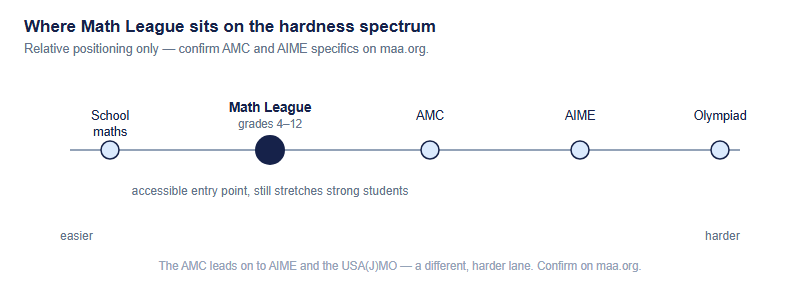
A practical implication: Math League and the AMC are not rivals to rank against each other on difficulty alone. A grade-6 student can build real contest habits in Math League now and add the AMC later when olympiad-style problems become the goal. Difficulty is only one axis; breadth, age of entry and repeatability are the others, and on those Math League is deliberately the gentler on-ramp. That gentleness at the entry point is precisely what makes the difficulty productive rather than discouraging: a student meets problems that are hard enough to teach something and rarely so hard that they give up.
Setting realistic expectations
Because the difficulty is trainable, the expectations that hurt most are the impatient ones. In our own coaching experience, the students who improve fastest are the ones whose families treat the first sitting as a baseline, not a verdict. Two verified reference points help calibrate what “strong” looks like without inventing cutoffs: Math League’s selective summer programme uses a score of 25 or higher (grades 4–8) as an eligibility bar, and for grades 9–10 it asks for a cumulative 28 or higher across the six high-school contests. That second number is the more revealing one — because each high-school contest has six questions, a cumulative 28 shows how much the series rewards steady accuracy over a season rather than one brilliant day.
It also helps to picture a normal trajectory rather than a single target. A capable student new to the format often spends a first season simply converting known mathematics into contest marks — trimming careless errors, fixing answer form, and learning to pace thirty minutes. Real score growth tends to show in the second season, once those mechanics are automatic and attention is free for the harder tail. Framed that way, an underwhelming first result is not a ceiling; it is the baseline you build from, which is exactly why the competition suits a multi-year commitment far better than one anxious attempt.
So the realistic expectation is this: early on, expect to lose marks to the clock, to careless slips and (from 2026) to by-hand arithmetic — not to the mathematics being beyond you. Fix those over a season and the score follows. Any promise of a guaranteed result or ranking is a warning sign; honest preparation only commits to the process. Treat all specific numbers here as a guide and confirm the current thresholds and formats on mathleague.com.
Frequently asked questions
Is Math League hard?
It is challenging but not an olympiad — mostly one step beyond strong classroom maths, made testing by the clock, exact answers and, from September 2026, no calculators. Confirm specifics on mathleague.com.
Is Math League harder than the AMC?
Generally no. The AMC is olympiad-leaning and leads to AIME and the USA(J)MO; Math League stays closer to the curriculum and spans grades 4–12. Confirm AMC details on maa.org.
What is a good Math League score?
Thresholds vary by contest and year. As a reference, the summer programme uses 25+ (grades 4–8) or a cumulative 28+ across the six high-school contests. Confirm current figures on mathleague.com.
Does the 2026 no-calculator rule make it harder?
For calculator-reliant students, yes. From September 2026 no calculators are allowed on any contest, so mental and written arithmetic fluency matter more. Confirm on mathleague.com.
This is an independent guide operated by Hanlin Education for China-based international-school students. It is not affiliated with, endorsed by, or sponsored by the official Math League (mathleague.com). Formats, scores and rules change each year — confirm current details on mathleague.com. Any confirmed error is corrected within 7 working days.