For families preparing for Math League competitions, the calculator rules now depend on the event. The official Math League notice dated 4 July 2026 allows calculators without a QWERTY keyboard in its US/Canada school contests for the 2026-27 school year, after contradictory printed materials, and says the no-calculator policy will apply the next school year. The China-region online preliminary manual already prohibits calculators and other auxiliary tools. Estimation remains essential in any no-calculator setting because eliminating impossible answer choices before detailed calculation can save time and reduce errors. This article explores estimation techniques in that context.
The Strategic Value of Estimation in a No-Calculator Environment
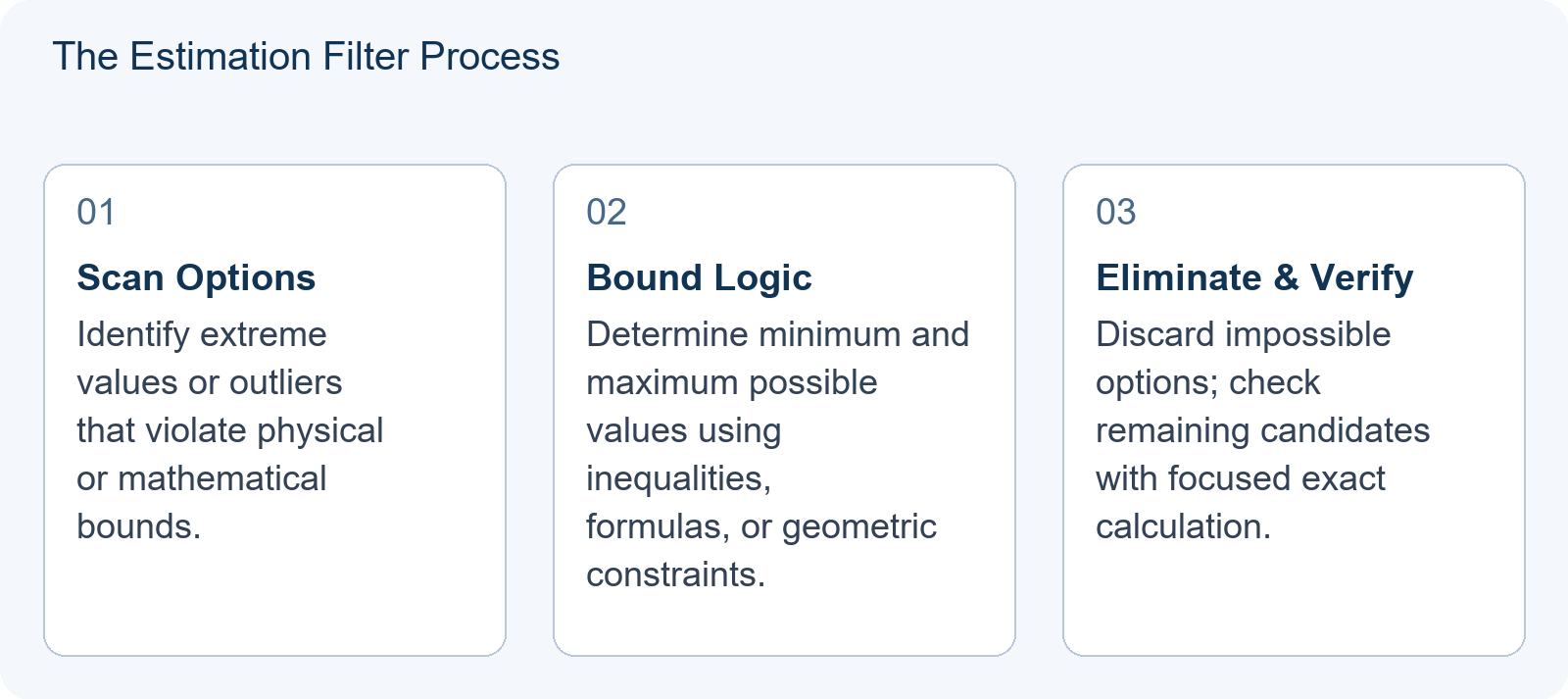
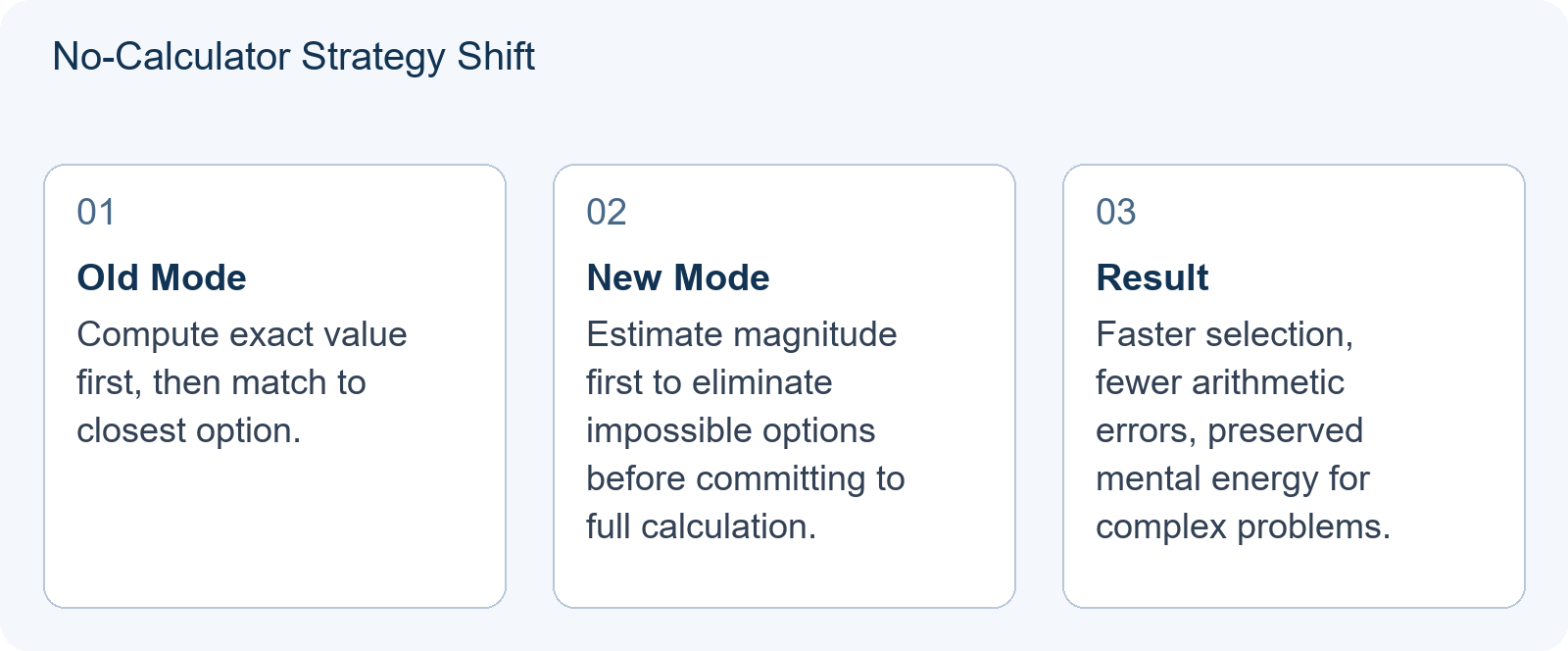
Estimation is often misunderstood as a rough guess, but in competitive mathematics, it is a rigorous logical filter. In a multiple-choice problem, a justified numerical bound can eliminate any option outside that bound. It cannot by itself distinguish several options inside the same interval. If a student can determine that the answer must be between 10 and 20, any option outside that range can be discarded immediately. This reduces the cognitive load, allowing the student to focus their mental arithmetic on the remaining plausible candidates. For grades 4 through 12, this skill bridges the gap between elementary arithmetic fluency and high school algebraic reasoning.
For the US/Canada school contests, the 4 July 2026 notice allows a calculator without a QWERTY keyboard for 2026-27 and announces a no-calculator policy for the next school year. For China-based participants in the online preliminary round, the 2026-2027 participant manual specifies that no calculators or auxiliary tools are permitted, and students may use clean scratch paper for calculations. Students should develop estimation as a primary tool in every no-calculator setting.
- Contest registration
- Free past papers
- 1-on-1 trial lesson

Worked Teaching Illustration: Magnitude Checks in Geometry
Consider a teaching illustration for a Grade 8 geometry question: Find the area of a triangle with side lengths 5, 12, and 13, and suppose the answer choices are 15, 30, 60, and 120.
A student might attempt to use Heron’s formula, which requires calculating the semi-perimeter s = (5 + 12 + 13) / 2 = 15, and then computing the area as √(15 × 10 × 3 × 2) = √900 = 30. Without a calculator, this square root extraction requires care but is manageable since √900 = 30 exactly.
Instead, a student with strong estimation skills would recognize that 5-12-13 is a Pythagorean triple, confirming a right triangle. The area is immediately ½ × 5 × 12 = 30. But even without recalling this property, estimation eliminates options efficiently.
First, apply a geometric bound: for any triangle with two sides a and b, the area cannot exceed ½ab. With sides 5 and 12, this gives a maximum possible area of ½ × 5 × 12 = 30. Therefore, any answer greater than 30 is impossible. This eliminates 60 and 120 immediately.
Between 15 and 30, exact reasoning resolves the remaining candidate. By the law of cosines, 13² = 5² + 12² − 2(5)(12)cos(θ), which yields 169 = 25 + 144 − 120cos(θ), so cos(θ) = 0 and θ = 90°. The area equals exactly 30. The Pythagorean relation 5² + 12² = 13² confirms the right angle directly. Estimation guided the logic to eliminate two options, and exact geometry confirmed the answer without relying on recalling the triple.
Contrasting Case: Where Superficial Estimation Fails
Estimation has limits, particularly in problems requiring precise integer solutions or modular arithmetic. Consider a number theory teaching illustration: Find the remainder when 10^10 is divided by 7, with options 1, 2, 3, 4, 5, and 6.
A student might estimate that 10^10 is enormous and guess the remainder is small. This fails because remainders do not scale with magnitude—all six options are equally “small” relative to 10^10. Here, estimation cannot eliminate any option based on size alone.
The correct approach uses modular pattern recognition. Since 10 ≡ 3 (mod 7), we compute powers: 10^2 ≡ 9 ≡ 2 (mod 7), and 10^3 ≡ 2 × 3 = 6 ≡ −1 (mod 7). Squaring, 10^6 ≡ (−1)^2 = 1 (mod 7). Therefore, 10^10 = 10^6 × 10^4 ≡ 1 × 10^4 (mod 7). Since 10^4 = 10^3 × 10 ≡ (−1) × 3 = −3 ≡ 4 (mod 7), the remainder is 4.
Attempting to estimate here leads to paralysis. The lesson is clear: use estimation for continuous quantities with physically meaningful bounds (area, volume, rates, lengths), and switch to exact modular or algebraic logic for discrete integer constraints where magnitude provides no discriminatory power.
Diagnostic Application: Identifying Your Estimation Gap
To assess whether a student relies too heavily on brute-force calculation, present five practice problems where answer choices are widely spaced—differing by factors of 2 or more. Time them under contest conditions. If they spend more than 30 seconds per question attempting full precision before considering elimination, they are missing the estimation opportunity. Conversely, if they guess wildly without justification, they lack number sense.
A healthy diagnostic result shows a student who spends 5–10 seconds scanning options, eliminating two clearly wrong ones with stated bounds, then spending 20–30 seconds verifying the remaining candidate. This balance indicates readiness for the no-calculator constraint. Feedback should focus on why certain options were rejected, reinforcing the logical basis of elimination rather than just the final answer.
For example, given: “A car travels 347 miles at 58 mph. About how long does the trip take?” with options 4.5 hours, 5.5 hours, 6 hours, and 12 hours, a student should note that 58 × 6 = 348, so the answer is slightly under 6 hours. They can eliminate 4.5 (too low, since 58 × 4.5 = 261) and 12 (double the reasonable range). Between 5.5 and 6, precise division confirms approximately 5.98 hours, so 6 hours is closest. The estimation eliminated two options and guided efficient verification.
Integrating Estimation into Daily Practice
Preparation should not be limited to solving problems correctly; it must include solving them efficiently. Parents and tutors can create “elimination drills” where students are given a problem and four options, but asked only to identify which two options are impossible and why. This decouples the pressure of finding the right answer from the skill of bounding the solution space.
Over time, this builds an intuitive sense for magnitudes relevant to grade-level topics. For instance, knowing that the sum of angles in an n-sided polygon is (n−2) × 180° helps eliminate absurd angle measures quickly. A hexagon’s interior angle sum is 720°; any option suggesting 360° or 1080° for a hexagon is immediately impossible. This routine transforms passive calculation into active hypothesis testing.
Course Fit and Resource Preparation
Families seeking structured support should look for programs that explicitly teach heuristic strategies alongside standard curriculum. When consulting with preparation providers, ask specific questions about how they handle the 2026-27 no-calculator policy. Do they offer timed drills that reward early elimination? Is there feedback on the efficiency of the method used, not just the correctness of the final answer?
Resources that provide selected-year solutions with annotated reasoning are valuable, as they show the thought process behind skipping unnecessary steps. Ensure that any material used aligns with the official Math League sample contests available on the organizer’s site, focusing on the style of questions that test conceptual understanding over rote computation.
Conclusion: From Calculation to Reasoning
The ban on calculators is not a penalty; it is a clarification of what mathematical proficiency truly means. It demands that students understand the properties of numbers well enough to predict outcomes before deriving them. By mastering estimation, students turn the multiple-choice format into an ally, using the options themselves as boundaries for their reasoning. This approach reduces anxiety, saves time, and improves accuracy. As the 2026-27 season approaches, integrating these habits into regular practice will distinguish prepared students from those merely memorizing formulas.
For further reading on related strategic skills, explore our guides on Math League Divisibility: Checking a Candidate Answer Without Recalculating Everything and Math League Units and Rates: Choosing a Common Unit Before Comparing Answers, which complement estimation in building a robust toolkit for competition success. Students preparing for the preliminary round format may also find practical guidance in our article on Math League Online Preliminary Round (12 December 2026): The Two-Camera Setup, What Voids a Result, and a Home Rehearsal Plan for China Families.
From Elimination to Verification: The Two-Step Estimation Protocol
The previous sections established that estimation serves as a logical filter, not a substitute for precision. However, many students stop after eliminating impossible options, assuming the remaining choice must be correct. This is a critical error in competitive mathematics. Distractors are often designed to survive initial magnitude checks but fail under closer scrutiny. To address this gap, we introduce a two-step protocol: Broad Elimination followed by Narrow Verification. This method ensures that estimation guides the calculation rather than replacing it.
Step 1: Broad Elimination via Geometric Bounds
Consider the Grade 8 geometry teaching illustration previously discussed: finding the area of a triangle with sides 5, 12, and 13. The answer choices are 15, 30, 60, and 120. A student applying broad elimination recognizes that for any triangle with two sides and , the maximum possible area is . Here, . Therefore, any option exceeding 30 is physically impossible. This immediately discards 60 and 120. The student is left with 15 and 30. At this stage, many students might guess or perform a lengthy Heron’s formula calculation. Instead, they should move to Step 2.
Step 2: Narrow Verification via Parity or Simple Checks
Narrow verification uses lightweight mathematical properties to distinguish between the remaining candidates without full computation. In the triangle example, the difference between 15 and 30 is significant. A quick check involves verifying if the triangle is right-angled. Since , the triangle is right-angled. The area of a right triangle is exactly half the product of its legs: . Thus, 30 is confirmed, and 15 is rejected because it would imply an angle significantly less than 90 degrees, which contradicts the Pythagorean relationship.
This protocol applies broadly. For instance, in a rate problem where a car travels 347 miles at 58 mph, broad elimination removes 12 hours (too high) and 4.5 hours (too low, since ). The remaining options are 5.5 and 6. Narrow verification requires only checking if exceeds 347. Since , the time is slightly under 6 hours. If the options were 5.9 and 6.0, one would need precise division, but typically Math League multiple-choice questions allow for this level of approximation to resolve the final ambiguity efficiently.
Diagnostic Practice Task
To internalize this protocol, parents can assign a specific drill. Provide three problems with four options each. Require the student to write down two sentences per problem: first, stating which two options are eliminated and why (using bounds); second, stating how they verified the remaining candidate (using parity, exact simple multiplication, or geometric properties). Do not accept answers that skip the verification step. This forces the student to treat estimation as a scaffold for rigorous proof, not a shortcut to guessing. Over time, this reduces anxiety by providing a clear, repeatable structure for handling uncertainty in the no-calculator environment.
Frequently Asked Questions
Does Math League allow scratch paper for estimation?
Yes, students may use clean scratch paper for calculations and notes during the contest, as specified in the participant manual for the preliminary round.
Is estimation useful for all Math League questions?
It is most effective for geometry, word problems, and probability where physical or arithmetic bounds apply. For number theory or algebra requiring exact integers, logical deduction and pattern recognition are preferred over magnitude estimation.
When does the no-calculator rule start?
For US/Canada school contests, the official Math League notice dated 04 July 2026 allows calculators without a QWERTY keyboard for the 2026-2027 school year and says the no-calculator policy will apply the next school year. The China-region online preliminary manual already prohibits calculators.