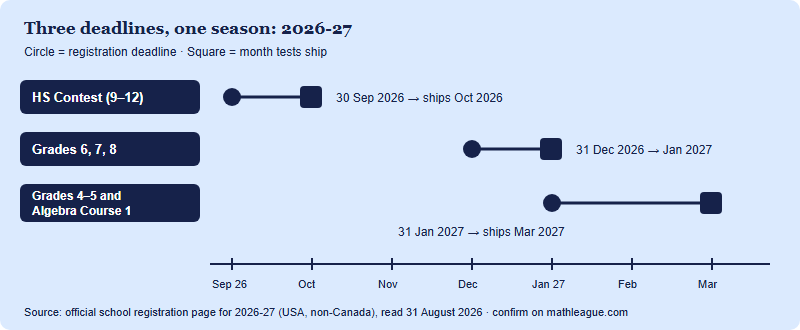
Math League is not bought the way most competitions are. Schools order sets of papers — each contest is priced per set of 30, shipping included — and the seven contests carry three different registration deadlines rather than one. On the official school registration page for 2026-27, the high school deadline falls first, in September, while the elementary and Algebra 1 deadlines sit in January.
Schools order sets of papers, not individual entries
The first thing to understand is structural, and it explains almost every practical question that follows. Math League sells contests to schools as physical sets. The registration page instructs the person ordering to add to the cart each contest they would like to order, and notes that the quantity of tests can be adjusted in the cart. There is no per-student checkout, no individual entry code, and no student-facing sign-up form for the school-year contests.
That single fact has consequences students and parents rarely anticipate. It means the person who has to act is a teacher, not you. It means the cost your family sees is a share of a school purchase, not a fee you pay directly. And it means the deadline that matters is the one your school has to hit, which may be weeks before anything visible happens to you. If Math League itself is new to you, our overview of what Math League is sets out the structure behind these contests before you start reading order pages.
- Contest registration
- Free past papers
- 1-on-1 trial lesson

The published 2026-27 prices and deadlines
The table below reproduces what the official school registration page listed for the 2026-27 school year when we read it at the end of August 2026. Two cautions before you use it. First, the page we read is headed for the USA, non-Canada region — other routes exist and may carry different figures. Second, prices and dates are set year by year. Treat this as a shape to plan around, and confirm the line for your exact contest on mathleague.com before your school orders.
| Contest | Published price | Registration deadline | Tests ship |
|---|---|---|---|
| 4th Grade Contest | $45 USD per set of 30, shipping included | 31 January 2027 | March 2027 |
| 5th Grade Contest | $45 USD per set of 30, shipping included | 31 January 2027 | March 2027 |
| 6th Grade Contest | $45 USD per set of 30, shipping included | 31 December 2026 | January 2027 |
| 7th Grade Contest | $45 USD per set of 30, shipping included | 31 December 2026 | January 2027 |
| 8th Grade Contest | $45 USD per set of 30, shipping included | 31 December 2026 | January 2027 |
| HS Contest (grades 9–12) | $100 USD per set of 30, shipping included | 30 September 2026 | October 2026 |
| Algebra Course 1 Contest | $45 USD per set of 30, shipping included | 31 January 2027 | March 2027 |
Read the grade 6 line carefully, because it is the one that catches people. Grade 6 is priced with the elementary contests at $45 but carries the middle-grades deadline of 31 December — a month before grades 4 and 5. If your school is ordering across several year groups at once, the prices group one way and the deadlines group another, and assuming they match is the easiest mistake available on that page.
Why high school closes first
The four-month gap is not an accident of administration; it follows from what each product is. The elementary and Algebra 1 contests are single papers, and the page shows them shipping in March for a spring sitting — so an order placed in January still arrives with time to spare. The high school contest is a season of six contests spread through the school year, and the page shows those tests shipping in October. A school that has not ordered by the end of September has not missed a date; it has missed the start of a series.
This is the practical reason a student cannot decide in November that they would like to try the high school series this year. The materials for the season have already gone out. It is also why, for families weighing whether to start at all, the decision belongs in the previous academic year rather than in the term itself — which is exactly the planning problem our study roadmap is built around.
The set of 30 changes the economics of a small club
Because the unit of purchase is a set of 30 rather than a single entry, cost per student is decided by how many students actually sit the paper, not by the price on the page. The arithmetic below is ours, applied to the published prices; Math League publishes the set price, not a per-student figure.
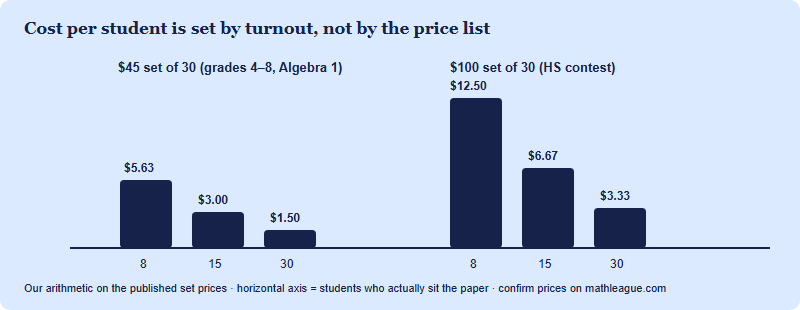
Two things follow. The first is that adding students up to thirty costs the school nothing extra, so a club that quietly caps itself at its eight keenest mathematicians is paying roughly four times per head what a full set would cost. The second is subtler and matters for how a programme survives: because the cost of the thirtieth student is zero, the argument for opening a club to the merely curious is financial as well as educational. Small programmes look expensive on a budget line, and expensive programmes are the ones that get cut in year two.
One item is genuinely worth asking Math League directly. The high school product is a season of six contests, and the page prices the HS Contest at $100 per set of 30. Exactly what a set covers across a six-contest series is precisely the sort of detail we will not infer for you. Ask before ordering, and keep the answer in writing.
The deadline you found online may not be your deadline
This is the trap we see most often with China-based schools, and it is caused by doing the right thing. A teacher searches, finds an official Math League registration page, notes a deadline, and plans around it. But the page we read is explicitly headed for one region, and Math League operates more than one route into its contests. The dates and prices on a regional page belong to that region.
The safe procedure is unglamorous. Establish which route your school registers through before you write any date in a calendar, take that route's deadline and price in writing, and only then plan backwards. A date copied from the wrong page is worse than no date at all, because it feels like diligence. Confirm which contest your students should be entered for at the same time, since ordering the wrong band wastes a whole cycle — our grade band guide covers how to place a student who sits between years.
Four things are worth settling before anyone clicks a checkout button:
- Which route, and its dates. Confirm the registration route your school uses, and take that route's deadline and price directly from Math League rather than from a regional page found in a search.
- Which contests, by name. The catalogue is specific: separate contests for grades 4, 5, 6, 7 and 8, a high school contest, and an Algebra Course 1 contest. Order by contest name, not by a description of your students.
- How many students will really sit it. The set is thirty. Decide whether you are filling it, and if not, whether a second year group can share the order.
- What arrives, and when. Shipping months are published beside the deadlines. Someone at the school needs to know a package is coming and what to do with it, especially for a series that runs across the year.
None of this is difficult. It is administrative work that happens months before any mathematics does, and it fails quietly when nobody owns it. The schools whose students sit Math League every year are rarely the ones with the strongest mathematicians. They are the ones where a named teacher checks a route, an order and a shipping month, on time, every year.
Frequently asked questions
Can an individual student register for Math League contests?
The school registration page addresses schools and prices contests in sets of 30. If no school route is open to you, ask Math League directly.
Why is the high school deadline so much earlier?
The high school contest is a season, not a single paper, and its tests ship in October 2026 — so registration closes on 30 September 2026.
How much does Math League cost per student?
There is no per-student price. Sets of 30 were published at $45 USD, or $100 USD for high school; cost per head depends on turnout.
Do these prices and dates apply to a school in China?
Not necessarily. The page we read was headed for the USA, non-Canada region. Confirm the figures for your own registration route on mathleague.com.
This is an independent guide operated by Hanlin Education for China-based international-school students. It is not affiliated with, endorsed by, or sponsored by the official Math League (mathleague.com). Prices, deadlines, shipping months and registration routes change from year to year and by region — confirm current details on mathleague.com before your school orders. Errors reported to us are corrected within 7 working days.