Math League usually belongs in one of two places on an application: the activities list, if it was a sustained commitment, or the honours section, if you actually won a named award. The wording matters more than students expect. A precise, modest entry reads as credible; an inflated one invites scrutiny of everything else in the file, which is the opposite of what you wanted.
First, the expectation-setting sentence
No competition result produces an admission decision, and nobody can promise otherwise. What a competition record can do is corroborate a story the rest of your file is already telling — that you do mathematics beyond what the timetable requires, that you keep doing it over years, and that you have been measured against people outside your school. Wording well does not create that story. It stops you damaging one you already have. Our separate piece on what Math League is covers the structure behind the results discussed here.
Two different boxes, and why students confuse them
Most application systems separate what you did from what you were awarded. On the Common Application, for example, there is an activities list and a separate honours section; UCAS handles the same material inside a written personal statement; many university-specific systems do something in between. The fields are short, and the limits are shown in the portal itself — check the current character counts there before drafting, because they are set by the application platform and change from cycle to cycle.
- Contest registration
- Free past papers
- 1-on-1 trial lesson

The distinction is simple once stated. Participating in Math League contests — even doing well — is an activity. Receiving a named award is an honour. Sitting six contests across a season and improving is a genuinely good activity entry; it is not an honour, and putting it there is the single most common error we see in drafts from China international schools.
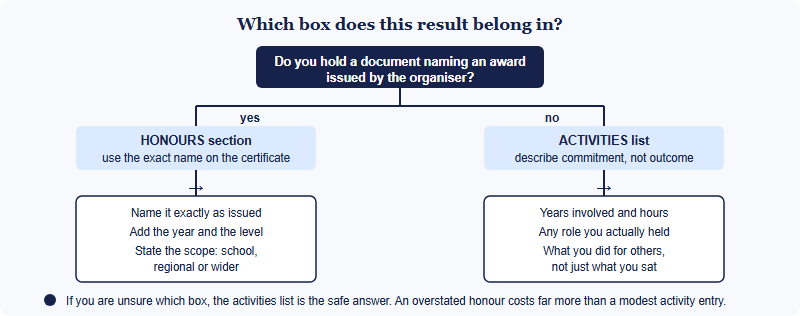
What each kind of result entitles you to say
Award names, levels and recognition tiers differ by contest and by grade band, and they are reissued each season, so there is no universal list to copy. The rule that always works: use the exact wording printed on the certificate or result letter you were issued, and add nothing to it. If the paper in your hand does not use the word "national", you may not use it either.
| What you actually have | Where it goes | Wording that is defensible | Wording that is not |
|---|---|---|---|
| Sat one or two contests, no award | Activities, if at all | "Math League contests, grade 10 — school maths team" | "Math League competitor (national level)" |
| Sat a full season across several years | Activities | "Math League school team, grades 9-12; sat the full contest series each year" | "Long-term member of the American Math League" |
| Named award on a certificate | Honours | The exact award name, plus year and grade band | Any renaming, translation or upgrade of that name |
| Top score in your school | Honours, scope stated | "Highest score in school, Math League contest series, 2026" | "Math League champion" |
| Contributed to a school team result | Activities | "Member of the school team whose combined scores were submitted" | "Led the team to a national ranking" |
| Organised or coached others | Activities, with the role named | "Founded and ran the weekly contest-practice club, 12 members" | "Head coach of the school mathematics programme" |
Five phrasings that quietly damage you
- Promoting participation into an award. "Participant" is honest and neutral; "awardee" without a document is a claim you cannot support if asked.
- Upgrading scope. A school-level result described with regional or national language is the fastest way to lose a reader's trust, and readers who assess many applications from the same city notice patterns.
- Borrowing another competition's vocabulary. Math League has its own structure. Importing medal language or another contest's qualification vocabulary describes something that did not happen. Math League does publish some cumulative-score thresholds of its own, so quote the wording it actually used rather than a term borrowed from elsewhere.
- Percentages without a stated denominator. "Top 5%" means nothing until the reader knows top 5% of what population, in which contest, in which year.
- Padding an honours list. The honours section is short by design. Filling it with participation entries pushes out something real and signals that you had little to put there.
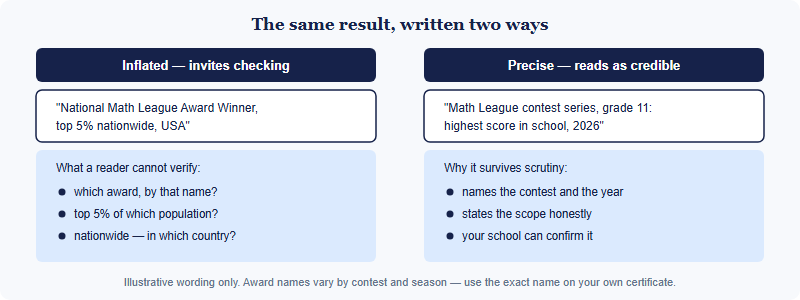
The one-line rule for percentiles and rankings
If you quote a number, quote the denominator with it in the same line. "Top 10% of entrants at my school" is a modest claim, stated cleanly, and it is worth more than an unqualified "top 10%" because the reader knows exactly what they are looking at. If you do not know the denominator, do not quote the number — a rank you cannot describe is not evidence, it is decoration.
A second habit worth adopting: never convert a raw score into a percentile yourself. Unless the organiser published the distribution, any percentile you compute is an estimate, and describing an estimate as a result is exactly the kind of small overreach that a careful reader catches. Score reports and any published statistics come from mathleague.com and from whoever administered your contest; use those, or say nothing.
Where the claim actually gets checked
Applications are rarely audited line by line, but three checkpoints exist and China international-school students meet all three.
- Your counsellor. References are written by someone who knows what happens in your school. An entry your counsellor would not recognise is a genuine risk, and it is the most common way an inflated claim comes apart.
- Your own interview answers. If you list it, expect to be able to describe it: which contests, which year, what you found hard. A student who cannot describe their own honour has just told the reader something.
- Internal consistency. An honour that contradicts your transcript, your timeline or your other entries stands out precisely because the rest of the file is consistent.
This is the practical case for accuracy, separate from the ethical one. A precise entry costs nothing and survives all three checkpoints. An inflated entry buys a marginally better line and puts the whole file at risk.
If you have no award yet
Most students in any given season do not hold a named award, and that is not a reason to hide the activity. Sustained, described participation is legitimate content: several years of contests, a practice club you actually ran, a habit of doing mathematics that the timetable did not require. Write what is true — the years, the commitment, the role — and let the honours section stay short.
If you are earlier in school and want the record to be worth writing about by application time, the lever is sequencing rather than wording: entering at a band you can actually build on, and staying with it long enough for the line to mean something. Our study roadmap sets out how that is normally structured across a season.
Frequently asked questions
Does Math League go in the honours or activities section?
Activities, unless you hold a document from the organiser naming an award. Then the honours section, worded exactly as issued.
Can I write "national award" if I did well?
Only if that is the wording on your certificate. Award names and scope are set by the organiser — check yours and mathleague.com.
Should I list a participation certificate as an honour?
No. Participation certificates are not awards, and using a short honours slot on one weakens the whole section.
Will listing Math League help me get admitted?
No competition entry decides an outcome. It can corroborate a wider record of mathematics; nobody can promise more than that.
The summary is short. Copy the exact words on your certificate, state the scope, quote a denominator whenever you quote a number, and put everything else in the activities list. Students consistently underestimate how well a modest, verifiable entry reads next to an inflated one — and if you are still choosing which band to enter, our grade band guide is the place to start.
This is an independent guide operated by Hanlin Education for China-based international-school students. We are not affiliated with, endorsed by, or sponsored by the official Math League (mathleague.com). Award names, scoring and recognition levels are set by the organiser and change from season to season — confirm all current details on mathleague.com, and application field limits and requirements with the application platform itself. Any error reported to us is corrected within 7 working days.