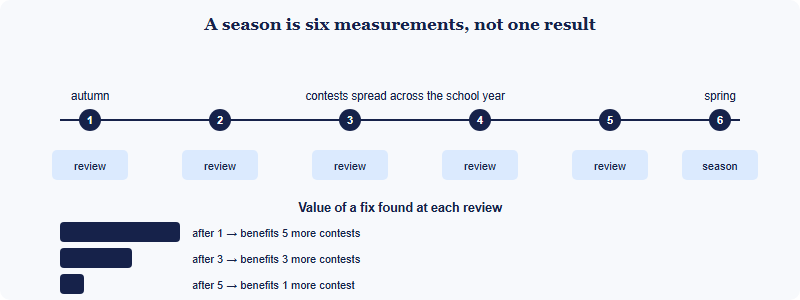
Most competitions give a student one score a year. The Math League high school series gives six, spaced across the school year, and the season total is cumulative. That turns a season into something rare: a repeated measurement of the same student under the same conditions. Used properly it tells you what to change and when. Used carelessly it is six numbers nobody looks at twice.
Cumulative changes when your marks matter
In a knockout structure, an early round is a gate: survive it and the score is forgotten. The high school series does not work that way. Math League describes the series as six contests whose results accumulate across the season rather than resetting, so an October paper carries the same weight in your season total as a March one. Confirm the current scoring and award rules on mathleague.com, because they are reissued each year, but the structural point is stable and it has three consequences.
- There is no warm-up contest. The instinct to treat contest 1 as a practice run costs real marks that never come back.
- A bad paper is recoverable but not erasable. Five strong results still outweigh one poor one, which is exactly why panicking after contest 1 is the wrong response.
- Late improvement is worth less than early improvement. Fixing a leak before contest 2 harvests five more contests of benefit; fixing it before contest 6 harvests one.
That last point is the practical argument for building a feedback loop at all. The value of a diagnosis falls as the season goes on, so the review after contest 1 is worth more than every later review combined. If you are still deciding which band the student should sit, settle that first — our grade band guide covers it, and no amount of season management fixes a wrong band.
- Contest registration
- Free past papers
- 1-on-1 trial lesson

Build the log before contest 1, not after contest 3
A feedback loop needs data you cannot reconstruct later. Once a paper has been handed back, discussed in class and filed, nobody remembers which question ate eleven minutes. Five fields, recorded within twenty-four hours of each contest, are enough.
| Field | What to record | Why it earns its place |
|---|---|---|
| Score | The raw result, plus the season running total | The headline number, and the only one most students keep |
| Attempted vs correct | How many you genuinely attempted; how many of those were right | Separates "did not reach it" from "reached it and got it wrong" — completely different problems |
| Time sink | The single question that consumed the most minutes, and roughly how many | Pace leaks are invisible in a score but visible here |
| Miss type | For each miss: unknown tool / wrong method / arithmetic slip / misread question | Tells you whether to study content or change habits |
| Condition notes | Sat when, after what, how the week had gone | Stops you over-interpreting a paper sat the morning after a mock exam week |
The single most useful field is the second one. A student who attempts four questions and gets four right has a pace problem. A student who attempts every question and gets half right has an accuracy or content problem. Both may score identically, and they need opposite interventions — more speed work versus more care. A bare score cannot tell them apart, which is why so much preparation gets aimed at the wrong target.
Four shapes a six-contest line can take
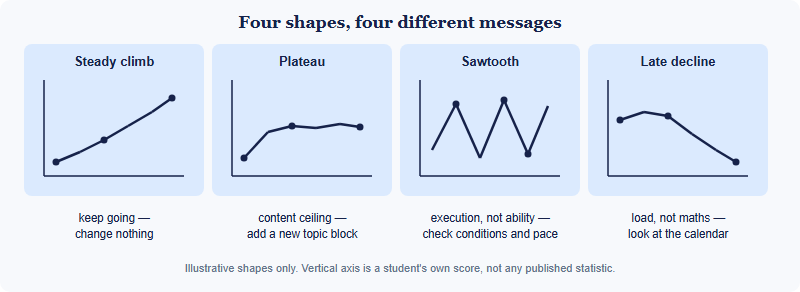
By contest 3 you have enough points to see a shape. Each shape has a standard reading and a standard response. Treat these as working hypotheses to test at the next contest, not verdicts.
| Shape | Most likely reading | What the log should show if the reading is right | Response |
|---|---|---|---|
| Steady climb | Preparation is working | Falling counts of "unknown tool" misses | Change nothing. Resist the urge to add material mid-season. |
| Plateau after early gains | You have harvested the easy questions and hit a content ceiling | Attempted count stable; misses concentrated in one or two topics | Add exactly one new topic block, not four. |
| Sawtooth (up, down, up) | Execution and conditions, not ability | Slips and misreads dominate; poor papers cluster in bad weeks | Fix the routine: sitting conditions, a checking pass, sleep before the contest. |
| Decline across the second half | Competing academic load, not lost skill | Attempted count falling; time sink rising; condition notes crowded | Protect a smaller, regular practice slot instead of adding more. |
What to change between contests — and what to leave alone
The gap between contests is typically a few weeks, which is enough for one deliberate change and not enough for three. Making several changes at once destroys the experiment: the next result cannot tell you which change worked.
- Change one variable. Either a topic block, or a pacing rule, or a checking habit. Not two.
- Give it two contests. One paper is too noisy to judge anything; two is a signal.
- Write the prediction down. "If the fix works, my attempted count should rise from four to six." A prediction makes the next result informative instead of merely encouraging or disappointing.
- Do not switch bands mid-season unless the entry was clearly wrong from the start. A cumulative season punishes restarts.
What you should almost never change mid-season is the underlying study structure. Rebuilding a whole routine in November because of one weak paper usually costs more than the paper did. The structure belongs to the pre-season decision, and our study roadmap covers how to set it before contest 1.
The team dimension: your score is also someone else's number
Math League contests are administered through schools, and a school team score is built from a school's leading individual results rather than from a separate team paper — in the high school series the school total is formed from its top individual scores. Confirm the exact rule for your contest on mathleague.com, because the count and the method vary by level.
This has a quiet effect on how a team should run its season. If the school total depends on a handful of leading scores, the marginal value of coaching sits with the students hovering just outside that group, not with the top scorer who is already near ceiling. A coordinator with limited hours generally raises the school total faster by lifting the students sitting at and just below the counted group than by polishing the top scorer — check on mathleague.com how many scores your contest counts before deciding where that line falls. It also means a strong student's absence on the day is a team-level event, which is worth knowing before someone books an orthodontist appointment inside the testing window.
Two ways this goes wrong
The first failure is over-reading a single contest. Six questions in half an hour is a small sample; one unlucky topic draw moves a score more than a month of work. Never redesign a season on one paper — wait for the second point on the line.
The second failure is the opposite: logging diligently and then never acting. A log that produces no decision is a diary. Every review should end with one written sentence naming the single change and the prediction it implies. If you cannot write that sentence, the honest conclusion is that nothing needs changing yet, which is itself a legitimate result — and much better than inventing a fix to feel productive.
Frequently asked questions
Do Math League high school contest scores really add up across the season?
The series is scored cumulatively rather than as knockout rounds. Confirm the current scoring and award rules for your level on mathleague.com.
How many contests before I should change my preparation?
Wait for at least two data points. One paper is a small sample and a single unlucky topic can move it more than a month of study.
Should a weak first contest change which band we sit?
Rarely. Mid-season switching restarts a cumulative season. Revisit the band choice between seasons instead.
Who sees the school team score?
Team results are handled through the school that registers you. Ask your coordinator, and check reporting details on mathleague.com.
Very little of this is about mathematics. It is about treating a season as a designed experiment rather than six unrelated afternoons — and the students who improve fastest are usually the ones who wrote down what they expected to happen before it did. If you are new to how the series fits into the wider grade 4-12 structure, start with our complete guide to Math League.
This is an independent guide operated by Hanlin Education for China-based international-school students. We are not affiliated with, endorsed by, or sponsored by the official Math League (mathleague.com). Contest formats, scoring, team rules and dates are set by the organiser and change from season to season — confirm all current details on mathleague.com before registering or planning. Any error reported to us is corrected within 7 working days.