Contest algebra is not school algebra done faster. Five shapes recur on Math League papers, and each rewards a set-up move made before any solving begins: build the combination you were asked for, substitute for a repeated block, exploit symmetry, split into cases, or factor instead of expanding. Choosing the move is where the marks are — and from September 2026 there is no calculator to rescue a bad choice.
Why the set-up decides the mark
Math League does not publish a syllabus, so nobody can hand you a definitive list of algebra topics. What past papers do show, consistently, is a design principle: the arithmetic at the end of a well-chosen route is small, and the arithmetic at the end of a badly chosen route is enormous. That is not a coincidence. A short contest with a fixed clock has to distinguish students somehow, and the cheapest way to do it is to build questions where the obvious approach works but takes four times as long.
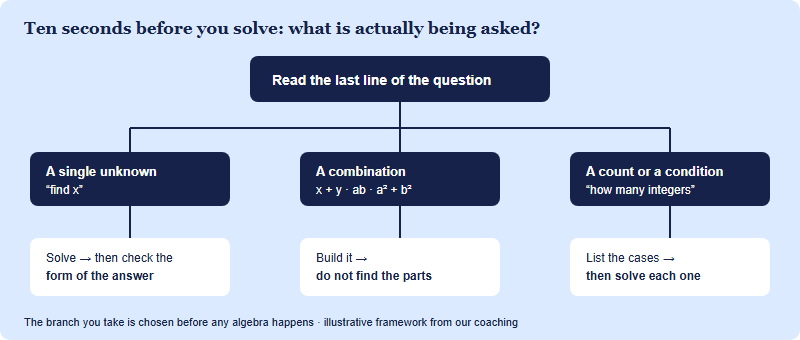
This changes what practice should look like. Most students in China international schools arrive with excellent algebraic execution — they can solve, expand, factorise and rearrange accurately. What they have rarely been trained to do is pause for ten seconds before starting, because school problems are designed so that the obvious method is the intended method. Under contest conditions the obvious method is often a trap, and the trap is a time cost rather than a wrong answer. Our overview of what Math League is sets out the contest structure this section assumes.
- Contest registration
- Free past papers
- 1-on-1 trial lesson

Every worked example below is written by us in the style of contest algebra. We do not reproduce Math League questions; use the official past papers for authentic material and treat these as illustrations of the move.
The five shapes, and the move each one wants
| Shape | How you recognise it | The move | What brute force costs |
|---|---|---|---|
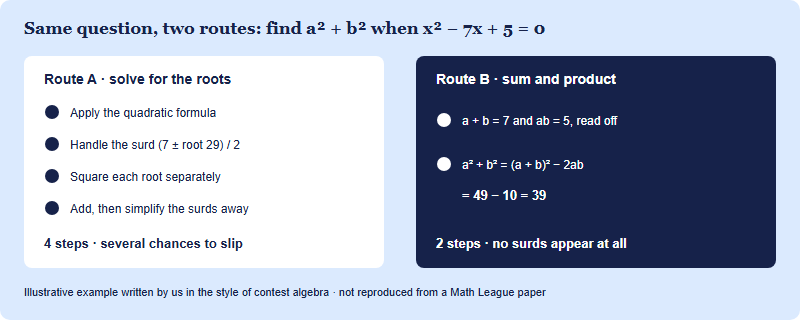
| 1. The combination | The question asks for x + y, xy, a² + b² or x + 1/x — not for x and y separately | Build the combination directly from what you are given | Solving for each unknown, often through surds, then recombining |
| 2. The hidden quadratic | A block repeats: x² appears twice, or the same bracket appears squared and plain | Substitute u for the repeated block, solve, then substitute back | Expanding to a quartic and hunting for roots |
| 3. The symmetric system | Two equations that turn into each other when you swap the variables | Add them, then subtract them; you usually get the answer in one step | Elimination, substitution, fractions, two separate values |
| 4. The case split | Absolute value, an inequality, or a phrase like “how many integer values” | Write the cases down before solving any of them | Finding one solution and missing the second |
| 5. The structure | Large or awkward numbers that sit close together, or an expression built to factor | Factor first; the numbers collapse | Long multiplication by hand, with no calculator to check it |
Shape by shape, with the arithmetic that follows
1. The combination. Suppose 3x + 2y = 17 and 2x + 3y = 13, and the question asks for x + y. Adding the equations gives 5x + 5y = 30, so x + y = 6. You never needed x or y. The same instinct handles the reciprocal family: if x + 1/x = 5, then squaring gives x² + 2 + 1/x² = 25, so x² + 1/x² = 23 — without ever finding x, which is irrational and would have wrecked the arithmetic.
2. The hidden quadratic. Faced with x⁴ − 5x² + 4 = 0, set u = x². Then u² − 5u + 4 = 0, so u = 1 or u = 4, giving x = ±1 and x = ±2. Four roots, thirty seconds, no quartic formula. The trigger to watch for is a repeated block, and it is not always a power — the same substitution rescues equations where a bracket such as (x + 3) appears both squared and plain.
3. The symmetric system. Symmetry is a gift the paper hands you deliberately. When two equations swap into each other under an exchange of variables, adding gives you the sum and subtracting gives you the difference, and one of those is almost always what was requested. Students trained on substitution reach for it automatically and end up with fractions that were never necessary.
4. The case split. If |2x − 3| = 7, there are two cases: 2x − 3 = 7 gives x = 5, and 2x − 3 = −7 gives x = −2. Students who solve only the first case lose the whole mark on a short-answer paper. The same discipline applies to inequalities, where multiplying or dividing by a negative reverses the sign: from −3x > 12 the answer is x < −4, not x > −4. Write the cases down before solving any of them; the act of writing prevents the omission.
5. The structure. When a question offers numbers that sit close together, it is usually offering a factorisation. The difference of two squares turns 2026² − 2025² into (2026 − 2025)(2026 + 2025) = 4051, and 99 × 101 into (100 − 1)(100 + 1) = 9999. Both are trivial factored and unpleasant expanded. Since September 2026 no Math League contest permits a calculator, the gap between those two routes is now paid in minutes and in slips.
What changes between the bands
The five shapes appear across the grade range, but how you should play them depends on which paper you are sitting, because the answer format differs. At grades 4–8 the contests are multiple choice, which gives you a legitimate extra tool: when the algebra looks long, testing the options is a valid method rather than cheating. If a question asks which value satisfies a messy equation, substituting three options is frequently faster than rearranging, and it is self-checking.
At grades 9–12 the high school contests are short answer, and that tool disappears. There is nothing to test against, no partial credit for good method, and the official papers require answers exact or correctly rounded to four or more significant digits. So the set-up move matters more at 9–12 than at 6–8, precisely because there is no safety net at the end. Placing a student in the right band is therefore not only a difficulty question but a strategy one; our grade band guide covers placement for students who sit between years.
One habit spans both bands. Before you write the final answer, reread the last line of the question. Students who lose marks on algebra rarely make algebraic errors; they answer a question adjacent to the one asked — giving x when the paper wanted 2x, or a fraction when it wanted a whole number of items.
A three-week algebra block
- Week 1 — recognition only. Take twenty past-paper algebra questions and do not solve any of them. For each, write down which of the five shapes it is and what move you would make. Ten minutes per session, checked against a worked solution. The aim is to make the classification automatic.
- Week 2 — the move, timed. Now solve, but hold yourself to the move you identified. If you find yourself solving for both variables when the question asked for their sum, stop and restart. Twenty minutes, three or four questions.
- Week 3 — under contest conditions. Full timed sections, no calculator, with a rule: any question that takes more than the average time gets logged, and the log entry names which shape you missed. That log is the single most useful document a student builds all season.
Three weeks will not add new mathematics to a student who is already fluent, and it is not meant to. It converts existing algebra into contest algebra by changing what happens in the first ten seconds of a question. If you are fitting this into a wider plan, our study roadmap shows where a topic block like this belongs in a season.
Frequently asked questions
Does Math League publish an algebra syllabus?
No official topic list is published. The shapes here are drawn from past papers and our own coaching — confirm content on mathleague.com.
Is testing the answer options a legitimate method?
Yes, on the multiple-choice contests at grades 4–8. On the short-answer high school contests there are no options, so the tactic is unavailable.
How much does the no-calculator rule change algebra questions?
It does not change the mathematics, but it raises the cost of a long route. From September 2026 no contest permits a calculator.
My child solves correctly but slowly. What should we train?
Recognition, not more algebra. Practise classifying questions without solving them, then insist the chosen move is used when solving.
This is an independent guide operated by Hanlin Education for China-based international-school students. It is not affiliated with, endorsed by, or sponsored by the official Math League (mathleague.com). Contest content, formats and rules change from year to year — confirm current details on mathleague.com. All worked examples here are written by us in the style of contest algebra and are not reproduced from Math League papers. Errors reported to us are corrected within 7 working days.