The Math League high school series is written for students who have moved past the arithmetic-and-plane-geometry core of grades 4-8. In practice that means four extra blocks of material: trigonometry, logarithms and exponents, functions and inverses, and polynomial and coordinate work. Math League's own high school topic description also names series and sequences, which the four blocks below do not cover — read the full list on mathleague.com. Math League does publish a broad topic description rather than a detailed syllabus, so treat what follows as what to be ready for, not an official specification.
Why the high school series feels like a different subject
Students who did well in the grade 6-8 paper often report the same shock in their first high school contest: the questions are not longer, they are built from different raw material. A grade 6-8 question typically asks you to combine familiar operations cleverly. A high school question frequently assumes a piece of machinery — a logarithm rule, an exact trigonometric value, the relationship between a quadratic's coefficients and its roots — and then asks you to use it under time pressure.
That distinction matters for planning. If a student is losing marks because they are slow at arithmetic, more contest practice helps. If they are losing marks because they have never met the tool a question is built on, no amount of practice on the wrong band will fix it. This is the first thing to establish before you commit to a season of papers, and it is why choosing the right entry point matters more than choosing the hardest one. Our grade band guide works through that decision in detail.
- Contest registration
- Free past papers
- 1-on-1 trial lesson

Two structural facts shape everything below. Math League has run school contests since 1977 and spans grades 4 to 12, so the high school series sits at the top of a long ladder rather than standing alone. And the high school contests are described as a series of six short papers spread across the school year, each sat in roughly half an hour. Confirm the current format, question count and timing on mathleague.com before planning around them — these details are reissued each season.
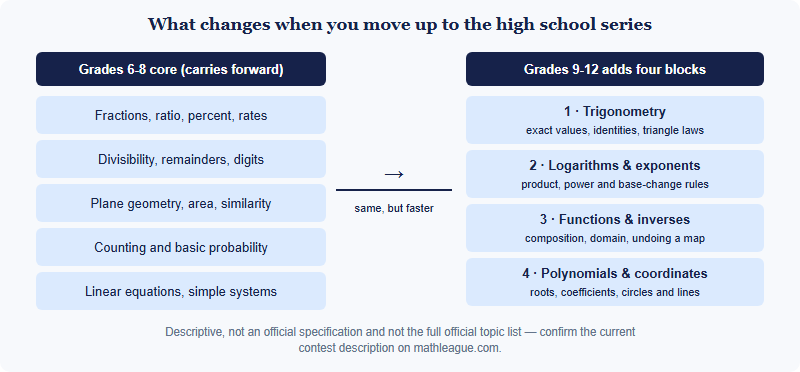
The four blocks, and what each one actually demands
Each block asks for a different kind of readiness. Recognition speed matters more than depth: a contest question rarely wants a full derivation, it wants you to see which tool applies within a few seconds.
| Block | What a question typically wants | The readiness test | Where China-curriculum students are often already strong |
|---|---|---|---|
| Trigonometry | Exact values, one identity, or a triangle law applied once | Can you write sin, cos and tan of 30°, 45° and 60° from memory in under 20 seconds? | Identity manipulation — usually well drilled at school |
| Logarithms & exponents | Collapse an expression, or convert between log and exponential form | Can you turn a sum of logs into a single log, and back, without pausing? | Index laws — typically solid |
| Functions & inverses | Composition, a nested evaluation, or a rule given in words | Given f and g, can you produce f(g(2)) and g(f(2)) and see that they differ? | Algebraic substitution |
| Polynomials & coordinates | A relationship between roots and coefficients, or a distance in the plane | Can you get the sum and product of a quadratic's roots without solving it? | Factorising — often faster than peers |
Eight facts that carry most of the load
These are mathematical facts, not competition rules, so they are stable from year to year. Learn them to instant recall rather than derivation. On a short paper with only a handful of questions, thirty seconds spent rebuilding a log rule is a meaningful fraction of the entire contest.
| # | The fact | What it unlocks | The trap |
|---|---|---|---|
| 1 | log(ab) = log a + log b, and log(a/b) = log a − log b | Collapsing a long expression into a single log | Applying it to log(a + b), which does not split |
| 2 | log(a^k) = k · log a | Pulling exponents out; solving for an unknown power | Losing the sign when k is negative or fractional |
| 3 | Change of base: log_b(x) = log(x) ÷ log(b) | Comparing logs written in different bases | Inverting the fraction |
| 4 | Exact values at 30°, 45° and 60°: 1/2, √2/2, √3/2 and their partners | Any triangle question with a friendly angle | Swapping sin 30° and cos 30° under pressure |
| 5 | sin²θ + cos²θ = 1 | Recovering the missing ratio from one given ratio | Forgetting that the sign depends on the quadrant |
| 6 | Law of cosines: c² = a² + b² − 2ab · cos C | Triangles that are not right-angled | Pairing the wrong angle with the wrong side |
| 7 | For ax² + bx + c, the roots sum to −b/a and multiply to c/a | Answering a question about roots without ever finding them | Dropping the minus sign on the sum |
| 8 | Composition is ordered: f(g(x)) is not g(f(x)) | Nested-function questions and inverse checks | Reading the notation from the outside in |
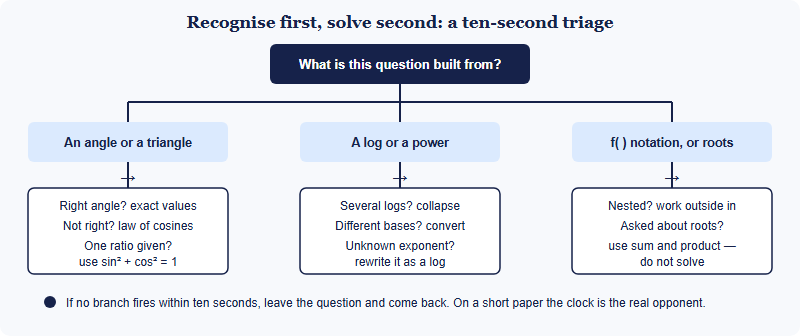
Why a short paper punishes half-knowledge
A contest with only a few questions has an unforgiving arithmetic of its own: every question is a large share of the paper, so a single topic you have never met can move your result more than an afternoon of careless slips. That is the structural reason to prioritise breadth of recognition over depth in one favourite area during a first season.
It also changes what "knowing a topic" means. In a school test, knowing logarithms means you can work through a page of exercises. In a contest, it means you can look at an expression and see within two seconds that it collapses. Those are different skills, and only the second is built by timed drilling.
One further constraint is worth checking before you build a plan around mental shortcuts. Math League's rules, including its calculator policy, are published on mathleague.com and the policy has been revised in recent seasons. Read the current version for your grade band and contest rather than assuming last year's conditions still hold.
A six-week readiness block before your first high school contest
This is a recognition-building block, not a full preparation programme. It assumes a student who is comfortable with grade 6-8 material and is meeting the four new blocks for the first time. For the season-length structure, our study roadmap sets out the longer version.
- Weeks 1-2 · Exact values and log rules. Ten minutes a day, written from memory, no notes. Target: the full set of exact values plus the three log rules written correctly in under two minutes, five days running.
- Week 3 · Identity and triangle drills. Twenty short items: given one ratio, produce the others; given two sides and the included angle, find the third. Correctness first, then speed.
- Week 4 · Functions and roots. Composition in both orders, inverse checks, and quadratic questions answered using sum and product only — deliberately forbidding yourself from solving for the roots.
- Week 5 · Mixed triage. Take twenty questions from all four blocks, shuffled. Spend ten seconds each writing only the tool you would use, not the answer. Score the triage, not the maths.
- Week 6 · Timed rehearsal. Sit a full past paper under contest conditions, then review only the questions where your triage was wrong. Those are the real gaps.
Two habits make the block work. First, separate triage errors from calculation errors when you review, because they need different fixes: a triage error means a missing tool, a calculation error means a missing check. Second, keep the daily recall drill even in the weeks when it feels trivial — recall decays quickly, and the entire point is to make these eight facts free.
Frequently asked questions
Do I need calculus for the Math League high school series?
No. The series is aimed at secondary students in grades 9-12. Confirm the current contest description and any topic guidance on mathleague.com.
My child is in grade 9 and has not met logarithms yet. Is it too early?
Not necessarily, but expect some questions to be unreachable in year one. Choosing the right band matters more than choosing the hardest one.
Is memorising exact trigonometric values really worth it?
Yes. On a short timed paper, recall you never have to reconstruct is the cheapest speed available, and these values never change.
Where do I confirm format, timing and calculator rules?
On mathleague.com only. Details are reissued each season, and this site is an independent guide rather than the organiser.
If one of the four blocks above is entirely new to a student, the honest reading is that this season is a calibration year rather than a medal year. That is a perfectly good use of a season, and it beats sitting a band that produces a discouraging score for reasons that have nothing to do with ability. Our complete guide to Math League explains where the high school series sits in the wider grade 4-12 ladder.
This is an independent guide operated by Hanlin Education for China-based international-school students. We are not affiliated with, endorsed by, or sponsored by the official Math League (mathleague.com). Formats, topics, dates and rules are set by the organiser and change from season to season — confirm all current details on mathleague.com before registering or planning. Any error reported to us is corrected within 7 working days.