Most Math League contests are not sat at one fixed moment worldwide. They run inside a testing window of one to several weeks, and someone — usually your school coordinator — chooses the day within it. That is a planning lever almost no other competition gives you, and it comes with an obligation: while the window is open, the paper stays private.
What a testing window actually is
A window is a published range of dates during which a contest may be administered. Schools sit the paper on a day that suits their timetable, which is why two students in the same city can take the same contest a fortnight apart. This is structurally different from a single-sitting competition, and it changes both how you plan and how you behave afterwards.
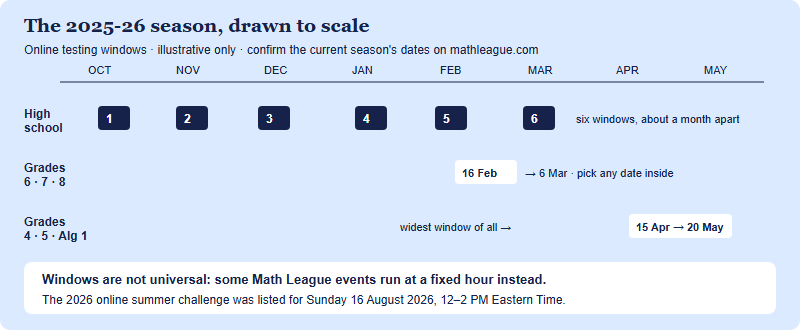
The 2025-26 season shows the shape clearly. Math League published the following online testing windows for that season, alongside single scheduled dates for contests sat on paper — treat them as an illustration of the pattern rather than as next season's calendar, because dates are reissued annually and the 2026-27 calendar must be confirmed on mathleague.com.
- Contest registration
- Free past papers
- 1-on-1 trial lesson

| Contest | 2025-26 online testing window (per Math League’s online testing FAQ) | Shape |
|---|---|---|
| High school contest 1 | 13 – 24 October 2025 | Six separate windows, each about two weeks, spaced roughly a month apart across the school year |
| High school contest 2 | 10 – 21 November 2025 | |
| High school contest 3 | 8 – 19 December 2025 | |
| High school contest 4 | 12 – 23 January 2026 | |
| High school contest 5 | 9 – 20 February 2026 | |
| High school contest 6 | 9 – 20 March 2026 | |
| Grades 6, 7 and 8 | Any date from 16 February to 6 March 2026 (online) | One wider window, roughly three weeks |
| Grades 4, 5 and Algebra Course 1 | Any date from 15 April to 20 May 2026 (online) | One much wider window, over a month |
Two things stand out. First, the high-school season is a rhythm, not an event: six contests spread from autumn to spring. Second, the lower grade bands get a single, much wider window — over a month for grades 4, 5 and Algebra Course 1 — which means the choice of date is a real decision, not a formality. If you are not yet sure which band applies to you, the grade-band guide is the place to settle that first.
Not every Math League event works this way, and assuming otherwise is a genuine risk. Some events are fixed-time: the 2026 online summer challenge, for instance, was listed as taking place on Sunday 16 August 2026 from 12 to 2 PM Eastern Time — a specific hour, not a window. So the first question about any Math League event you enter is simply which kind it is.
Who actually chooses your date
In nearly all cases the answer is your school's contest coordinator — the teacher who registered the group and who administers the paper. Students rarely choose individually, which has an important consequence: if you want the date to suit you, the conversation happens weeks before the window opens, not during it.
Ask your coordinator four questions early in the term:
- Which day inside the window are we sitting? If it is not fixed yet, this is the moment your preferences can still count.
- What time of day, and in which room? A paper sat in the last period after a full timetable is a different exam from one sat first thing.
- Is our contest a window or a fixed-time event? The answer changes everything about scheduling, especially for online events run on a United States clock.
- What are the current materials rules? Math League has stated that from September 2026 calculators are no longer permitted on any of their contests — worth confirming for your specific paper on mathleague.com so nobody arrives expecting one.
If your school has not run Math League before, the coordinator may be choosing the date with no information about what makes a good one. Bringing them the criteria below is genuinely useful, and it is a reasonable thing for a student to do.
How to choose a good date inside the window
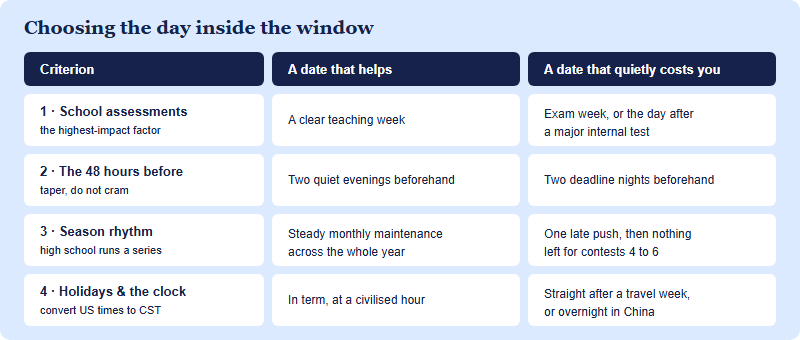
Four criteria decide whether a date helps or hurts. They are ranked by how much difference they make.
- 1 · Avoid the assessment collision. The single biggest factor is what else is happening that week. A contest sat in the middle of end-of-term assessments, or the day after a major internal exam, is sat by a tired student. In international schools in China the February and April-May windows sit uncomfortably close to internal assessment periods and, for older students, external examination season — so check the school calendar before the contest calendar.
- 2 · Protect the 48 hours before. A good date has two quiet evenings in front of it. Those evenings are not for learning new topics; they are for light timed practice and sleep. If the only available date sits behind two nights of other deadlines, an earlier date in the window is usually better even if it means less total preparation.
- 3 · Respect the season rhythm. For the high-school series, contests recur roughly monthly. That rhythm rewards steady maintenance across the year rather than a single push, and it means a poor result in one contest is followed by another opportunity within weeks. How results across the series are used is set by Math League — confirm the current arrangements on mathleague.com.
- 4 · Mind the holidays and the clock. Windows that straddle Chinese New Year, half-term or a travel week can leave a student sitting the paper after ten days away from mathematics. For any online event tied to a United States time, convert the start time to China Standard Time before agreeing to it — an afternoon slot in Eastern Time is the middle of the night in China.
The duty a window creates
Here is the part that gets skipped. Because a window means other students sit the same paper days or weeks after you, anything you say about the questions before the window closes damages the contest for them. A screenshot in a group chat, a "that last geometry one was brutal" message, a photograph of the paper posted to a study account — each of these hands an advantage to someone who has not sat it yet.
Treat the rule as simple and absolute: until the window has closed, you do not discuss the contents of the paper with anyone who has not already sat it — not classmates in another section, not friends at another school, not online. This is not merely etiquette. Any sharing restriction that applies to your contest is set by Math League, not by us; read the instructions supplied with your contest and confirm anything unclear on mathleague.com before you post.
There is a selfish reason too. The comparability of scores is what makes a result meaningful. A season where questions circulate mid-window produces results that mean less for everyone in it, including you.
What the window changes about your preparation
Knowing your exact date turns a vague intention to prepare into a schedule, and that is most of the benefit. Three practical consequences follow, and they slot into the sequencing set out in our study roadmap.
- Peak on your date, not on the deadline. Students who only know the window tend to work towards its final day and then discover they are sitting on day three. Fix the date first, then count backwards.
- Build a taper. The last two days should be light: one short timed set, a review of your own error log, and an early night. New material learned in the final 48 hours rarely survives contact with the clock.
- For the high-school series, plan the year not the week. Six contests spaced about a month apart reward consistency. The realistic model is a steady weekly habit with a short sharpening block before each window — not six separate crammings.
If your school does not yet run Math League at all, the date question becomes a registration question first. Start with the overview of what Math League is, then confirm the registration route, deadlines and fees for your grade band on mathleague.com — these are set by the organisation, which has run contests for grades 4 to 12 since 1977, and they change from season to season.
Frequently asked questions
Can I choose my own contest date?
Usually your school coordinator chooses the day inside the window. Ask early in the term, before the date is fixed, if you want input.
Does sitting on the first day of the window disadvantage me?
No — the paper is the same. Choose by your own readiness and school calendar, not by position inside the window.
Can I discuss the questions after I finish?
Not while the window is open, since others sit the same paper later. Follow the instructions supplied with your contest and confirm on mathleague.com.
Are all Math League events run as windows?
No. Some are fixed-time events — the 2026 online summer challenge was listed for a set two-hour slot in Eastern Time. Check your event.
This is an independent guide operated by Hanlin Education for China-based international-school students. We are not affiliated with, endorsed by, or sponsored by the official Math League (mathleague.com). Contest windows, dates, formats, fees and administration rules change from season to season — confirm current details on mathleague.com before you register or sit a paper. Errors reported to our editorial desk are corrected within 7 working days.