The Math League Algebra 1 Contest is a single paper of 30 multiple-choice questions in 30 minutes, written for students taking algebra for the first time. It is defined by the course you are studying, not the grade you sit in, and the published 2026–27 window is April 15 or later — which makes it the least crowded entry point on the whole Math League calendar for China-based students.
What the Algebra 1 Contest actually is
Math League has run contests since 1977 for grades 4–12, and most of its papers are labelled by grade: a grades 4–5 paper, a grades 6–8 paper, a high-school series. The Algebra 1 Contest is the exception. Math League describes it as being for “students learning algebra for the first time,” and states that the questions “require no more knowledge than that of a first year high school algebra course.”
The published specification is compact and worth memorising before you plan any training:
- Contest registration
- Free past papers
- 1-on-1 trial lesson

- 30 multiple-choice questions, 30 minutes. That is an average of 60 seconds per question, including reading.
- Three pages of rising difficulty. Page 1 is straightforward, page 2 is moderate, page 3 is the hard tail.
- Content: basic algebra skills plus creative applications, with a mix of word problems and computational problems that emphasise applied algebra technique.
- Awards: certificates of merit for high-scoring students, plus one High School Contest problem book for the school's top scorer.
- Setting: designed for intraschool competition — your school administers it.
If you are new to the whole system, start with our overview of what Math League is and how the contests fit together, then come back to this paper as a specific decision.
Course, not grade: why that single word changes your planning
Almost every competition a China-based international-school family looks at is gated by age or grade. The Algebra 1 Contest is gated by what you are studying. Math League's own wording is about first-time algebra students and first-year algebra knowledge — it does not publish a grade ceiling or floor on that page.
That matters because international schools in China run algebra on wildly different clocks. A student may meet a full first-year algebra course in grade 7 at one school, grade 8 at another, and grade 9 at a third; IGCSE, AP-track and IB-MYP timetables all sequence it differently. Under a grade-based rule, those three students would be pushed into three different papers. Under a course-based rule, they are all potentially reading the same specification.
Do not turn that into an assumption. Whether a specific student in a specific school year may be entered is an administrative question for the person who orders the contest, and the definitive answer lives with Math League — confirm eligibility on mathleague.com before you promise a student anything. What you can plan around is the intellectual scope: if the student has covered a full first-year algebra syllabus, the paper is within reach.
The April date is a strategic gift
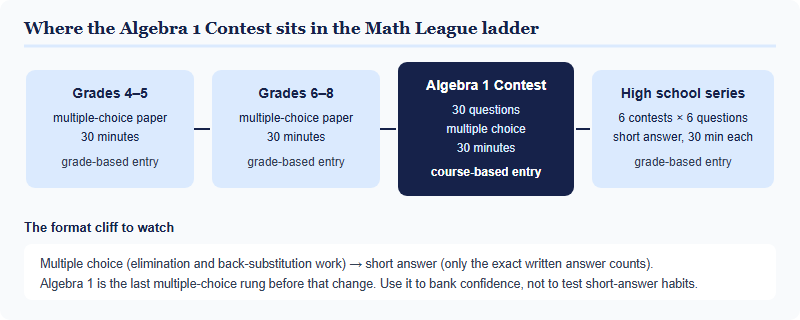
Math League's published 2026–27 schedule puts the Algebra Course 1 contest at April 15 or later, with materials shipping in March. The grades 4–5 paper sits in the same late window. The grades 6, 7 and 8 paper is scheduled for the third Tuesday in February (February 16, 2027) or the fourth Tuesday (February 23, 2027). The high-school series runs six contests from October 20, 2026 through March 16, 2027. Math League also notes that alternate contest dates may be scheduled one week after the listed date in the event of scheduling conflicts.
| Level | Published 2026–27 timing | Format as published | Planning consequence |
|---|---|---|---|
| Grades 4–5 | April 15 or later (ships March) | Multiple-choice paper, 30 minutes | Late-year sitting; a full school year of content has landed |
| Grades 6–8 | Feb 16, 2027 or Feb 23, 2027 | Multiple-choice paper, 30 minutes | Falls near mid-year assessment season in many schools |
| Algebra Course 1 | April 15 or later (ships March) | 30 multiple-choice questions, 30 minutes | Almost the whole algebra course is taught before you sit |
| High school (grades 9–12) | Oct 20, Nov 17, Dec 15 2026; Jan 12, Feb 9, Mar 16 2027 | Six contests, six short-answer questions, 30 minutes each | A season, not an event — commitment across five months |
Two practical consequences follow. First, curriculum coverage: a paper sat in mid-April tests a course that has been taught for roughly seven or eight months. Quadratics, systems and factoring — the topics that usually arrive in the second half of a first algebra course — are fair game and you will have met them. Contrast that with a February sitting, where a student is often examined on material taught three weeks earlier.
Second, calendar clash: April is after the high-school series has finished and two months after the grades 6–8 date. For a school running several Math League levels, the Algebra 1 paper is the one that does not collide with anything else in the Math League year. If your school has been reluctant to add a contest because “the term is already full,” this is the easiest one to slot in. Our guide to choosing the right grade band is the companion read when you are deciding who sits what.
What the paper rewards: algebra done fast, and done exactly
Sixty seconds per question is the number that should drive your preparation. That budget is not evenly spendable: page 1 questions should cost far less than a minute so that page 3 questions can cost two or three.
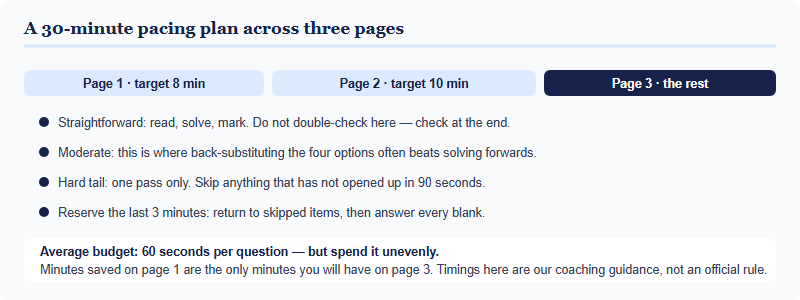
Because the paper is multiple choice, two tactics are legal here that stop working later in the system:
- Back-substitution. When a question asks for a value of x and offers four candidates (labelled A to D on Math League's published sample papers), testing the options is often faster than solving — especially for messy quadratics or systems. Test one of the two middle values first; the result usually tells you which direction to move.
- Elimination by structure. Sign, parity, magnitude and units frequently kill two or three options before you compute anything. On a word problem, ask what a sensible answer looks like before finding it.
Both tactics disappear at high-school level, where the six-contest series asks for short answers rather than choices. That is precisely why the Algebra 1 paper is a useful confidence rung rather than a true rehearsal for grades 9–12 — treat it as its own event.
One more change to build into training: Math League has stated that beginning in September 2026 calculators are no longer allowed on any of its contests. For an algebra paper this shows up less in the algebra and more in the arithmetic underneath it — expanding brackets, simplifying fractions, evaluating squares. Anyone who has been doing homework with a calculator at their elbow needs a few weeks of unassisted arithmetic before contest day.
A six-week preparation block that fits a school term
With an April sitting, a sensible block starts in early March, when materials ship. Six weeks is enough because the syllabus is bounded — nothing beyond a first algebra course can appear.
| Week | Focus | Session shape (2×45 min) | Checkpoint |
|---|---|---|---|
| 1 | Linear equations, inequalities, rearranging formulae | 20 min unassisted arithmetic, 70 min mixed problems | Solve any linear equation in under 45 seconds |
| 2 | Systems of equations; ratio, rate and percent word problems | Translate 15 word problems into equations without solving them | Translation accuracy above 90% |
| 3 | Exponents, radicals, scientific notation | Timed sets of 10 questions in 8 minutes | No calculator used all week |
| 4 | Factoring and quadratics | Alternate solving forwards vs back-substituting the options | Know which method is faster for each question type |
| 5 | Full-length practice under 30-minute conditions — work from our own gathered set of Algebra 1 practice papers (ask us via our resources page) | Sit, mark, then rebuild every wrong answer from scratch | Finish all three pages within time |
| 6 | Error log and taper | Only your own past mistakes, 30 minutes a day | Repeat-error rate falling, not rising |
The one non-negotiable is week 6. Most students at this level lose more marks to repeated personal errors — a sign dropped when expanding a bracket, a denominator forgotten — than to unseen topics. A written error log is the cheapest score gain available. For a longer view of how a training block sits inside a whole season, see our Math League study roadmap.
What China-based schools should check before ordering
Because the Algebra 1 Contest is designed for intraschool competition, the practical path runs through your school, not through an individual student registration. If nobody at your school has ordered a Math League paper before, start with our walkthrough of how to enter Math League from China and our contest overview, which cover the school-side steps. Then confirm four things — all of them on mathleague.com or with Math League directly:
- Who administers it. A teacher or contest manager needs to order materials and run the sitting under the published conditions.
- Eligibility for your students. The paper is described as being for first-time algebra students; whether a particular student in a particular school year qualifies is Math League's call, not ours.
- The current date, fee and shipping timing. The 2026–27 schedule lists April 15 or later with March shipping, and notes alternate dates one week later for scheduling conflicts — but always verify for your own year, and allow extra transit time for delivery to China.
- What arrives with the awards. Certificates of merit go to high scorers, and the school's top scorer receives a High School Contest problem book — a genuinely useful next-step resource if that student is heading into the grades 9–12 series.
Used well, this is the paper that lets a student who is mid-way through algebra get a real, externally set, timed result on the exact material they are studying — without waiting for grade 9. That is a rare thing in a competition calendar built mostly around age.
Frequently asked questions
How many questions are on the Math League Algebra 1 Contest?
Thirty multiple-choice questions in 30 minutes, arranged across three pages of rising difficulty, per mathleague.com.
Which grade takes the Algebra 1 Contest?
It is defined by course, not grade: Math League describes it as for students learning algebra for the first time. Confirm eligibility on mathleague.com.
When is the Algebra 1 Contest held?
The published 2026–27 schedule lists April 15 or later, with materials shipping in March. Verify current dates on mathleague.com.
Can students use a calculator?
No. Math League has stated that from September 2026 calculators are not allowed on any of its contests. Train unassisted arithmetic.
This is an independent guide operated by Hanlin Education for China-based international-school students. We are not affiliated with, endorsed by, or sponsored by the official Math League (mathleague.com). Contest dates, formats, eligibility, fees and awards are set by Math League and can change — always confirm current details on mathleague.com before registering or planning. Factual corrections are made within 7 working days of notification.