Math League is a school-administered contest series: in the standard model, a teacher registers the school, receives the materials, and proctors the contests on campus. That means the fastest route to participating is usually not an individual sign-up — it is convincing one teacher at your school to sponsor a program. This playbook walks students, parents and teachers at China international schools through that process step by step, from the first pitch to the first contest sitting. Registration mechanics and fees change, so always confirm the current process on mathleague.com.
Why Math League runs through schools — and why that is good news for you
Math League was founded in 1977 by two American mathematics teachers, Steven R. Conrad and Daniel Flegler, and it grew into one of the most widely taken school-based math contest series in North America precisely because it was designed around the school, not around a testing center. Contests for grades 4–12 are short — a short single sitting per contest — and are administered by the school itself, typically in a classroom during or after the school day.
For families at China international schools, this model has three practical advantages:
- Contest registration
- Free past papers
- 1-on-1 trial lesson

- Low logistics. No travel to an external test site for the regular contests. Your school proctors on campus, which matters when you are juggling IB, A-Level or AP calendars. (International arrangements, including how China-region participation is organised, should be confirmed on the official site and with your school — see also our overview of what Math League is and how it works.)
- Low time cost per contest. A single short sitting is one of the smallest commitments in the entire competition landscape. Contests are short — typically a single sitting of roughly half an hour, with question counts and exact timing varying by grade band; grades 9–12 sit a series of six contests across the year. Confirm the current format for each series on mathleague.com.
- A built-in team culture. Because the whole school sits together, Math League naturally becomes a club activity rather than a lonely individual grind — which is exactly what keeps grade 4–8 students coming back.
The catch is obvious: if no teacher at your school has registered, there is no sitting. So the real “how to participate” question for many China students is really “how do I get my school on board?” That is a solvable problem, and students have solved it at schools across China. Here is the sequence that works.
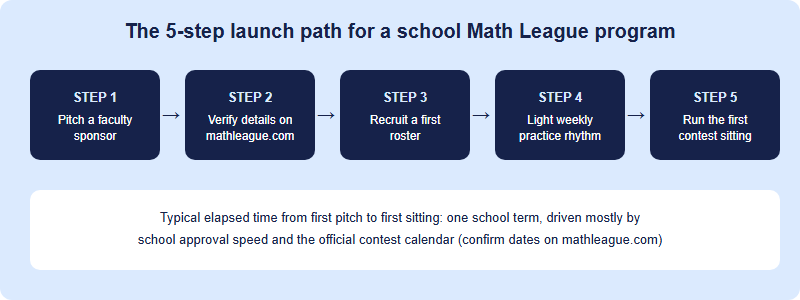
Step 1 — Recruit a faculty sponsor with a five-minute pitch
Everything starts with one adult at school who is willing to be the contact person. In most schools this is a math teacher or the head of the math department, but a homeroom teacher or activities coordinator who is willing to liaise with the math department can also open the door.
When you make the pitch — and students making the pitch themselves is genuinely more persuasive than a parent email — keep it to the three things a busy teacher actually needs to know:
- The time cost is small and predictable. Each contest is one short proctored sitting (roughly half an hour; confirm the current format on mathleague.com). There is no coaching obligation attached to registering; practice is optional and can be student-led.
- It serves a wide range of students. Math League spans grades 4–12 with grade-banded papers, so a single program can serve elementary, middle and high school divisions. If your teacher wants detail on which students fit which band, point them to our guide on choosing the right Math League grade band.
- The school controls everything. The school decides how many students sit, when in the allowed window to run the contest, and how much fuss to make about results.
Bring a one-page summary rather than a long email. The table below is a starting template you can adapt.
| Question a teacher will ask | Short answer for your pitch | Where to verify |
|---|---|---|
| What exactly does the school run? | Short single-sitting contests (about half an hour), proctored on campus, using official materials | mathleague.com |
| How much of my time does this take? | Registration admin plus proctoring the sittings; coaching is optional | mathleague.com + this article |
| Which students can take part? | Grade-banded papers across grades 4–12; one program can cover the whole school | mathleague.com |
| What does it cost? | Registration is per school/contest package — current fees on the official site | mathleague.com (do not quote old numbers) |
| When are the contests? | Contest dates and windows are published officially each season | mathleague.com |
| Is this legitimate / established? | Founded 1977; one of the most widely taken school-based contest series in North America | mathleague.com |
Step 2 — Confirm registration mechanics on the official site (not from this article)
We are deliberately not printing registration deadlines, fee amounts, or shipping details here, because they are exactly the kind of facts that change season to season, and a playbook that quotes stale numbers is worse than no playbook. What we can give you is the checklist of questions your faculty sponsor should resolve directly on mathleague.com or with the organiser before committing:
- Which contest series fits our students — the elementary (grades 4–5), middle (6–8), or high school (9–12) series, or several at once?
- What is the registration route for a school located in China, and are there region-specific arrangements this season?
- What are this season's contest dates or administration windows, and do they collide with our exam weeks?
- How are answer sheets returned or scores reported, and when do results come back?
- What are the current fees, and does the school or do families cover them?
One honest note from our editorial desk: schools in China sometimes discover that the practical route differs from what a US-facing help page describes. Whatever your school is told by the organiser is authoritative; treat every third-party description — including ours — as orientation only.
Step 3 — Recruit a realistic first-year roster
The most common first-year mistake we see at China schools is recruiting only the “obvious” top students in one grade. That produces a tiny, fragile program: two students get busy in exam season and the club dies. A healthier first-year roster looks like this:
- Go broad across bands, not deep in one. If your school spans primary through secondary, open sign-ups for grades 4–5, 6–8 and 9–12 simultaneously. The banded papers mean a grade 5 student and a grade 11 student can both have an honest experience in the same program.
- Set the entry bar at interest, not at “already a math star.” Math League's regular contests are designed so that most engaged students get traction on early questions. A roster of 15 curious students beats a roster of 4 stars.
- Name one student captain per band. Captains chase attendance and run practice sessions, which keeps the faculty sponsor's workload close to zero between contests.
Parents deciding whether their own child should join the roster may find it useful to start from our band-fit guide (which grade band is right for your child) rather than from the child's current school grades — contest fit and report-card grades are correlated but not the same thing.
Step 4 — Set a practice rhythm the club can actually sustain
You do not need a heavy training program to run a respectable first season. A sustainable minimum looks like: one 45–60 minute club session per week, alternating between (a) working a timed mini-set under contest conditions and (b) whiteboarding the three hardest problems from the previous session. That is enough to teach the two skills the short timed format punishes most — pacing and answer discipline — without competing against homework for hours.
If some members want to go beyond club sessions, hand them a structured plan instead of vague encouragement; our Math League study roadmap lays out a self-study sequence by grade band that individual students can run at home alongside the weekly club rhythm.
The first-semester timeline and the four pitfalls that kill new programs
Below is the semester shape we recommend to schools starting from zero. Exact contest dates come from the official calendar, so treat this as relative sequencing, not fixed dates.
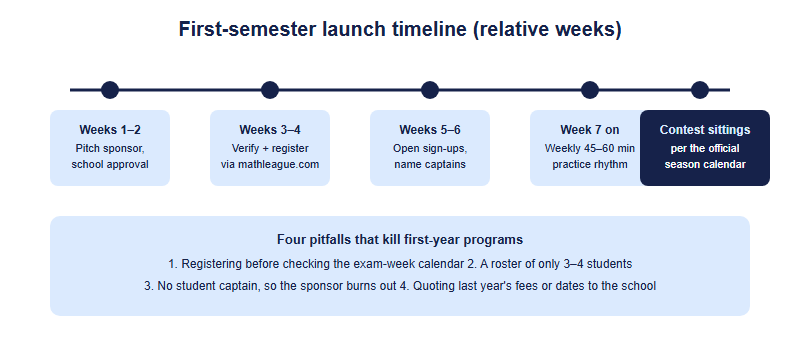
The four pitfalls in the diagram deserve one line each. First, cross-check the official contest windows against your school's internal exam calendar before registering — a contest that lands in IB mock week will be skipped. Second, recruit wide; small rosters do not survive attrition. Third, give students real ownership through captaincy, or the program lives and dies with one teacher's spare time. Fourth, never present stale numbers to school administrators — being corrected by the finance office on a fee you quoted wrongly is how proposals die.
What if the school says no this year?
It happens, usually for calendar or budget-cycle reasons rather than hostility. Three constructive responses: (1) ask what would make a yes possible next cycle — often it is as simple as re-applying before the activities budget is set; (2) keep a small unofficial practice group running so there is visible demand to point to; and (3) have interested students continue individually with a structured plan — the study roadmap works with or without a registered school program, and a semester of preparation is never wasted when the program does launch. If your family is exploring whether any individual participation routes exist in a given season, treat that as a question for the organiser directly via mathleague.com rather than relying on forum hearsay.
FAQ
Can a school in China register for Math League?
Math League participation is school-administered, and schools outside North America do take part. Confirm the current registration route for China-based schools directly on mathleague.com.
How much teacher time does a Math League program need?
The floor is registration admin plus proctoring each short contest sitting. With student captains running practice, many sponsors spend under an hour per contest cycle.
Can I take Math League if my school refuses to register?
The standard model runs through schools. Ask the organiser via mathleague.com whether any individual routes exist this season; meanwhile, keep preparing — readiness transfers.
How many students should a first-year program recruit?
Aim for 12–20 across grade bands rather than a handful of stars. Broad rosters survive exam-season attrition and make the sitting feel like a real school event.
This is an independent guide operated by Hanlin Education for China-based international-school students. We are not affiliated with, endorsed by, or sponsored by the official Math League (mathleague.com). Contest formats, registration procedures, dates and fees change — always confirm current details on mathleague.com. If you spot an error, we correct verified issues within 7 working days.