Math League deliberately publishes no fixed syllabus — it states only that every contest draws questions from different areas of mathematics — but that does not mean there is nothing to study. Across the bands, the contests draw again and again from four recurring domains: number, algebra, geometry, and counting & probability. This guide maps those domains, shows what each looks like at competition level, and explains how the emphasis shifts as a China student climbs from grades 4-5 to the grades 9-12 series — while being clear about which specifics only mathleague.com can confirm for a given contest.
Why there is no official syllabus — and why that is fine
Families arriving from a school-exam mindset often want a checklist: tell me the exact topics, and we will drill them. Competition mathematics does not work that way, and Math League is explicit that its questions come from across the mathematical landscape rather than a bounded list. The skill it tests is not "have you covered topic X?" but "can you recognise which idea a fresh, unfamiliar problem needs, and apply it under time pressure?"
That is actually good news for a student, because it makes preparation a matter of breadth plus problem-solving rather than memorising a syllabus. You cannot predict the exact questions, but you can make sure the student has met every major domain and practised turning problems into solutions. A content map is therefore not a promise about any single contest — it is a study compass. Use it to make sure no major area is a blind spot, and confirm any published topic guidance for your specific contest on the official site.
- Contest registration
- Free past papers
- 1-on-1 trial lesson

One consequence is worth stating for China families: a student who has "finished" the school textbook is not automatically ready. School curricula and competition mathematics overlap but are not the same — competitions lean harder on number sense, systematic reasoning and non-routine problems. The overview of how Math League works sets out the format; this map is about the mathematics that fills it.
The four domains, and what each looks like at contest level
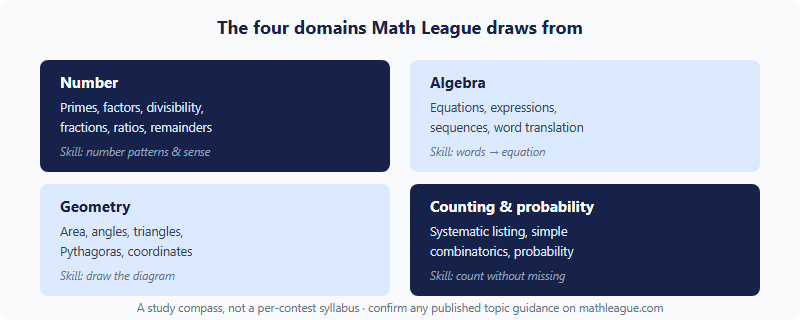
Almost every Math League problem, at every band, is a member of one of four broad families. Knowing them turns vague "do more maths" advice into a structured audit: is the student genuinely comfortable in all four, or quietly avoiding one?
| Domain | What it covers | Signature contest skills |
|---|---|---|
| Number | Factors, multiples, primes, divisibility, fractions, ratios, percentages, remainders | Spotting number patterns; working with divisibility and prime factorisation quickly |
| Algebra | Expressions, linear (and later quadratic) equations, sequences, translating words to symbols | Turning a word problem into an equation; manipulating expressions cleanly |
| Geometry | Perimeter, area, angles, triangles, the Pythagorean relationship, coordinates, later similarity | Drawing a clear diagram; using angle and area relationships to unlock a figure |
| Counting & probability | Systematic listing, basic combinatorics, simple probability, logical reasoning | Counting without missing or double-counting; reasoning about "how many ways" |
The most important instruction that falls out of this table is about the avoided domain. Students naturally practise what they are already good at, which means the weakest domain gets the least practice and therefore stays weakest — a self-reinforcing blind spot that quietly caps scores. For many China students the weak domain is counting & probability or geometry, because these are less drilled in a typical school curriculum than number and algebra. A short, honest audit of the four, followed by deliberate work on the weakest, is the single highest-return study decision in the whole map.
How the emphasis shifts from grades 4-5 to 9-12
The four domains are constant, but their depth is not. What changes as a student climbs the ladder is not the list of topics so much as how many steps a problem takes, how abstract the reasoning becomes, and how much a single question combines domains. Understanding this shift stops families from two opposite errors: drilling grade-9 material at grade 5, and coasting on grade-5 habits into grade 9.
- Grades 4-5 — fluency and recognition. Problems stay close to a strong primary curriculum: accurate arithmetic, simple number patterns, basic shapes and areas, and word problems that map fairly directly to one calculation. The domains are all present, but each appears in its most concrete form. Priority: arithmetic fluency and reading the question in English.
- Grades 6-8 — the reasoning bridge. The same four domains deepen: number work brings in divisibility and remainders, algebra formalises the words-to-equation move, geometry adds angle relationships and the Pythagorean idea, and counting becomes systematic. Problems start needing two or three linked steps and an actual idea rather than a single procedure. Priority: breadth across all four, and pace.
- Grades 9-12 — depth and combination. In the high-school series, questions are fewer but harder, often combining domains in one problem and rewarding a clever insight over brute computation. Algebra and geometry grow more abstract, number theory and combinatorics get genuinely challenging, and the short-answer format leaves no room for a lucky guess. Priority: non-routine problem solving and clean, efficient technique.
Choosing the band that matches the student's current depth — not just their grade on the form — is what keeps this progression healthy, which is exactly the decision the grade-band guide is built to help with. A student who meets the right depth at each stage climbs smoothly; one placed too high meets abstraction before the fluency to support it, and stalls.
Where competition topics part ways with school topics
For China international-school families, the most useful single idea in this whole map is that Math League's content is angled differently from a school syllabus, even when the topic names look identical. The domains overlap heavily with what a student meets in class, but the emphasis, the phrasing and the expected style of solution diverge — which is why a strong school-exam performer can still be caught out on a contest, and why a student who trains only from textbooks under-prepares for the real thing.
Three differences account for most of the gap. First, emphasis: competitions lean far harder on number sense and systematic counting than a typical curriculum, which spends more time on standard procedures. Second, non-routine phrasing: a contest question rarely tells you which method to use, whereas a textbook exercise usually sits under the heading of the technique it wants — recognising the method is itself half the competition skill. Third, efficiency under time: school exams reward a complete, written-out method; a timed contest rewards the fastest correct route, often a clever shortcut over a full derivation.
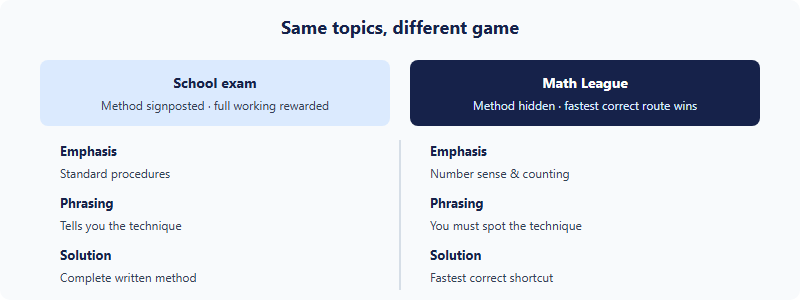
The practical takeaway is not to abandon school work — a solid curriculum foundation is exactly what competition practice builds on — but to add a distinct layer on top of it: regular exposure to non-routine problems where the method is not given away. That layer is what closes the gap between a capable student and a capable competitor, and it is why practising on genuine contest-style material matters more than doing extra textbook exercises.
Turning the map into a study plan
A content map is only useful if it changes what a student actually does on a Tuesday evening. The translation is straightforward, and it dovetails with the rhythm the study roadmap recommends: steady, frequent, review-driven practice rather than heroic cramming. Three moves turn the four domains into a plan:
- Audit, then rotate. Have the student rate their own comfort in each of the four domains honestly, then rotate practice so the weakest gets deliberate attention rather than being avoided. Revisit the audit every few weeks — weak spots move as they improve.
- Practise on real papers. The best material is official past papers, worked under timed conditions, because they show how the domains actually appear in Math League's style rather than in a generic textbook. Where exact topic weighting for your contest matters, check the official site rather than assuming.
- Review by domain. When a question is missed, tag it by domain in an error log. Over a few weeks the log reveals not just careless-error patterns but which mathematical area is genuinely costing the most marks — the single most actionable piece of information a student can have.
Do this consistently and the map stops being a static list and becomes a feedback loop: audit, practise, review, re-audit. That loop is what steadily converts a student who has "seen" the topics into one who can deploy them on an unfamiliar problem under a clock — which is the only thing the contest actually rewards. For where the whole ladder leads, the Math League overview puts the domains in the context of the full competition path.
FAQ
Does Math League have a fixed syllabus?
No. Math League states its contests draw from different areas of mathematics rather than a bounded list, so prepare for breadth and problem-solving, and confirm any published topic guidance on mathleague.com.
What topics should my child study for Math League?
Build across four recurring domains — number, algebra, geometry, and counting & probability — and deliberately strengthen whichever the student is weakest in rather than only practising their strong area.
Is finishing the school textbook enough for Math League?
Not by itself. School and competition mathematics overlap but differ; contests lean harder on number sense, systematic reasoning and non-routine problems than a typical curriculum does.
How do the topics change from grades 4-5 to 9-12?
The four domains stay constant but deepen: from concrete arithmetic and single-step problems at grades 4-5, to multi-step reasoning at 6-8, to abstract, combined, insight-heavy problems at 9-12.
This is an independent guide operated by Hanlin Education for China-based international-school students. It is NOT affiliated with, endorsed by, or sponsored by the official Math League (mathleague.com). Math League publishes no fixed public syllabus and contest content, topic emphasis and formats vary by year, band and region — confirm current details on mathleague.com before relying on them. Any errors will be corrected within 7 working days.