Students trained in Chinese school math arrive at Math League with a real asset — fast, accurate computation and disciplined procedure execution — and a real liability: contest problems are non-routine by design, so the “recognise the type, apply the drilled method” reflex that earns full marks at school often stalls. This article maps exactly which textbook habits transfer, which ones backfire, and gives a four-stage retraining ladder for making the switch without abandoning the strengths you already have.
The core difference: routine problems test execution, contest problems test selection
Most school mathematics — in China's national curriculum and, honestly, in most curricula worldwide — is organised by chapter. You study a technique, then solve twenty problems that all use that technique. The hard cognitive step, deciding which tool applies, has been done for you by the chapter title. School tests then measure how fast and accurately you execute.
Math League contests remove that scaffolding. A 30-minute paper — 30 questions for grades 4–5, 35 for grades 6–8, or six short-answer problems per contest in the grades 9–12 series — mixes topics with no labels, and the later problems are deliberately written so that the obvious method is slow or fruitless while some observation makes the problem short. (If you want the full picture of formats and grade bands first, start with our complete guide to what Math League is.)
- Contest registration
- Free past papers
- 1-on-1 trial lesson

This is why the transition feels strange: nothing is wrong with your knowledge. What is missing is a second skill layer — method selection under uncertainty — that school simply never needed you to build. The good news is that it is trainable, and students with strong procedural foundations typically build it faster than students starting from scratch, because once they spot the right idea, their execution is already clean.
Five textbook habits that quietly hurt you in a Math League sitting
These are the five patterns we see most often when procedurally strong students first sit timed contest sets. None of them is a character flaw; each is a rational adaptation to school testing that needs a contest-specific override.
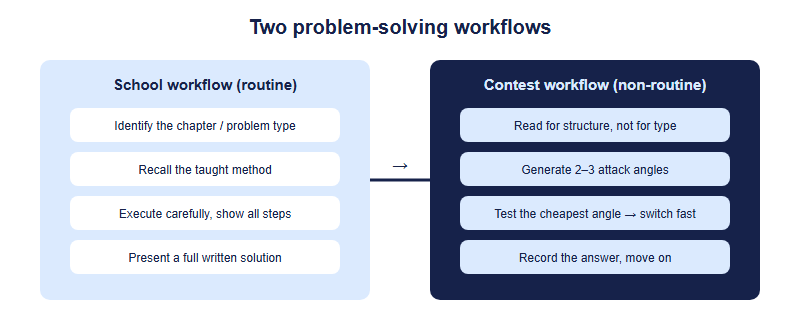
- 1. Chapter pattern-matching. The reflex of asking “which chapter is this from?” instead of “what is actually being asked?” On mixed papers, mis-filing a problem into the wrong chapter leads to minutes of confident work in the wrong direction.
- 2. One-method loyalty. School rewards mastering the taught method. Contests reward having two or three attack angles and switching fast when the first stalls. Students who have never been asked to abandon a working-but-slow method mid-problem find switching almost physically uncomfortable.
- 3. Full-solution habits on an answers-only paper. Math League regular contests are scored on answers. Writing tidy full derivations — a virtue at school — burns time the format does not credit. The override is scratch-work discipline: fast, legible-to-you notes, not presentation-quality solutions.
- 4. Linear front-to-back solving. School papers roughly match your speed to the time limit, so solving in order works. Contest papers are designed with a difficulty ramp; grinding on one stubborn mid-paper problem while easier points sit unread behind it is the single most expensive habit on this list.
- 5. Treating “I have no idea” as failure. In school, blanking on a problem usually means you forgot something. In contests, a first blank moment is the normal starting state of a non-routine problem, and the productive response is a toolkit of openers: try small cases, draw it, estimate the size of the answer, work backwards from what is asked.
What transfers beautifully — do not throw these away
Retraining does not mean starting over. Three assets from Chinese-curriculum training are direct competitive advantages in Math League:
- Computational speed and accuracy. On a 30-question, 30-minute elementary paper or a 35-question middle-school paper, raw arithmetic reliability is worth real points. Many contest losses are execution losses, and you are already strong there.
- Algebraic fluency. Comfort manipulating expressions without errors means that once you find the right setup, you finish problems other students only start.
- Work discipline. The habit of daily structured practice is the single best predictor of improvement in contest math — you only need to point it at the right kind of practice.
The table below is the habit-by-habit conversion chart: what to keep, what to override, and the specific drill that builds each override. It is the operational core of this article.
| Textbook habit | Contest override | Drill that builds it |
|---|---|---|
| Ask “which chapter is this?” | Ask “what structure do I see?” (parity, symmetry, extremes, small cases) | Mixed sets with topics shuffled; before solving, write a one-line structure note for each problem |
| Stick with the taught method | Hold 2–3 candidate angles; switch after ~60–90 seconds of no progress | “Two-ways” drill: solve the same problem by two different methods, weekly |
| Write full presentation-quality solutions | Answers-only discipline with fast, checkable scratch work | Timed answer-sheet practice; after each set, audit which errors came from scratch-work chaos |
| Solve strictly front to back | Two-pass strategy: sweep for fast points first, then return to holdouts | Practice sets where the first pass is capped (e.g., 40% of time), forcing triage decisions |
| Blank = panic | Blank = run the opener toolkit (small cases, draw it, estimate, work backwards) | Keep an “opener log”: for every hard problem cracked, record which opener unlocked it |
The four-stage retraining ladder
Habits change through staged exposure, not resolutions. This ladder takes a procedurally strong student from school mode to contest mode; most students need several weeks per stage, and it slots naturally into the weekly structure of our Math League study roadmap.
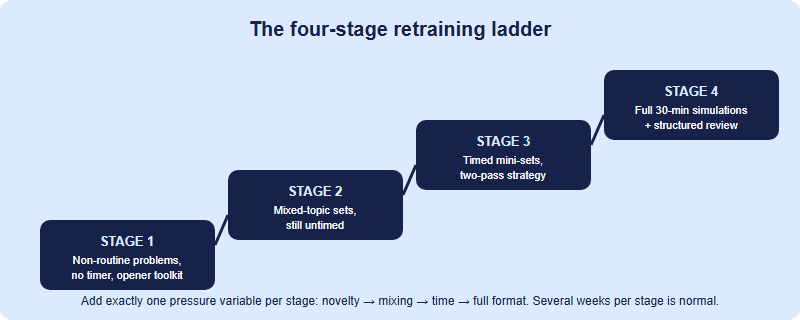
- Stage 1 — Novelty without time pressure. Work genuinely non-routine problems with no timer, focusing purely on openers: small cases, diagrams, estimation, working backwards. Success metric: the blank moment stops feeling like an emergency.
- Stage 2 — Mixing. Move to shuffled, mixed-topic sets, still untimed. Before solving each problem, write a one-line note on its structure. Success metric: your first idea about a problem is usually about structure, not chapter.
- Stage 3 — Time, in small doses. Timed mini-sets (for example, 8–10 questions in a proportional slice of contest time) with an explicit two-pass rule. Success metric: you skip fluently — no guilt, no lingering.
- Stage 4 — Full simulation and review. Complete 30-minute papers under quiet conditions, followed by a review session that matters more than the sitting itself: classify every dropped point as knowledge gap, selection error, or execution slip, and feed that classification back into next week's practice.
A note for parents: why the first timed scores can look shockingly low
A student who scores 95% on school exams may crack only a fraction of a contest paper on the first timed attempt. This is not evidence of a weak foundation — it is exactly the expected signature of strong execution skills paired with an untrained selection layer, meeting a paper engineered to have a steep difficulty ramp. Contest scores are not percentages of mastery; they are positions on a deliberately hard scale.
Two practical implications. First, judge progress by trend across simulations, not by any single score. Second, make sure the student is sitting the right band in the first place — a mis-banded student gets noise, not signal, from practice scores. Our guide to choosing the correct Math League grade band covers that decision; format details for each band are on the official site, mathleague.com, and in our foundation guide.
FAQ
Is Chinese-curriculum training a disadvantage for Math League?
No — computation speed and algebraic fluency are real advantages. The gap is method selection on non-routine problems, and that layer is trainable in weeks to months.
Why does my child score high at school but low on contest practice?
School tests execution of a pre-selected method; contests test selection under a difficulty ramp. Low first timed scores are the expected start, not a verdict.
How long does the retraining ladder take?
Most students spend several weeks per stage, so one school term is a realistic arc. Strong procedural students often move faster once skipping stops feeling like failure.
Should I practise with a timer from day one?
No. Add one pressure variable at a time: novelty first, then topic mixing, then time, then the full 30-minute format. Early timers teach panic, not pacing.
This is an independent guide operated by Hanlin Education for China-based international-school students. We are not affiliated with, endorsed by, or sponsored by the official Math League (mathleague.com). Contest formats and rules change — always confirm current details on mathleague.com. If you spot an error, we correct verified issues within 7 working days.