Your child is ready for Math League when four signals line up: genuine curiosity about puzzle-style problems, a weekly schedule with real slack in it, the ability to stay at the table after getting a problem wrong, and enough working English to read a word problem without translating every line. School grades alone predict none of these well. This guide gives parents a checklist to test each signal this week, and a season-long playbook for supporting without pressuring.
Why “good at math” is the wrong readiness test
Math League — founded in 1977 and one of the most widely taken school-based contest series in North America, spanning grades 4–12 — is built around short, timed sittings of non-routine problems (confirm the current format for each series on mathleague.com). That format is friendly to beginners in one sense (the time commitment per contest is tiny) and unforgiving in another: a child meets problems that do not look like homework, in a timed setting, and usually does not get everything right. That last part is the point of contest math, and it is also the part school grades tell you nothing about.
We have watched two mirror-image mistakes in China families. The first: a straight-A student is entered because the grades are excellent, hits the first hard paper, interprets a normal contest score as failure, and refuses to continue. The second: a child who loves puzzles is held back “until the grades improve,” missing years of the low-stakes contest experience that would have served them best. Both mistakes come from using report cards as a readiness meter. Use the four signals below instead.
- Contest registration
- Free past papers
- 1-on-1 trial lesson

The four readiness signals — and how to test each one this week
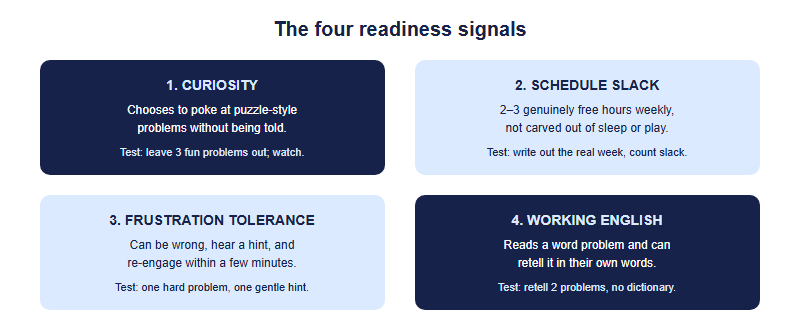
Each signal, in slightly more depth:
- Curiosity. Leave three puzzle-flavoured problems on the table — no assignment attached — and watch what happens over a week. A child who picks one up unprompted has the engine that survives a whole season. A child who only works problems when supervised can still participate happily, but the program should stay light.
- Schedule slack. Write down the actual week: school, homework, existing tutoring, sleep, and unstructured play. If preparation time can only come out of sleep or the last free afternoon, the honest answer is “not this season” — a contest added to a full tank produces resentment, not growth.
- Frustration tolerance. Sit with your child on one genuinely hard problem. Let them get stuck; offer one gentle hint. What you are watching for is not whether they solve it, but whether they come back to the table within a few minutes of frustration. This is the signal most predictive of whether contest math becomes a joy or a battlefield — and it can be built gradually with untimed, low-stakes puzzles before any contest entry.
- Working English. Math League papers are English word problems. The bar is not fluency; it is being able to read a problem and retell it in their own words. If retelling fails, a term of math-flavoured English reading fixes it faster than contest exposure does.
Notice what is not on this list: olympiad tutoring history, school ranking, or being the best in class. If the four signals are present, band placement is the next decision — that is a separate question with its own logic, covered in our guide to choosing the right Math League grade band.
The support playbook: five behaviours that help, five that backfire
Once a child is in a season, the parent's marginal contribution is mostly environmental. Here is the honest do/don't table, compiled from years of watching China families run this exact season.
| Helps | Backfires | Why |
|---|---|---|
| Protect one fixed weekly practice slot | Adding surprise extra sessions after a bad practice score | Consistency builds skill; punitive volume builds avoidance |
| Ask “what was the most interesting problem?” | Asking “what score did you get?” first, every time | The first question rewards thinking; the second teaches that only the number matters |
| Treat wrong answers as data for next week | Reviewing mistakes in the car straight after the sitting | Post-contest hours are for food and rest; review works when emotions have settled |
| Let the student own the goal (points, problems cracked, one band up next year) | Announcing the goal for them (“you will win a certificate”) | Owned goals survive setbacks; imposed goals convert setbacks into shame |
| Benchmark against the child's own last simulation | Benchmarking against a classmate or a sibling | Contest scales are designed to be hard; peer comparison on a hard scale is pure discouragement |
One more behaviour deserves its own paragraph because it is so common in high-achieving families: do not coach the math yourself unless invited. Even mathematically strong parents tend to teach the school workflow — full solutions, one correct method — which, as we explain in our piece on retraining from textbook habits, is precisely the workflow contest sitting does not reward. Your leverage is logistics, climate, and — if the family decides more structure is wanted — choosing between self-study and coached preparation, a decision we map in the study roadmap.
A season-long parent rhythm, stage by stage
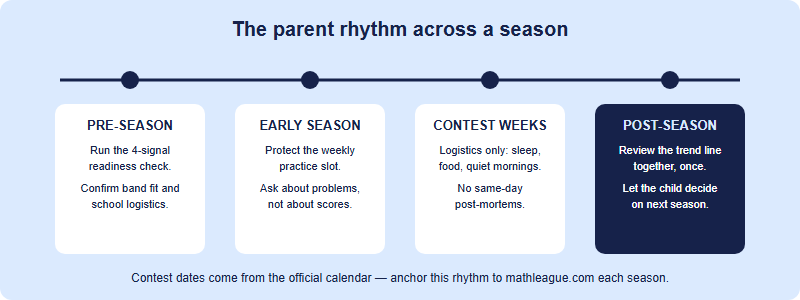
The post-season stage carries a decision families often skip: whether to continue, change bands, or stop. Let the child argue their own case first. A student who wants to return — even after a modest season — has the one asset no tutor can install. A student who is done has still banked a year of timed-problem experience that transfers to every future exam room they will ever sit in. Both outcomes are wins if the season was run with the climate above.
When waiting a year is the right call
Three situations where our honest advice is to wait: (1) the schedule audit shows zero real slack — fix the schedule first, because a contest cannot outcompete exhaustion; (2) frustration tolerance is currently low — spend a term on untimed puzzles at home where being stuck is safe and fun, then re-test; (3) English retelling fails consistently — a term of English math reading will make the eventual first season dramatically better. None of these is a talent verdict. Math League's grades 4–12 span means the door does not close; a child who starts a year later with all four signals present routinely overtakes a child who started earlier without them.
If you are still at the orientation stage — unsure what the contests even look like — start with our complete introduction to Math League, then come back and run the four-signal check. And for anything procedural — dates, registration, formats this season — the authoritative source is always mathleague.com.
FAQ
My child gets top grades in math. Is that enough to start Math League?
Not by itself. Test the four signals — curiosity, schedule slack, frustration tolerance, working English. Grades predict execution, not contest readiness.
How many hours a week does a healthy first season take?
Two to three genuinely free hours weekly is a sustainable floor for a first season. If those hours would come out of sleep or play, wait a season instead.
Should I go over mistakes with my child right after a contest?
No. Same-day post-mortems attach anxiety to the event. Review a few days later, calmly, treating wrong answers as data for next week's practice.
Is starting a year later a real disadvantage?
Rarely. Math League spans grades 4-12, so the runway is long. A child starting with all four signals present typically progresses faster than an earlier, unready start.
This is an independent guide operated by Hanlin Education for China-based international-school students. We are not affiliated with, endorsed by, or sponsored by the official Math League (mathleague.com). Contest formats, dates and procedures change — always confirm current details on mathleague.com. If you spot an error, we correct verified issues within 7 working days.