A capable China student who knows the mathematics can still score well below their true level on Math League — and the reason is almost never the maths. It is the test-craft around the maths: burning the clock on one stubborn problem, careless slips on questions they could do in their sleep, and mishandling the guessing decision. Math League's middle and high-school contests are timed sprints, and under a clock those habits cost more marks than any missing theorem. This guide names the four leakage points and gives a concrete fix for each.
The core insight: the leak is around the maths, not in it
Start with a diagnosis most families get wrong. When a strong student underperforms on a contest, the instinct is to conclude they need harder mathematics — more advanced topics, tougher problems. Usually the opposite is true: they are losing marks on questions they already understand, through errors that have nothing to do with mathematical knowledge. Adding more theory to a student who is leaking points to carelessness is like pouring water into a bucket with a hole in it.
This matters because the fix is different — and faster. Test-craft is a learnable, trainable skill, and improving it can lift a score more quickly than months of new content. A student who converts even half of their careless losses into marks, and who stops sacrificing easy late questions to a single hard one, will often jump a whole tier without learning any new mathematics at all. The rest of this article is about finding and sealing those leaks.
- Contest registration
- Free past papers
- 1-on-1 trial lesson

One reframe helps China students in particular: on a timed contest, your job is not to solve every problem — it is to harvest the most marks in the time available. That is a subtly different task, and students who internalise it stop making the strategic mistakes that quietly cap their scores. The overview of how Math League works lays out the format; this piece is about competing well inside it.
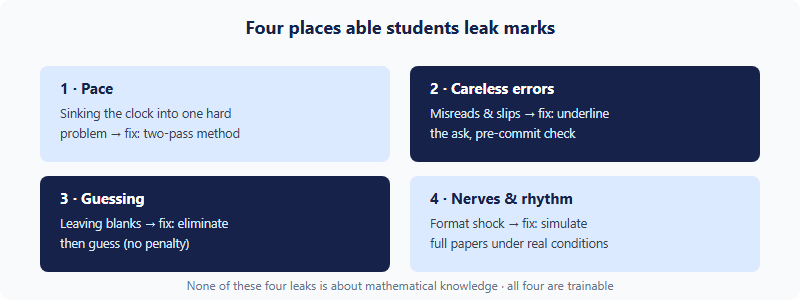
Leak 1 — Pace: sinking the clock into one problem
The single most expensive habit in timed competition mathematics is the sunk-cost problem: a student meets a hard question, refuses to abandon it, and spends five or six minutes there while three easier questions further on go unattempted. Because Math League's contests pack a brisk set of questions into a short window — the site publishes the middle band as 35 questions in 30 minutes, for example, so confirm your own contest's pace on mathleague.com — every minute over-invested in one item is stolen from several others.
The fix is a two-pass strategy, and it is the highest-return change in this whole article. On the first pass, move through the paper answering everything that yields quickly and flagging anything that resists after a short, honest attempt. Only on the second pass do you return to the flagged problems, now with the guaranteed marks already banked. This single discipline ensures a hard question early in the paper can never cost you three easy questions later.
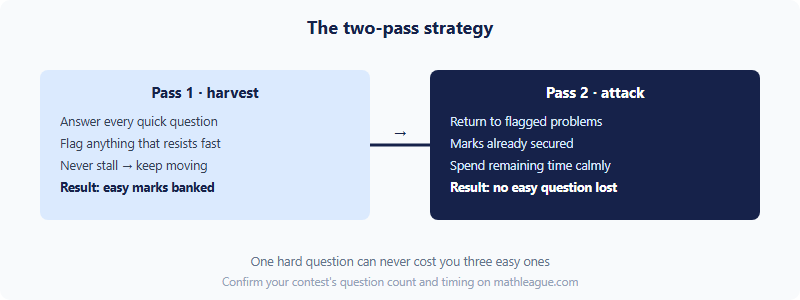
Practising the two-pass method is simple: in every timed run at home, force the student to complete a full first pass before returning to anything. It feels uncomfortable at first for a perfectionist who wants to finish problems in order — which is exactly why it must be trained before the contest, not attempted for the first time on the day.
Leak 2 — Careless errors: the marks you already earned
The second leak is the most painful, because the student did the mathematics correctly and still lost the mark. Careless errors cluster in predictable places, and naming them turns a vague "be more careful" into a checklist a student can actually act on. The usual culprits:
- Misreading the question — solving for the wrong quantity, missing a word like "not", "least", or "positive", or answering a different question than the one asked.
- Arithmetic slips — a sign dropped, a digit transposed, a step rushed — small mechanical errors under time pressure.
- Answering the wrong thing — computing an intermediate value correctly, then reporting it instead of the final answer the question wanted (a perimeter when it asked for area; the value of x when it asked for 2x).
- Transcription errors — solving correctly but recording the wrong option, or marking the answer on the wrong line.
| Careless-error type | Where it strikes | The counter-habit |
|---|---|---|
| Misreading | Long word problems; questions with "not / least / positive" | Underline exactly what is asked before solving |
| Arithmetic slip | Multi-step calculations under time pressure | Write steps neatly; sanity-check the size of the answer |
| Wrong quantity | Problems with an intermediate value | Circle the target quantity; re-read the ask before writing |
| Transcription | Transferring the answer to the sheet | Confirm the option letter matches your working |
The counter-habit that beats all four is a two-second pre-commit check: before writing the final answer, re-read what the question actually asked and confirm your answer is that thing, in the right form. It costs almost no time and reclaims marks the student has genuinely already earned. The most efficient way to build it is in review: keep an honest error log, tag each lost mark by type, and the pattern that is costing the most becomes obvious within a few sessions — a discipline the study roadmap builds into every practice.
Leak 3 — Guessing: leaving marks on the table
The third leak is unique to how Math League is marked, and getting it right is close to free marks. Math League's own competition materials state there is no penalty designed to punish a careful guess — so on a multiple-choice question you cannot fully solve, leaving it blank is strictly worse than making a reasoned attempt. Yet many strong students, trained on exams that penalise wrong answers, instinctively leave hard questions blank and quietly forfeit marks they could have had. Always confirm the exact marking rule for your contest on mathleague.com, but where no penalty applies, the strategy is clear.
Smart guessing is not random. On a multiple-choice question, eliminate before you choose: rule out options that are the wrong order of magnitude, the wrong sign, or the wrong parity (odd where the answer must be even), and rule out the "trap" option that matches a common misread. Each elimination raises the odds of the remaining guess. A student who narrows four options to two before guessing has roughly doubled their chance on that question — over a full paper, that is a meaningful number of marks harvested from questions they could not fully solve.
The habit to train is a firm rule: no multiple-choice question is ever left blank when the marking carries no penalty. On the second pass, any flagged problem the student cannot crack gets an eliminate-then-guess attempt in the final minute. It converts hopeless-looking questions into a genuine expected gain.
Leak 4 — Nerves and rhythm: the invisible tax
The final leak is the least tangible and the most underestimated. A student who has never rehearsed the exact conditions of the contest — the clock, the English phrasing, the silence of a timed room — pays a nerves tax on the day: the first few questions are read twice, the hands are slightly unsteady, and easy marks slip in the opening minutes before the student settles. For China students meeting timed, English-language competition mathematics, this tax is real and entirely avoidable.
The antidote is simulation. In the weeks before a contest, run at least a few full-length practice papers under genuine test conditions: strict timing, no interruptions, answers recorded exactly as they will be on the day, questions read in English without translation. The goal is to make the contest itself feel familiar and boring, so that on the day nothing about the format is a surprise and the student can spend their whole attention on the mathematics.
Rhythm is part of this. A well-rehearsed student knows roughly how the pace should feel, senses when they are falling behind, and adjusts without panic. That calm is not a personality trait; it is a trained response, and it is built by rehearsal. Combine simulation with the two-pass method, the pre-commit check and the no-blank guessing rule, and the four leaks close together — turning a student who knows the mathematics into one who reliably scores it. Choosing the right level in the first place, via the grade-band guide, keeps the difficulty in the range where good test-craft can actually show.
FAQ
Why does my child score below their real ability on Math League?
Usually the loss is test-craft, not mathematics: sinking time into one hard question, careless slips, and leaving guessable questions blank. Fixing those often lifts a score fast.
Should you guess on Math League questions?
Math League states there is no penalty designed to punish a careful guess, so a reasoned attempt beats a blank. Eliminate wrong options first, and confirm the exact marking rule on mathleague.com.
What is the two-pass strategy?
Answer every quick question and flag the hard ones on a first pass, banking guaranteed marks; return to the flagged problems on a second pass, so one hard question never costs you several easy ones.
How do you stop careless errors under time pressure?
Underline what is asked, sanity-check the size of your answer, confirm you solved for the right quantity, and keep an error log so the most costly mistake type becomes obvious in review.
This is an independent guide operated by Hanlin Education for China-based international-school students. It is NOT affiliated with, endorsed by, or sponsored by the official Math League (mathleague.com). Contest formats, question counts, timings and marking rules vary by year and region — confirm current details on mathleague.com before relying on them. Any errors will be corrected within 7 working days.