For China-based students, the marks lost at Math League are frequently not the maths — they are the English wording and the answer format. You solve the problem correctly, then lose the point because you misread “consecutive,” gave a decimal where a fraction in lowest terms was wanted, or dropped a unit. This guide is a practical glossary and formatting checklist to close that gap. Where any rule depends on a specific contest, confirm it on mathleague.com.
Why language is the hidden score-killer
A student who has done years of maths in Chinese can be a genuinely strong solver and still bleed points on an English-language contest. The reason is that Math League’s questions — especially the short-answer high-school contests, where there are no multiple-choice options to fall back on — assume fluent reading of mathematical English. The study roadmap names this directly, listing English math vocabulary as a core preparation pillar for China-based students, right alongside doing past papers.
The trap is invisible because it does not feel like a weakness. You read the question, it seems clear, you answer — and only when you review the solution do you realise “at most” meant something different from what you assumed, or that “the difference” wanted a specific subtraction order. These are not maths errors; they are comprehension errors wearing a maths costume, and they are highly fixable once you can name them.
- Contest registration
- Free past papers
- 1-on-1 trial lesson

Better still, vocabulary is one of the cheapest things to improve. You cannot become an olympiad-level problem solver in a week, but you can learn the fifty or so command words and answer conventions that recur across contests in a few focused sessions — and the points come back immediately.
The command words that change what a question means
Some English terms quietly redefine the whole problem. Misreading one of these does not cost partial credit — it sends you to a different answer entirely. Learn this set cold:
| Term | What it means in a problem | Common China-student slip |
|---|---|---|
| Consecutive | Following in order with no gaps (e.g. 5, 6, 7) | Reading it as “any few numbers” |
| At most / at least | ≤ / ≥ a bound (inclusive) | Treating them as strict < / > |
| The difference | Result of subtraction (often the positive value) | Subtracting in the wrong order |
| Sum / product / quotient | Add / multiply / divide result | Confusing product with sum under time pressure |
| Distinct | All different from each other | Allowing repeats that the question forbids |
| Remainder | What is left after integer division | Giving the decimal instead |
| Inclusive | Both endpoints are counted | Off-by-one in counting problems |
| In terms of | Express using the named variable(s) | Plugging in a number instead |
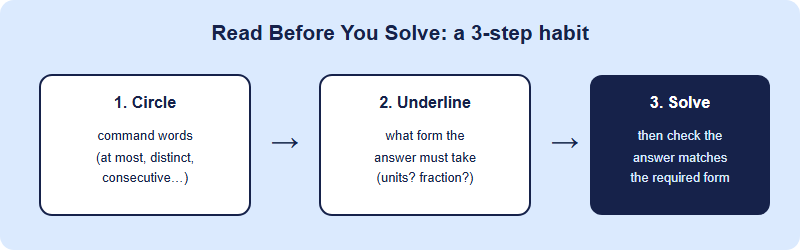
The fix is not to memorise definitions in the abstract but to tag them in real problems. When you do a past paper, circle every command word before you start computing. That one habit forces the reading step the roadmap recommends — understanding what is actually being asked before committing — and it turns these words from traps into signposts. For context on which contests are pure short-answer (and therefore least forgiving of misreads), see the foundational guide to what Math League is.
A concrete example shows how invisible the loss is. Take a question that asks for “the number of distinct two-digit numbers” that can be formed under some rule. A student who skims past “distinct” counts every arrangement, including repeats, and confidently writes a number that is too large. The algebra and the counting logic may be flawless; the single missed word makes the final answer wrong, with no partial credit on a short-answer contest. The same trap lurks in “at most” (a student solves for strictly-less-than and excludes a valid boundary case), in “the difference” (subtracting in the wrong order on a problem where sign matters), and in “in terms of n” (a student substitutes a number and loses a question that wanted an expression). In each case the maths was never the problem — which is exactly why circling the word first is worth more than another hour of problem drills.
Answer formatting: getting the maths right is only half the point
On a short-answer contest, the answer must be in the exact form the question and contest conventions expect. There is no grader generously reading your intent — a mismatched form is simply marked wrong. The most common formatting losses for China-based students cluster in a few predictable places:
- Fractions in lowest terms. If the expected answer is a fraction, it usually must be fully reduced. Writing 6/8 instead of 3/4 can cost the point even though the value is correct.
- Exact vs decimal. Where an exact value like a radical or a fraction is wanted, a rounded decimal may not be accepted — and where a decimal is wanted, check the expected precision.
- Units. If a problem is about centimetres or dollars, dropping the unit (or adding the wrong one) can invalidate an otherwise correct answer.
- Mixed numbers vs improper fractions. Conventions differ; know which form the contest expects rather than guessing.
- Form of expression. “In terms of x” means a variable expression, not a number — answering with a value misses the question even if your algebra is flawless.
None of these are about being a stronger mathematician. They are about discipline: producing the answer in the shape the contest asked for. The good news is that this is the single highest-return fix available to most international competitors, because the maths is already done — you are simply not giving the point away at the final step.
Build a personal “language + format” error log
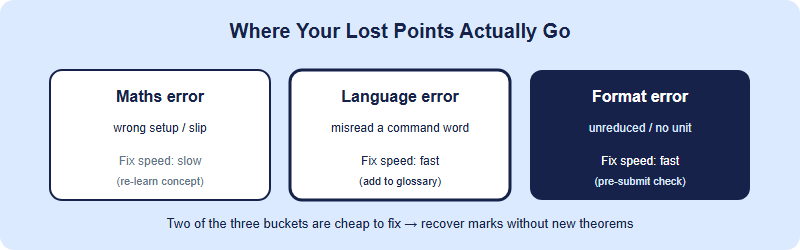
The most effective tool here is a two-column error log, an extension of the review habit the study roadmap recommends. Every time you review a practice paper, sort each lost point into one of two buckets:
| Bucket | Example | The fix |
|---|---|---|
| Maths error | Set up the equation wrong; arithmetic slip | Re-learn the concept; targeted drills |
| Language error | Misread “at most”; missed “distinct” | Add the word to your glossary; circle it next time |
| Format error | Unreduced fraction; missing unit; decimal not exact | Add a pre-submission format check |
After three or four papers, the pattern is usually undeniable: a large share of “wrong” answers were never maths failures at all. That is genuinely good news, because language and format errors are far faster to eliminate than gaps in mathematical ability. In practice we see China-based students recover a meaningful slice of their lost marks from this category alone — without learning a single new theorem — simply by closing the reading-and-formatting leak.
A two-week vocabulary plan you can actually run
You do not need a long course. A focused fortnight, layered onto your normal problem practice, is enough to move the needle:
- Days 1–3: Learn the command-word table above. For each term, find two past-paper questions that use it and solve them, circling the word first.
- Days 4–7: Do timed past papers as usual, but add the read-then-solve routine (circle command words, underline required answer form) to every question.
- Days 8–11: Start the two-column error log. After each paper, sort every lost point into maths / language / format and tally the buckets.
- Days 12–14: Add a 10-second pre-submission format check to every answer — reduced? units? exact form? — until it becomes automatic.
Keep doing real maths throughout; this plan sits on top of it, not instead of it. And remember that the maths content itself scales with grade band — confirm which level you are entering using the grade-band guide, since the vocabulary you meet in a grades 4–5 contest differs from a grades 9–12 one. For any contest-specific answer convention, the authority is mathleague.com.
FAQ
Is my English really costing me Math League points?
For many China-based students, yes — misreading command words like “at most” or “distinct” and answer-format slips often account for more lost marks than the maths itself. A two-column error log reveals the split.
What answer format does a short-answer contest expect?
Typically the exact form the question implies — fractions reduced to lowest terms, exact values where asked, correct units. Conventions vary by contest, so confirm specifics on mathleague.com.
Which English math words trip students up most?
Consecutive, at most / at least, distinct, the difference, remainder, inclusive, and “in terms of” — each can change the answer entirely if misread. Learn them in real past-paper context.
How long does it take to fix the language gap?
Much faster than fixing maths gaps. A focused two-week plan layered onto normal practice — glossary, read-then-solve habit, format checks — recovers most of these marks.
This is an independent guide operated by Hanlin Education for China-based international-school students. It is NOT affiliated with, endorsed by, or sponsored by the official Math League (mathleague.com). Answer-format conventions and contest rules vary by event and year — confirm current details on mathleague.com before competing. Any errors will be corrected within 7 working days.