Proportional questions are rarely lost in the reasoning. They are lost in the conversion — the single line where a ratio becomes a total, a percent becomes a multiplier, or a rate becomes a time. Four shapes cover most of what Math League asks in this area, each has one reliable first move, and since calculators were withdrawn in September 2026 the arithmetic behind that move has to be clean by hand.
Why this layer leaks more marks than students expect
Ratio, percent, fraction and rate questions look like the easy end of a contest paper, which is exactly why they cost so much. A student who has been taught them well at eleven meets them again at fifteen and assumes there is nothing to prepare. Then three things happen at once under a 30-minute clock.
The first is arithmetic. Math League has stated that from September 2026 calculators are not permitted on any of its contests, so every proportional question is now a by-hand question. A student who can set up a percent problem perfectly and then fumbles 0.85 × 240 has done all the thinking and banked none of it.
- Contest registration
- Free past papers
- 1-on-1 trial lesson

The second is the format split between bands. At grades 4–5 and 6–8 the papers are multiple-choice, so a shaky conversion can sometimes be rescued by testing the options. At grades 9–12 the six-contest high school series is short-answer with no partial credit, so an answer that is right in substance and wrong in form scores nothing. If you are unsure which band applies to you, our grade-band guide settles that first; the shapes below are the same either way, but the cost of a slip is not.
The third is speed. These questions are usually placed to be answered quickly, which means they are also where a paper's time budget is either protected or destroyed. Two minutes spent rebuilding percent logic from first principles is two minutes not spent on the question that was meant to be hard.
The four question shapes
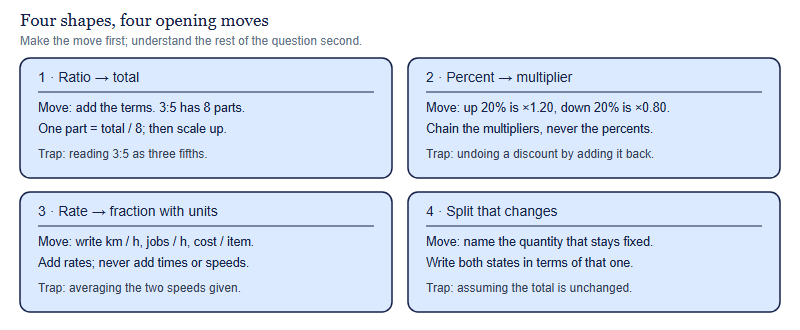
Across the grade bands, proportional questions come in four recognisable shapes. The value of naming them is that each has a first move you can make before you understand the rest of the question — which is what turns a stall into a start.
| Shape | What it is really asking | First move | The trap |
|---|---|---|---|
| 1. Ratio to total | Convert a part-to-part relationship into a share of a whole, or back again | Add the ratio terms to get the number of parts, then find one part | Treating 3:5 as "three fifths" instead of three eighths |
| 2. Percent change | Apply, chain or reverse a percentage | Turn every percent into a multiplier before touching a number | Reversing a discount by adding the same percent back |
| 3. Rate and unit rate | Combine, compare or average rates — speed, work, price per unit | Write the rate as a fraction with its units, then decide what is being totalled | Averaging two speeds instead of dividing total distance by total time |
| 4. Proportional split with a change | A ratio or fraction that shifts after something is added, removed or moved | Fix the quantity that does not change, and express both states in terms of it | Assuming the total stays constant when only one side was altered |
Shape 4 is the one that separates a contest question from a textbook exercise. A textbook asks you to apply a ratio; a contest asks what happens to the ratio when the situation moves. Take a club of 40 with boys and girls in the ratio 3:2 — that is 24 and 16. Let eight girls join, and the new ratio is 24:24, or 1:1. Nothing clever happened; the work was entirely in noticing that the number of boys was the fixed quantity and the total was not.
The two conversions that decide most answers
Shapes 2 and 3 — percent and rate — are the two we see most often in our own coaching, and both fail in the same way: a student converts by instinct instead of by rule. Two rules replace the instinct.
Percent is a multiplier, not an addition
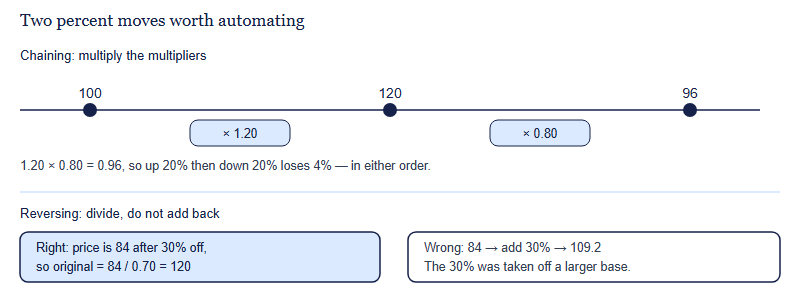
If you fix one habit from this article, fix this one. Percentages behave predictably when they are written as multipliers and unpredictably when they are treated as amounts to add and subtract. A 20 per cent rise is ×1.20. A 20 per cent fall is ×0.80. A price after a 30 per cent discount is ×0.70 of the original — which means the original is the discounted price divided by 0.70, not the discounted price increased by 30 per cent.
Three consequences fall straight out of that, and contest questions live in all three.
- Rises and falls do not cancel. Up 20 per cent then down 20 per cent is 1.20 × 0.80 = 0.96 — a net loss of 4 per cent, whatever order you apply them in.
- Some pairs do cancel exactly. Up 25 per cent then down 20 per cent is 1.25 × 0.80 = 1.00. Questions are built on that asymmetry, so it is worth recognising rather than rediscovering.
- The base decides the percentage. Going from 40 to 50 is a 25 per cent increase; coming back from 50 to 40 is a 20 per cent decrease. Same gap, different base, different answer.
Rates: add the rates, never the times
Rate questions punish an instinct that works everywhere else in school mathematics — the instinct to average. Two rules cover almost everything the papers ask.
For combined work, add the rates. If one pump fills a tank in 6 hours and another in 3, their rates are 1/6 and 1/3 of a tank per hour. Together that is 1/2 a tank per hour, so the tank fills in 2 hours. Notice what you never did: you never averaged 6 and 3.
For average speed, go back to the definition. Average speed is total distance divided by total time, and it is only equal to the average of the two speeds when the times are equal — which in contest questions they usually are not. Travel 60 km at 30 km/h and 60 km at 60 km/h: the times are 2 hours and 1 hour, so 120 km in 3 hours gives 40 km/h. The tempting answer, 45, is the one the question was built to collect.
The habit worth building is mechanical: write the rate as a fraction with its units attached before you do anything else. Units are not decoration on a contest paper — they are the check that tells you whether you should be adding, multiplying or dividing.
Answer form: where correct mathematics still scores nothing
On the high school series the answer is written, not chosen, and there is no partial credit — so the form of what you write is part of the question. Proportional topics produce more form errors than any other area, because a single quantity can be expressed correctly in four different ways.
| Situation | What students write | What to check before moving on |
|---|---|---|
| Answer is a fraction | 6/8, or a decimal that does not terminate | Fully simplified; exact form kept rather than rounded unless rounding is asked for |
| Answer is a percentage | 0.25 when the question said "what percent" | Percent or decimal — match the wording of the question, not your working |
| Answer is a ratio | 24:16 | Reduced to lowest terms, in the order the question named the two groups |
| Answer is a rate | 40, with no unit, after working in metres and minutes | Units converted to the ones asked for, and stated if the question asks for them |
| Answer is a mixed quantity | 7/2 where the question expects a number of items | Sense check: a count cannot be a fraction |
The five-second version of this table: before you write, reread the last six words of the question. Those six words almost always contain the form — as a percent, in lowest terms, in minutes, how many more. It is the cheapest mark protection available on any paper.
A fifteen-minute weekly drill that actually moves this
In our own coaching, the students who lose marks here are almost never the students who cannot do the mathematics. They are the students whose conversions are slow, so the conversion gets rushed. That is a fluency problem, and fluency responds to short, frequent, deliberately boring practice rather than to more problem sets.
The drill below takes fifteen minutes and is designed to be done twice a week, by hand, with no calculator. It is built to rehearse the conversions specifically, not to be an enjoyable maths session.
- Minutes 1–4 — the multiplier ladder. Write twenty percentages at random (7%, 35%, 112%, 4.5%) and convert each to a multiplier for both a rise and a fall. Speed is the target, not difficulty.
- Minutes 5–8 — reverse percent. Ten questions of the form "after an x per cent discount the price is y; find the original". Choose numbers that divide cleanly so you are drilling the move, not long division.
- Minutes 9–12 — ratio to total and back. Ten conversions between part-to-part and part-to-whole, half of them with three terms rather than two. Three-term ratios appear often and are practised rarely.
- Minutes 13–15 — the form check. Take five answers from the past week's practice and rewrite each in the form the question actually asked for. This is the step everyone skips and the one that shows up in a score.
Two seasons of this is more valuable than one intensive month, which is why it belongs inside a plan rather than beside one. Our study roadmap shows where fluency work sits alongside topic revision and timed papers across a year.
Frequently asked questions
Is 3:5 the same as three fifths?
No. In a part-to-part ratio there are eight parts, so 3:5 means three eighths of the whole. In our own coaching this is the single most common slip in this topic.
Does up 20% then down 20% return to the start?
No. 1.20 × 0.80 = 0.96, so you end 4 per cent below the original, in either order.
How do I reverse a discount?
Divide by the multiplier. If 84 is the price after 30 per cent off, the original is 84 / 0.70 = 120, not 84 plus 30 per cent.
Can I average two speeds?
Only when the two times are equal. Otherwise use total distance divided by total time — the averaged figure is usually the trap answer.
This is an independent guide operated by Hanlin Education for China-based international-school students. It is not affiliated with, endorsed by, or sponsored by the official Math League (mathleague.com). All example questions here are our own illustrations, not reproductions of contest papers. Contest formats, answer conventions and materials rules are set per edition and per region — confirm current details on mathleague.com. Errors reported to us are corrected within 7 working days.